CDN NEWS |
  US NEWS







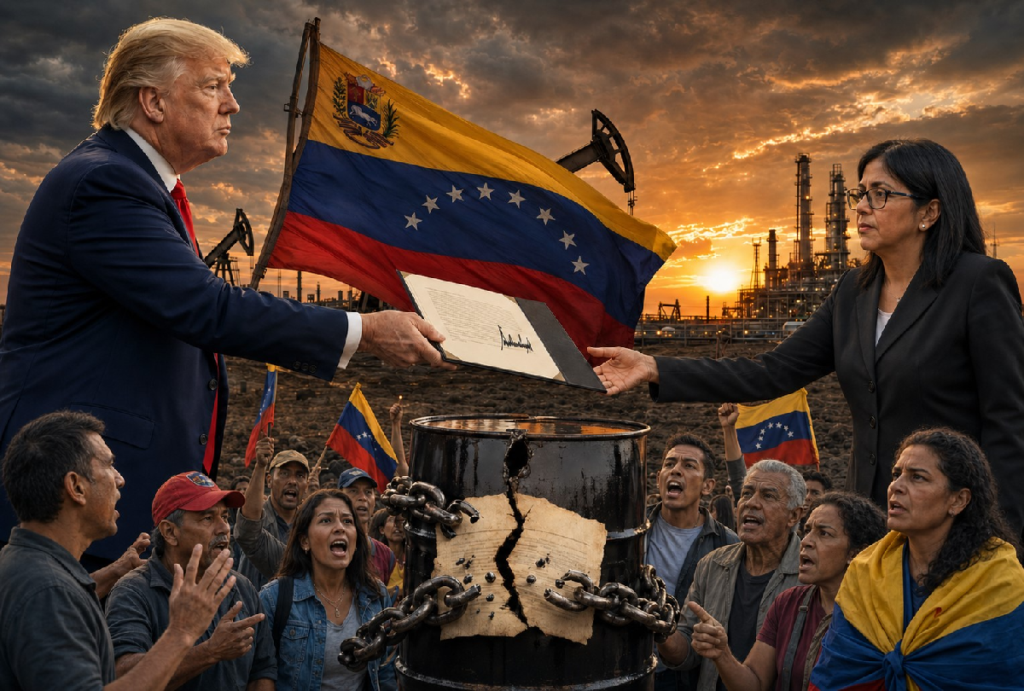
Questions over sovereignty, transparency and democratic legitimacy threaten to undermine the investment certainty the agreement was supposed to create
President Donald Trump promoted his agreement for access to 65 billion barrels of Venezuelan oil as “the biggest oil deal in world history.” Inside Venezuela, however, the arrangement is generating anger from an unusually broad range of voices—including democratic opposition leaders, ordinary citizens and former members of the country’s Chavista movement.
The criticism does not mean Venezuelans oppose foreign investment or closer energy ties with the United States. After years of declining production, deteriorating infrastructure and economic hardship, many recognize that Venezuela needs outside capital and technology.
What they are questioning is who negotiated the deal, what Venezuela has surrendered, who will profit from it and whether an unelected interim government has the authority to make commitments that could extend for generations.
Those questions could become more than a political problem. They could directly affect whether Trump’s enormous oil agreement attracts investment, survives legal challenges or remains in place under a future democratically elected Venezuelan government.
What Exactly is in the Deal?
The White House says North American Blue Energy Partners, or NABEP, will receive a 100-year lease covering 17 Venezuelan oilfields containing an estimated 65 billion barrels, approximately one-fifth of Venezuela’s reported proven reserves.
The U.S. government would take a 35 per cent interest in NABEP’s parent company, receive access to 20 per cent of production at cost and hold a right of first refusal over the remaining output. Trump has argued that the agreement will attract as much as $100 billion in investment, expand production and provide American refiners with a secure source of heavy crude.
But the Venezuelan and American descriptions of the agreement do not fully match.
Interim President Delcy Rodríguez has called it a 25-year bilateral project, not a 100-year concession, and insists Venezuela retains ownership and sovereignty over its resources. She says the 17 fields could eventually produce more than 1.5 million barrels per day and generate $209 billion in tax revenue for Venezuela.
Neither government has publicly released the complete agreement. The difference between a 25-year development arrangement and 100-year control over strategic fields is hardly a minor drafting issue. It raises questions about what was actually signed—and what could legally be enforced.
Machado Walks a Diplomatic Tightrope
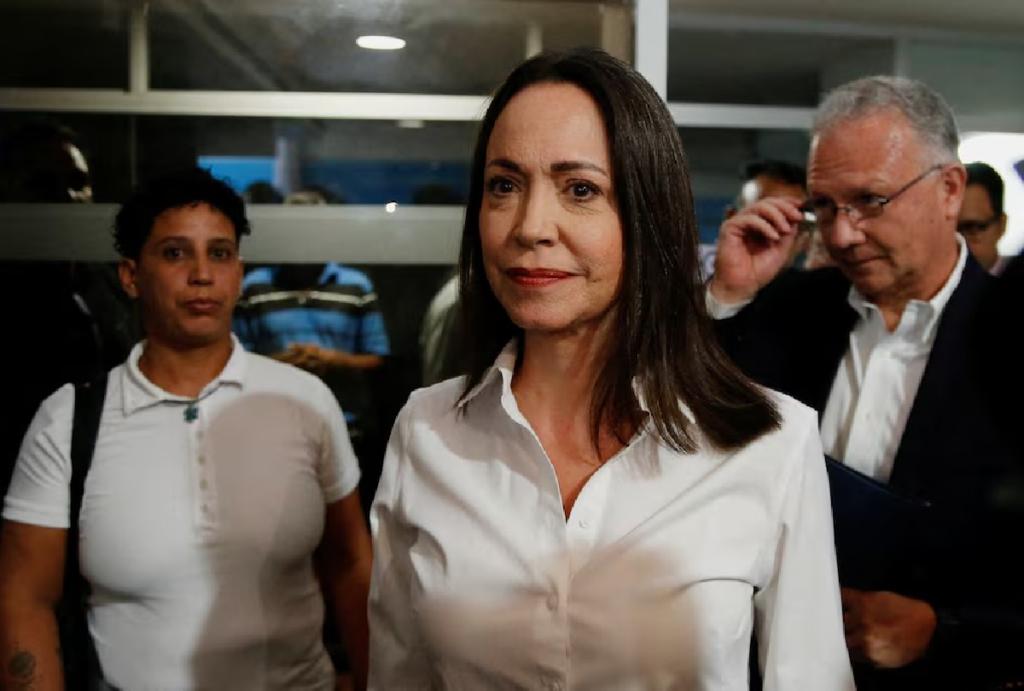
Opposition leader and Nobel Peace Prize winner María Corina Machado has been careful not to reject cooperation with Washington. Indeed, she continues to describe the United States as the essential partner for rebuilding Venezuela’s energy sector.
“The United States is the principal partner Venezuela needs to fully develop its strategic potential,” Machado said in a video statement. “And precisely because the partnership between Venezuela and the United States is strategic for both countries, we all need to make sure this is done right.”
Her criticism is directed primarily at the Rodríguez government and its lack of an electoral mandate.
“The wealth of our subsoil does not belong to an illegitimate regime—it belongs to the Venezuelan people,” Machado said, describing the public reaction as one of “sadness, anger and unease.”
She also questioned the deal’s “true scope,” including the identity of its signatories, the guarantees being offered and the benefits Venezuelans will actually receive.
Machado’s central warning is aimed directly at investors: political legitimacy and investment security cannot be separated.
“We need to attract capital and sustained, long-term investment under conditions that provide profitability, certainty and security,” she said. “That is only possible with the legitimacy and stability provided by a serious, democratic government.” Reuters
That is a significant statement. Machado is not threatening nationalization or rejecting American involvement. She is warning that contracts signed by an unelected government, behind closed doors and without clear constitutional authority may not provide the durability investors require.



Criticism Reaches Beyond the Democratic Opposition
Opposition to the arrangement extends into parts of the political left and among former Chavista officials.
Rafael Ramírez, who served as oil minister and president of state-owned PDVSA under Hugo Chávez, has called the deal illegitimate, unconstitutional and a pillaging of Venezuela’s resources. Former Chavista vice-president Elías Jaua characterized the country as being under foreign occupation, while former Chávez communications official Andrés Izarra accused Rodríguez of committing treason.
Former Caracas mayor Juan Barreto described the arrangement as a transition “from intervention to colony.”
These figures carry political baggage of their own, and their criticisms should not be confused with support for Machado’s democratic movement. Yet their opposition matters because it demonstrates how the agreement has activated Venezuela’s deeply rooted oil nationalism across ideological lines.
For generations, Venezuelans have regarded petroleum as national patrimony. Even many who blame Chávez and Nicolás Maduro for destroying PDVSA remain uneasy about granting a foreign government extraordinary control over the country’s most important resource.
“It’s not just worrying, it’s outrageous,” Caracas architect Lisandro Castro told the Associated Press. “There is genuine collective concern in Venezuela right now about what we are witnessing.” Associated Press
The criticism is not universal. Rodríguez’s governing socialist party has formally endorsed the agreement, and some Venezuelans believe foreign participation may be the only realistic way to restore production and employment. But even among potential supporters, acceptance appears conditional on visible economic benefits.
Why the Backlash Could Threaten Trump’s Deal
The immediate danger is not necessarily that Rodríguez will withdraw. Her government needs U.S. support, sanctions relief and investment. The larger danger is that the deal may fail to produce the legal and political certainty required for companies to invest tens of billions of dollars.
ExxonMobil and ConocoPhillips lost assets to nationalization under Chávez and have repeatedly emphasized contract sanctity and rule of law. Reuters reported that major producers are already uneasy about NABEP’s dominant position and the role of businessman Alejandro Betancourt, whose previous dealings with the Venezuelan government were investigated by American and European authorities, although he was never charged. Reuters
The controversy creates at least four risks:
- A future elected government could challenge or renegotiate the agreement on constitutional or public-interest grounds.
- Venezuelan courts or lawmakers could dispute whether Rodríguez had the authority to grant such extensive, long-term rights.
- Major oil companies may limit investment until they receive clearer fiscal terms, legal protections and political guarantees.
- Public resentment could make the project a permanent symbol of foreign exploitation, increasing the risk of protests, operational disruption and eventual expropriation.
There is also a political contradiction at the centre of Trump’s strategy. Washington says the deal will help rebuild Venezuela, yet Trump and Rodríguez have declined to establish a timetable for elections. Trump recently said Venezuela was “not ready” to vote, while Rodríguez said an election would occur only “when Venezuela is ready.”
The longer elections are delayed, the stronger Machado’s argument becomes: Washington is prioritizing control of Venezuelan oil over the democratic transition many Venezuelans believed would follow Maduro’s removal.
The Biggest Deal or the Biggest Uncertainty?
Venezuela unquestionably needs investment. Its production of approximately 1.25 million barrels per day remains far below the three million barrels per day it produced in the late 1990s. Restoring the industry will require drilling, pipelines, power infrastructure, upgraders, export facilities and years of sustained spending.
But geological reserves are not the same as commercially recoverable production. Nor does announcing control over 65 billion barrels guarantee that companies will supply the capital needed to extract them.
Trump’s deal was intended to remove uncertainty by placing the United States at the centre of Venezuela’s oil revival. Instead, its secrecy, disputed duration and questionable democratic legitimacy may have introduced a new layer of political risk.
Machado’s message is ultimately as much commercial as political: Venezuela can become a major American energy partner, but an agreement designed to last decades—or perhaps a century—cannot rest solely on the cooperation of an unelected government.
Without greater transparency, democratic legitimacy and clearly enforceable contracts, Trump’s “biggest oil deal ever” may prove much easier to announce than to finance, develop or defend.
Share This: