CDN NEWS |
  US NEWS







By Niccolo Conte | Design Miranda Smith
Key Takeaways
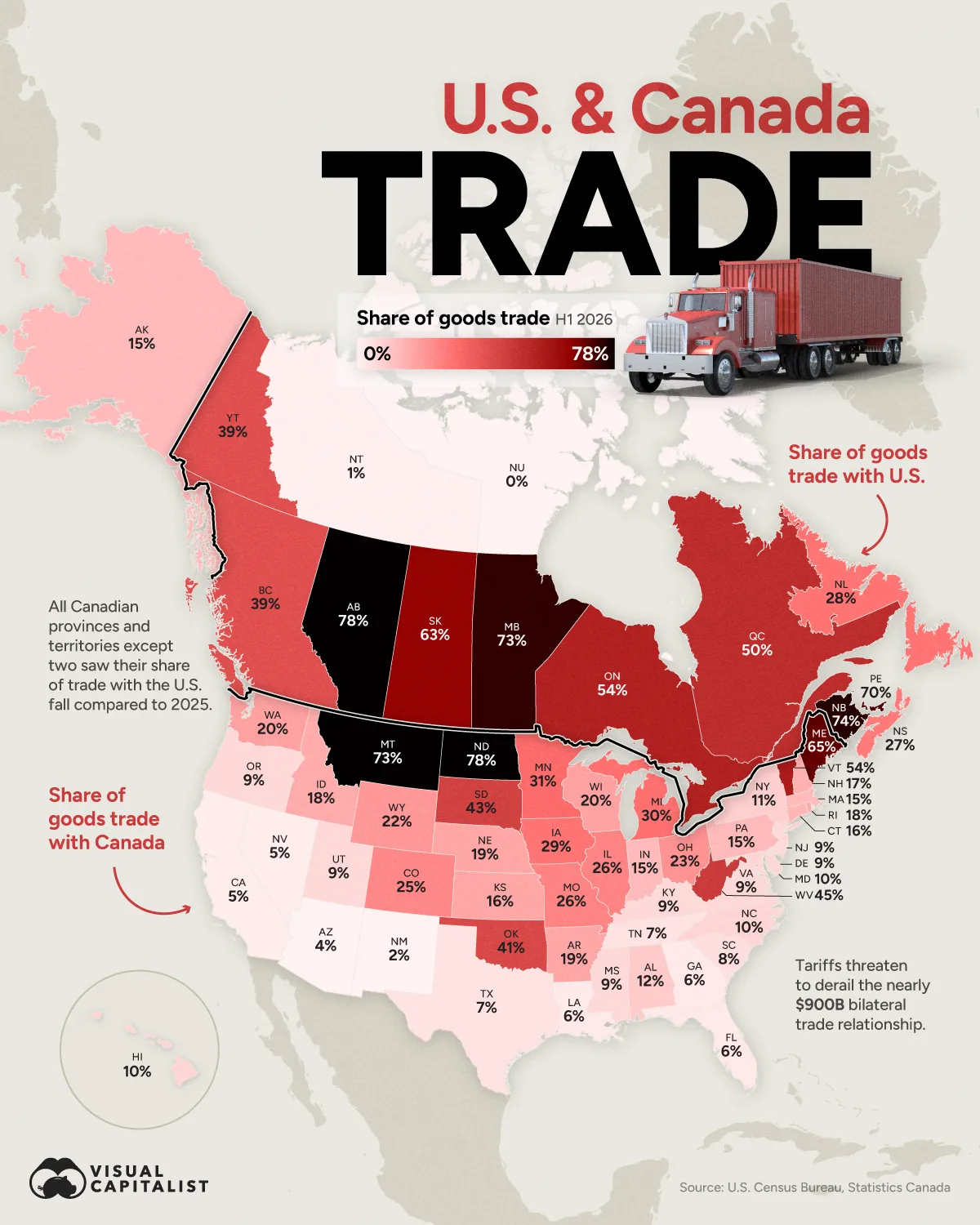
- Alberta and North Dakota lead by share of trade with the other country, with roughly 78% of their international goods trade involving their cross-border neighbor.
- West Virginia is the highest-ranking U.S. state without a Canadian border, with 45% of its international goods trade involving Canada.
- Six Canadian provinces conduct more than half of their international goods trade with the United States, compared with four U.S. states that do the same with Canada.
For businesses buying and selling goods across the U.S.-Canada border, the importance of that relationship varies significantly by location, especially amid shifting tariff policy.
This map compares the share of international goods trade that all 50 U.S. states and Canada’s 13 provinces and territories conduct with the other country in the first half of 2026, using data from the U.S. Census Bureau and Statistics Canada.
Alberta Leads Canadian Provinces in U.S. Trade Share
In the first half of 2026, 56.6% of Canada’s international goods trade was with the United States. Across provinces and territories, the gap spans nearly 80 percentage points, reflecting major differences in geography, infrastructure, and access to overseas markets.
The four provinces above 70% (Alberta, New Brunswick, Manitoba, and Prince Edward Island) have very different economies, but each has relatively limited routes to buyers outside the United States.
The table below shows the U.S. share of international goods trade for every Canadian province and territory in H1 2026, alongside the value of that trade in U.S. dollars:
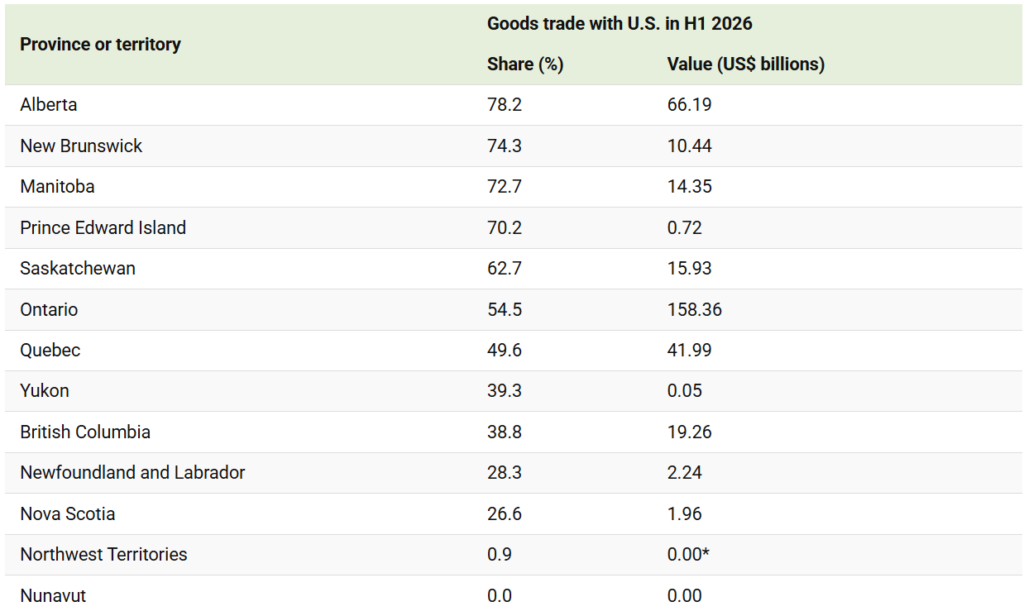
*The Northwest Territories recorded $2,497,855 in goods trade with the U.S. in H1 2026, which rounds to $0.00 billion in the table. Values combine domestic exports and imports.
Alberta ranks highest at 78.2%, with Global Affairs Canada identifying pipeline and transportation infrastructure oriented toward the U.S. as a central reason for its trade dependence. The Trans Mountain expansion has opened additional overseas capacity, but pipeline oil is harder to redirect than many other goods shipments.



Manitoba (72.7%) and Saskatchewan (62.7%) are also landlocked, with rail and highway links built largely along a north-south axis.
Ocean access can work the other way. British Columbia, whose Port of Vancouver faces Asia, conducts 38.8% of its international goods trade with the United States. Nova Scotia is lowest among the provinces at 26.6%, followed by Newfoundland and Labrador at 28.3%. The Northwest Territories (0.9%) and Nunavut (0.0%) have negligible shares of international goods trade with the U.S.
Ports are no guarantee of lower U.S. trade dependence, however. New Brunswick has deepwater capacity at Saint John and still ranks second at 74.3%, sending 91.3% of its exports to the U.S., the highest export share in the country. The Irving Oil Refinery there is Canada’s largest at 320,000 barrels per day, and more than half of its refined output ships by marine vessel to the U.S. Northeast.
Four U.S. Border States Have Majority-Canada Goods Trade
The United States is far less dependent on Canada overall, which accounts for roughly one in eight dollars of U.S. international goods trade. Only four states conduct more than half of their international goods trade with Canada, while 19 of the 50 states are below 10%.
Those four states are North Dakota (77.8%), Montana (73.2%), Maine (65.1%), and Vermont (53.7%).
The table below shows Canada’s share of international goods trade for all 50 U.S. states in H1 2026, alongside the value of that trade in U.S. dollars:
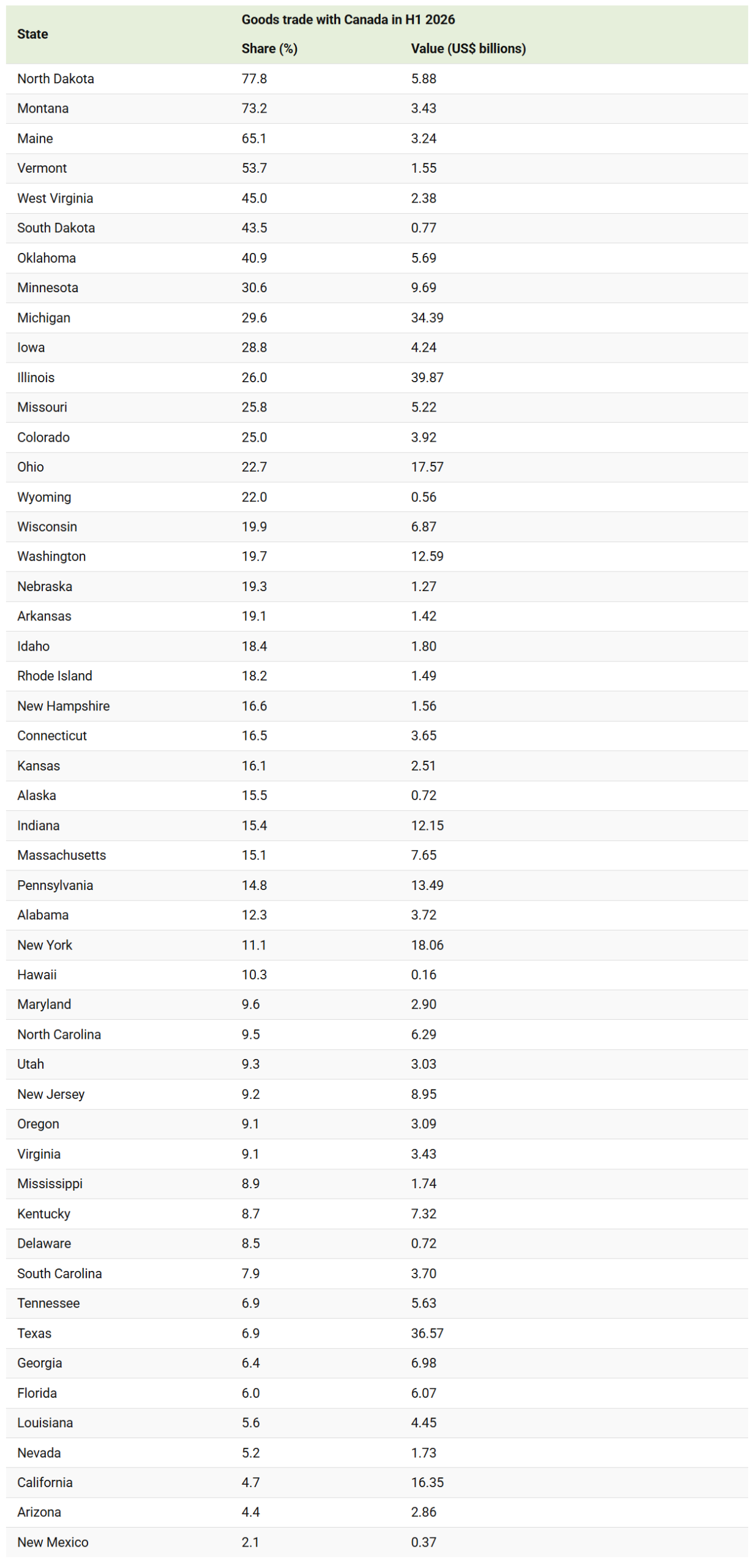
Proximity alone does not determine trade share, and interior states can outrank states along the Canadian border. New York sits at 11.1%, while Washington conducts 19.7% of its international goods trade with Canada.
Meanwhile, West Virginia is the highest-ranking state without a Canadian border at 45.0%, followed by South Dakota at 43.5% and Oklahoma at 40.9%. All three rank above Michigan (29.6%) and Washington.
Trade share also tells a different story from trade value, which matters when considering how much states are exposed to Canadian tariffs. Michigan’s 29.6% share is more than four times Texas’s 6.9%, yet the two moved comparable amounts of goods with Canada in H1 2026: roughly $34 billion and $37 billion, respectively.
Share This: