CDN NEWS |
  US NEWS







There’s a phrase that gets repeated in almost every conversation about equipment reliability on a new well site: “Production is deferred, not lost.” The idea is simple — if a piece of equipment goes down for a couple of days, the oil and gas is still in the ground. It’ll come out eventually. No harm done.
On paper, that sounds right. A well can produce for 20 or 30 years. What’s a two-day outage against a multi-decade timeline?
The problem is that the phrase quietly skips over two facts that matter a lot in the real world: the company that drills a well almost never owns it for its full producing life, and the oil and gas produced early in a well’s life is worth far more than the same volume produced years later.
Why the Early Months Matter Most
A newly drilled well in a shale play like the Haynesville produces at its highest rate in its first few weeks and months — often 2,100 to 2,400 barrels of oil equivalent per day. From there, production drops fast. By year six, that same well might be producing under 100 barrels a day. That decline curve isn’t a policy choice; it’s how these reservoirs behave.
That means the equipment supplying instrument air to a new well’s controllers and pumps isn’t just a piece of infrastructure — it’s protecting the most valuable window of the well’s entire life. A two-day outage in month three of production can cost tens of thousands of dollars in lost revenue at peak rates. Recovering that same volume of production later, once the well has declined, can take more than 40 days of extra output — worth far less once you account for the time value of money.
Who Actually Gets the “Deferred” Barrels?
Here’s the part that rarely comes up in these conversations: who owns the well when those deferred barrels finally come out of the ground?
Most new wells in U.S. shale plays are financed and developed by private equity-backed producers, who typically sell their assets well before a well’s producing life is over. Recent industry analysis of Permian Basin producers found more than half of private equity-backed operators have held their assets for eight years or more, with many approaching the end of that window. Billions of dollars in upstream assets change hands in the U.S. every year.
When a well is sold, the price is based on its remaining reserves and its production history — not on some future promise that the oil will “eventually” come out. If early downtime hurt that production record, it’s already baked into a lower valuation by the time of sale. The original operator doesn’t get a second chance to collect on molecules produced after the well changes hands. Those barrels belong to whoever owns it next.
In other words: production that’s genuinely “deferred” outside the original developer’s ownership window isn’t deferred at all. It’s permanently transferred to someone else.
Where Standard Equipment Falls Short
Instrument air systems — the traditional way of supplying gas to run pneumatic controllers — are proven technology, and in many settings they work fine. But even a well-built system, made up of several components each running at 99% reliability, adds up to a combined system reliability of around 95%. That gap translates to roughly 18 days of downtime a year, scattered across the well’s life — including, inevitably, some of it landing in those first critical months when every day is worth the most.
An equipment failure in year five of a well’s life is an inconvenience. The same failure in month three, when the well is producing at its highest rate, is a real financial hit.
A Different Approach
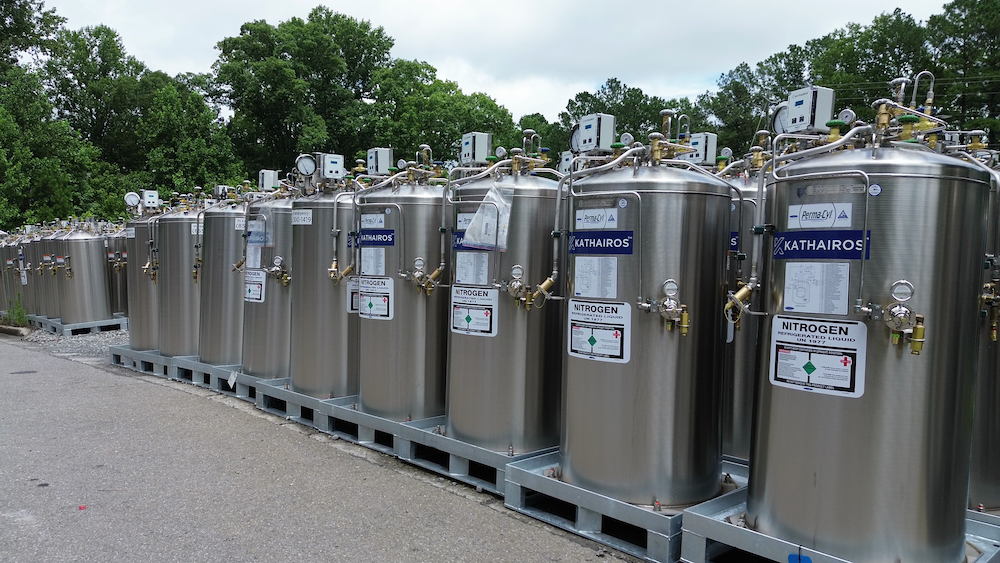
This is the gap Kathairos was built to close. Instead of instrument air, Kathairos supplies pneumatic controllers and pumps with liquid nitrogen — a system with no moving parts, no compressor, and no dependence on external power. Across more than 3,000 systems deployed and 36 million-plus operating hours, it has run at better than 99.99% uptime, with a single scheduled site visit roughly every 30 days to refill the tank.
Because the system can be commissioned before a well ever produces its first molecule, it delivers that reliability from day one — through the steep, high-value early months, not just once production has already leveled off. It also satisfies EPA’s new NSPS OOOOb rule, which requires zero-emission pneumatics on new greenfield sites, so operators aren’t choosing between meeting federal emissions requirements and protecting early revenue. Both happen through the same system.
The Right Questions to Ask
Before defaulting to “it’s deferred, not lost” on the next greenfield pneumatic decision, it’s worth asking a few pointed questions: What will this well produce in its first year? How fast will it decline? How long will we likely own it? And what’s the real, combined reliability of the equipment we’re specifying?
The oil and gas isn’t going anywhere. But the value of producing it early, during the window when it belongs to you, is not something you get to defer. Once that window closes, it’s gone. Get in touch with Kathairos to learn how our nitrogen-based methane elimination technology can help you reduce emissions and protect your bottom line. Contact our team.
Share This: