CDN NEWS |
  US NEWS








The proposed project will transport Canadian crude from the U.S.-Canada border to Wyoming
U.S. President Donald Trump on Thursday signed an order authorizing a proposed project to transport Canadian oil across the border as part of an effort to revive parts of the cancelled Keystone XL pipeline.
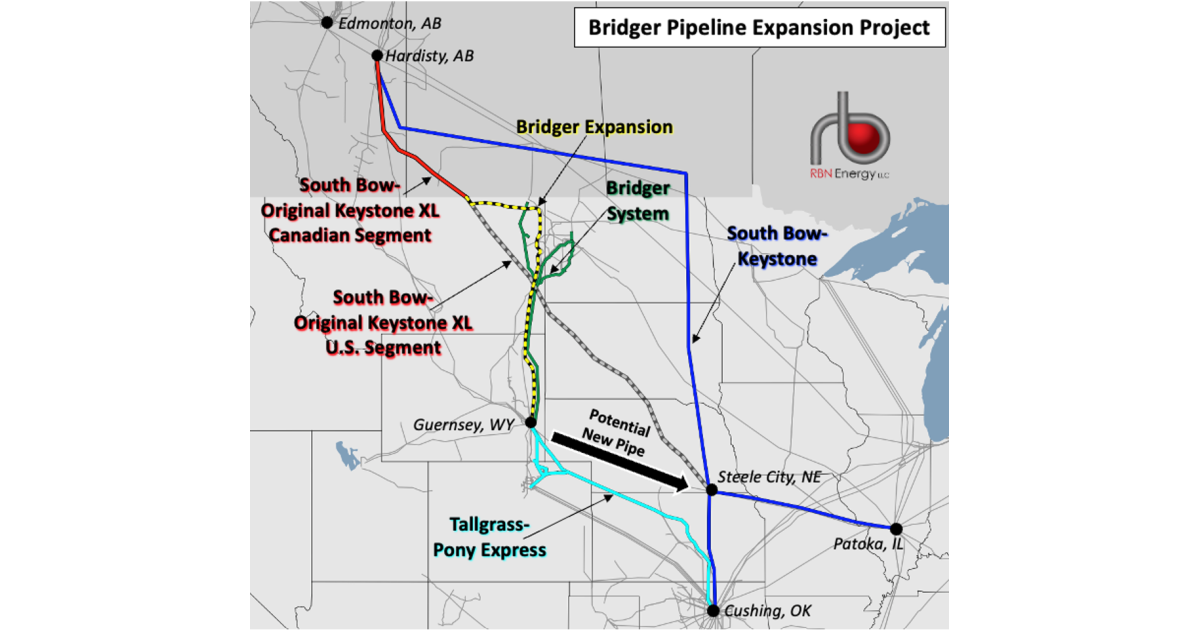
South Bow, the Canadian pipeline company behind the cancelled Keystone XL pipeline, is partnering with U.S. company Bridger Pipeline on the proposed project.
South Bow is considering reviving some of the already built line in Alberta and Saskatchewan.
Bridger Pipeline is pursuing construction of a potential 1,038-kilometre pipeline beginning near the U.S.-Canada border in Phillips County, Mont., and transiting to Guernsey, Wyo.
As Trump signed the order, White House Staff Secretary Will Scharf told the president, “This is a trans-border pipeline similar to the old Keystone XL pipeline.”
Trump responded: “A lot of jobs, too. A lot of jobs. OK, very good.”
New proposal revives part of Keystone XL route
The pipeline could increase Canada’s crude exports to the U.S. by more than 12 per cent if it goes ahead.
The new proposal involves a different route through the U.S. than the previous Keystone XL project, which was cancelled by former U.S. president Joe Biden in 2021 after years of Indigenous and environmental opposition.
However, it would use some of the previously built pipe on the Canadian side, where the Keystone XL line is already fully permitted. In 2021, about 150 kilometres of pipe were installed in Alberta.
“South Bow continues to evaluate the Prairie Connector project, a potential expansion of its Canadian asset base that would leverage existing infrastructure and permitted corridors to improve market access for Canadian crude oil,” South Bow spokesperson Solomiya Martoiu said in an emailed statement.
“The Prairie Connector project remains in early stages and is subject to ongoing commercial, stakeholder and rightsholder discussions, regulatory processes and evaluation,” Martoiu said.
South Bow was created in 2024, when former Keystone XL proponent TC Energy spun off its oil pipeline business.
“One reason we see it keep coming back is that there are some market realities that make a lot of sense,” James Coleman, an energy law professor at the University of Minnesota, said in an interview with CBC News.



“There are continued increases in oil production in Canada. We are seeing right now the biggest threats to waterborne traffic of oil that we’ve ever seen in the world,” he said.
North America is uniquely well positioned to deal with the energy crisis caused by the U.S. war in Iran because of the continent’s mix of heavy oil, light oil, refining capacity and natural gas, Coleman said.
Still, Coleman warned there could be legal challenges to this proposal, similar to the lawsuits against Keystone XL.
Keystone revival resurfaces during trade talks
The pipeline could transport about 550,000 barrels of Canadian crude per day to the U.S.
“Canada has benefited for decades from having fully integrated infrastructure tied to the United States, the largest oil and gas consuming market on the planet,” Lisa Baiton, CEO of the Canadian Association of Petroleum Producers, said in an emailed statement.
Baiton said the association supports “any new capacity that is commercially viable and can move Canadian energy reliably.”
State regulatory permits will still be required for the project to proceed.
“We are aware of the issuance of permits to Bridger Pipeline. The Government of Canada remains focused on strengthening Canada’s position as an energy superpower, supporting North American and global energy security, and advancing the diversification of our trade partnerships,” Charlotte Power, a spokesperson for natural resources minister Tim Hodgson, said in an emailed statement.
The presidential permit comes at a time when Canada and the U.S. are facing an ongoing trade war and will soon begin negotiations on a new North American trade agreement.
Last October, Prime Minister Mark Carney floated the idea of Keystone XL to Trump during a meeting at the White House.
During the construction of the Canadian leg of the Keystone XL pipeline, about 1,000 workers were based in the town of Oyen, located 300 kilometres east of Calgary.
The 1,897-kilometre Keystone XL pipeline was first announced in 2005 and designed to carry 830,000 barrels of crude a day from Hardisty, Alta., to Nebraska. It would then connect with the original Keystone pipeline, which runs to U.S. Gulf Coast refineries.
In 2024, TC Energy lost its bid to recoup $15 billion US from the U.S. government after claiming it was treated unfairly and inequitably.
Share This: