CDN NEWS |
  US NEWS







An EnergyNow Special Report
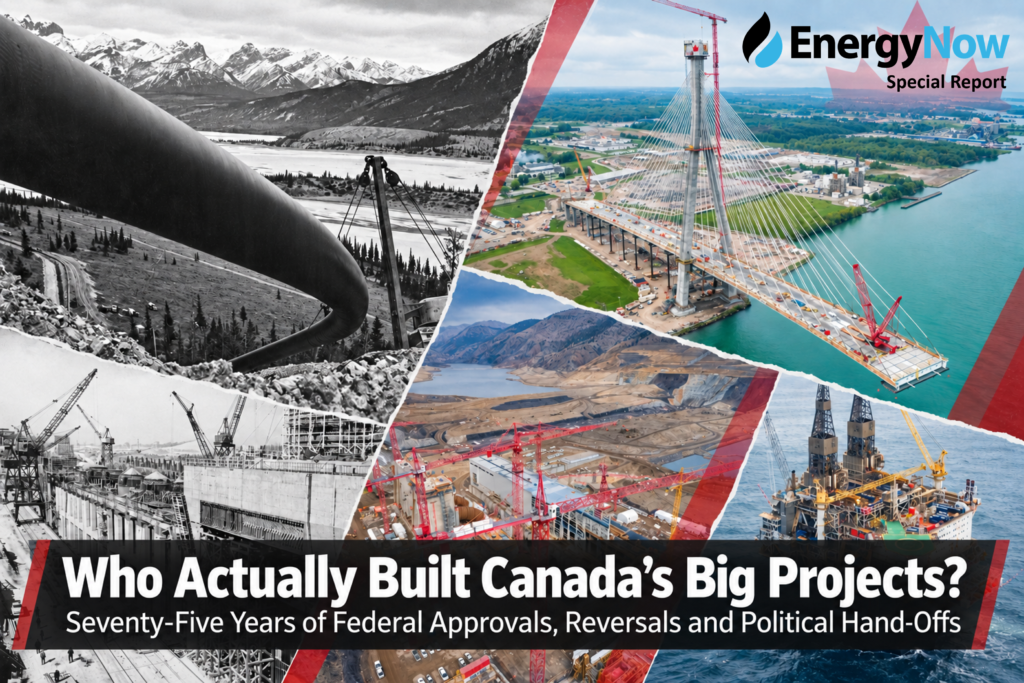
Canada’s biggest infrastructure projects rarely belong to one political party. A government may authorize a project, its successor may finance or reapprove it, and a later government may preside over completion. The reverse also happens: one Cabinet approves a project, a court nullifies the decision, and the next Cabinet formally rejects it. Northern Gateway is the clearest modern example.
That makes the familiar question – “Which party built it?” – harder than it sounds. Ottawa normally does not pour the concrete or weld the pipe. Provincial Crown corporations, private companies and public-private partnerships do. The fairest test is therefore to record four separate federal actions: who initiated or enabled the project, who gave the decisive approval, who kept it alive through construction, and who cancelled or rejected it.
The Short Answer
Over the past 75 years, both Liberal and Progressive Conservative/Conservative governments have approved projects that were completed under the other party. Both have also rejected major projects. The historical record does not support the claim that one party simply “builds” while the other simply “blocks.”
The more defensible conclusion is this: governments receive political credit for decisions, but projects are usually products of continuity. The St. Lawrence Seaway, Trans-Canada Highway, Trans-Canada natural-gas pipeline, Confederation Bridge and Gordie Howe International Bridge all crossed partisan hand-offs. The original Trans Mountain Pipeline is a notable exception: a Liberal government authorized it in 1951 and it entered service under the same government in 1953. The modern Trans Mountain Expansion is the outstanding recent case of one Liberal government approving, purchasing, reapproving and ultimately completing a project. Northern Gateway is the outstanding case of a Conservative approval that did not survive judicial review and was then rejected by a Liberal government.
A Project-by-Project Record
1. St. Lawrence Seaway – Liberal authorization, Progressive Conservative opening
Louis St-Laurent’s Liberal government established the St. Lawrence Seaway Authority in 1951 and committed Canada to proceed, even before Washington finally joined the undertaking. Construction began in 1954. John Diefenbaker’s Progressive Conservative government was in office when the Seaway opened in 1959. The honest attribution is shared: the Liberals supplied the decisive Canadian authorization; the Progressive Conservatives presided over completion and opening.
Sources: Eisenhower Presidential Library: https://www.eisenhowerlibrary.gov/research/online-documents/st-lawrence-seaway
2. Trans-Canada Highway – Liberal launch, Progressive Conservative opening, Liberal completion
The St-Laurent Liberals passed the Trans-Canada Highway Act in 1949 and construction began in 1950 through federal-provincial cost sharing. Diefenbaker formally opened the highway at Rogers Pass in 1962, but remaining sections were not completed until 1971, during Pierre Trudeau’s Liberal government. No single party can credibly claim the entire network.
Sources: Transport Canada: https://tc.canada.ca/en/corporate-services/policies/trans-canada-highway-backgrounder
3. Original Trans Mountain Pipeline – Liberal authorization, construction and completion
The original Trans Mountain project belongs firmly to the Louis St-Laurent Liberal era. Parliament created the Trans Mountain Pipeline Company through a special federal Act in March 1951, and the Board of Transport Commissioners approved the proposed interprovincial line. Construction began in February 1952, the final section was welded later that year, and oil began moving from Edmonton across the Rockies to Burnaby and Pacific markets in 1953. The roughly 1,150-kilometre line was privately engineered and built, but its federal authorization, construction period and entry into service all occurred under the St-Laurent Liberals. This original pipeline – now called Line 1 – is distinct from the Trans Mountain Expansion completed in 2024.
Sources: Canada Energy Regulator: https://apps.cer-rec.gc.ca/PPS/en/pipeline-profiles/trans-mountain-expanded-system | Canada Energy Regulator: corporate history: https://www.cer-rec.gc.ca/en/applications-hearings/view-applications-projects/trans-mountain-expansion/trans-mountain-share-unit-purchase-agreement.html
4. Trans-Canada natural-gas pipeline – Liberal approval, Progressive Conservative completion
The St-Laurent government forced through the controversial 1956 financing legislation that allowed the pipeline to cross the Canadian Shield. Construction began under the Liberals; the final weld and first Alberta gas deliveries to Toronto occurred in 1958 under Diefenbaker. Once again, approval and completion fell on opposite sides of an election.
Sources: Parks Canada: https://parks.canada.ca/lhn-nhs/qc/stlaurent/culture/histoire-history/evenements-events/natcul2g | Canadian Encyclopedia: https://thecanadianencyclopedia.ca/en/article/pipeline-debate
5. Pickering airport – Liberal launch, Liberal pause, Liberal final cancellation
Pierre Trudeau’s government acquired 18,600 acres east of Toronto in 1972 for a second major airport. Work was halted in 1975 after Ontario declined to provide supporting roads and services. Successive federal governments retained a reduced airport option for decades, while portions of the land went to Rouge National Urban Park. In January 2025, Justin Trudeau’s Liberal government formally ended the airport plan. This was not a project approved by one party and killed by another; its launch, first halt and final cancellation were all federal Liberal decisions, although Ontario’s withdrawal was pivotal.
Sources: Transport Canada: https://tc.canada.ca/en/initiatives/pickering-lands
6. Confederation Bridge – Progressive Conservative commitment, Liberal completion
The Mulroney Progressive Conservative government carried the fixed-link concept through the P.E.I. plebiscite, environmental review, developer selection and 1992 commitment. Construction began in 1993. Jean Chretien’s Liberal government inherited the project and opened it in 1997. The bridge was privately built under a long-term federal arrangement, so “built by” is shorthand: Progressive Conservatives made the binding commitment; Liberals completed the federal hand-off and opened it.
Sources: Confederation Bridge: https://www.confederationbridge.com/about-us/
7. Hibernia – Progressive Conservative rescue, Liberal first oil
Hibernia was a private offshore petroleum project, but it became a national undertaking when the Mulroney government negotiated federal financial support and an ownership interest in 1990 after Gulf Canada withdrew. Construction began that year. The platform reached first oil in 1997 under the Chretien Liberals. The project is best attributed to a Progressive Conservative decision to rescue and enable it, followed by Liberal-era completion.
Sources: Impact Assessment Agency research: https://www.canada.ca/content/dam/iaac-acei/documents/research/diversity-equity-inclusion-best-practices-major-projects.pdf
8. Ekati diamond mine – Liberal approval and completion
Canada’s first diamond mine underwent federal environmental review in the mid-1990s and opened in 1998. Both the federal decision and opening occurred under the Chretien Liberals. Ekati shows that major resource development did proceed under the federal environmental regime of that era, while also producing monitoring and socio-economic agreements that influenced later northern mines.
Sources: Natural Resources Canada: https://natural-resources.canada.ca/maps-tools-publications/publications/ekati-diamond-mine-northwest-territories
9. Mackenzie Gas Project – Conservative approval, commercial abandonment
The National Energy Board recommended approval and the Harper Conservative government issued the certificate in 2011 after a long review. The pipeline was never built. Its sponsors dissolved the joint venture in 2017 amid weak economics, and the certificate later expired. Calling this a Liberal “cancellation” would be inaccurate: the decisive event was proponent abandonment, not a Cabinet rejection.
10. New Prosperity copper-gold mine – Conservative rejection
After a federal review panel found serious environmental effects, the Harper Conservative government rejected Taseko’s revised New Prosperity proposal in 2014. It had also rejected the earlier Prosperity version in 2010. This is an important counterexample to any claim that Conservative governments invariably approve resource projects.
Sources: Government of Canada: https://www.canada.ca/en/news/archive/2014/03/prospectors-developers-association-canada-international-convention-2014.html
11. Site C hydroelectric dam – Conservative federal approval, construction across Liberal governments
The federal and British Columbia governments issued environmental approvals in 2014, when Stephen Harper’s Conservatives governed federally and the B.C. Liberals governed provincially. BC Hydro began construction in 2015. Federal permits and support continued under Justin Trudeau’s Liberals while the project was carried forward provincially first by the B.C. Liberals and then by the B.C. NDP. Site C cannot honestly be described as a federal Conservative construction project or a federal Liberal construction project; it was a provincially built project enabled by federal continuity.
12. Northern Gateway – Conservative approval, court reversal, Liberal rejection
The Harper government approved Enbridge’s Northern Gateway pipeline in 2014 subject to conditions. In June 2016, the Federal Court of Appeal quashed that approval because Canada had not adequately fulfilled its duty to consult Indigenous peoples. Justin Trudeau’s Liberal government then rejected the project in November 2016 and imposed a north-coast crude-oil tanker moratorium policy. The precise sequence matters: the Liberals cancelled the federal path forward, but the Conservative approval had already been set aside by the court.
Sources: Federal Court decision summary: https://www.bennettjones.com/Insights/Updates/2016/07/Federal-Court-of-Appeal-Government-Failed-to-Adequately-Consult-with-First-Nations
13. Muskrat Falls and the Lower Churchill links – Conservative guarantee, Liberal rescue and completion
The Harper government provided the central federal loan guarantee in 2013 for Muskrat Falls, the Labrador transmission assets and associated links. Justin Trudeau’s government added a further $2.9-billion guarantee in 2016 and later participated in financial restructuring as costs escalated. The generating station and transmission system reached completion in stages under the Liberals. The fair verdict is shared federal responsibility: Conservatives enabled the financing; Liberals supplied further backing and managed the completion-era consequences.
Sources: Natural Resources Canada audit: https://natural-resources.canada.ca/corporate/planning-reporting/audit-evaluation/audit-administration-lower-churchill-projects-loan-guarantees
14. Trans Mountain Expansion – Liberal approval, court reversal, Liberal reapproval and completion
The Trudeau Liberal Cabinet approved the expansion in November 2016. When Kinder Morgan threatened to stop work, Ottawa bought the existing pipeline and expansion project in 2018. The Federal Court of Appeal quashed the first approval that August, finding defects in the shipping assessment and Indigenous consultation. The same Liberal government conducted further work and reapproved the project in 2019. TMX entered service in May 2024. This is the clearest modern case in which one federal party owned the decisive political chain from approval through completion, although contractors built it and the court forced a better process.
Sources: Canada Energy Regulator: https://www.cer-rec.gc.ca/en/applications-hearings/view-applications-projects/trans-mountain-expansion/project-background.html | Government of Canada: https://www.canada.ca/en/campaign/trans-mountain.html
15. Gordie Howe International Bridge – Conservative agreement and Crown corporation, Liberal construction
The Harper government and Michigan signed the crossing agreement in 2012, and Ottawa created the Windsor-Detroit Bridge Authority. Procurement reached financial close and construction began in 2018 under the Trudeau Liberals. The project therefore belongs to both governments: Conservatives established the international and institutional foundation; Liberals carried procurement and construction. Its cross-border legal and political history also demonstrates that even a federally owned project can depend on another country.
Sources: Windsor-Detroit Bridge Authority: https://gordiehoweinternationalbridge.com/project/our-story/ | U.S. Federal Highway Administration: https://www.fhwa.dot.gov/ipd/project_profiles/mi_gordie_howe_int_bridge.aspx
16. Roberts Bank Terminal 2 – Liberal approval, construction outcome still pending
The Trudeau government approved the Vancouver Fraser Port Authority’s proposed container-terminal expansion in 2023 despite the review panel’s finding that it was likely to cause significant adverse environmental effects, concluding those effects were justified subject to conditions. Approval is not construction. Until financing, permits and building translate into an operating terminal, it should be listed as Liberal-approved, not Liberal-built.
Sources: Impact Assessment Agency: https://iaac-aeic.gc.ca/050/evaluations/document/147433
Projects frequently mislabelled as federal cancellations
Two distinctions are especially important. Energy East was not formally rejected by Cabinet; TransCanada withdrew its application in 2017 after market conditions and the regulatory process changed. The Mackenzie Gas Project likewise died commercially after receiving approval. Conversely, a court quashing an approval – as happened initially to both Northern Gateway and TMX – is not the same act as a government cancellation, even when the government later makes a new decision.
These distinctions do not absolve governments of responsibility. Regulatory design, consultation quality, fiscal support and political signals shape commercial choices. They do, however, prevent a partisan history from assigning a Cabinet decision that never actually occurred.
What the 75-year record really shows
First, Canada’s landmark projects are usually multi-government projects. The development cycle is longer than the electoral cycle. The party that cuts the ribbon often did not take the original political risk, while the party that approved a project may never see construction.
Second, continuity matters as much as approval. A certificate is only one milestone. Financing, Indigenous consultation, litigation, permits, procurement and market conditions determine whether approval becomes steel and concrete.
Third, both major governing traditions have built and blocked. Liberal governments launched the Seaway, highway, original Trans Mountain oil pipeline and Trans-Canada natural-gas pipeline, completed projects inherited from Progressive Conservatives, rejected Northern Gateway, and then pushed the Trans Mountain Expansion to completion. Progressive Conservative and Conservative governments enabled Confederation Bridge, Hibernia, Site C and the Gordie Howe bridge, while also rejecting New Prosperity.
Finally, the strongest political claim is not “we built it” but “we made the decision that allowed it to survive.” On that test, credit should be divided by stage. Canada gets a more accurate history – and a more useful debate about future nation-building – when authorization, financing, construction, completion and cancellation are reported separately.
EnergyNow Editorial conclusion
The evidence does not produce a clean partisan winner. It produces a warning about political mythology. Liberal and Conservative governments alike have inherited projects they once criticized, completed projects they did not originate, and stopped projects in sectors they generally supported. The real dividing line is less often party label than whether a government can sustain legal, financial and political support long enough for a project to outlive an election.
For Canada’s next generation of ports, pipelines, mines, nuclear plants, transmission corridors and trade infrastructure, speed will matter – but durable approvals will matter more. Northern Gateway demonstrates the cost of an approval that could not survive consultation and judicial review. TMX demonstrates the extraordinary cost of keeping a project alive after private capital loses confidence. The best nation-building policy is therefore neither automatic approval nor reflexive rejection. It is a credible decision, reached promptly, capable of surviving courts and elections, and clear enough that investors and communities know whether the country truly intends to build.
Methodological note
This article is a representative case-study review, not a census of every federally regulated project. “Federal approval” includes a material Act of Parliament, Governor-in-Council or ministerial decision, federal environmental decision, international agreement, or indispensable federal financing commitment. “Built under” identifies the federal government in office during the main construction or completion stage; it does not imply federal workers constructed a privately or provincially owned asset. Political attribution refers to the federal party unless otherwise stated.
Share This: