


 CDN NEWS |
  US NEWS







By Dmitry Zhdannikov and Anushree Ashish Mukherjee

- Clandestine shipments have helped to ease global shortage
- Uncertainty over volumes has helped to drive oil prices higher
- Discrepancy between peak daily flows and average
LONDON, Sept 9 – Estimates of Middle Eastern crude flows have varied wildly since tankers began “dark crossings” of the Strait of Hormuz, meaning they sail without transponder signals to avoid Iranian attacks.
The clandestine shipments have greatly boosted supplies, while the uncertainty over their extent has added to the risk premium in international oil prices.
On Wednesday Brent crude futures climbed above $100 per barrel for the first time since July, while U.S. diesel prices hit an all-time high last week.
Also last week, the U.S. energy secretary said shipments were almost back to where they were before U.S.-Israeli attacks on Iran on February 28 launched a war that has severely disrupted energy flows.
Data analysed by Reuters shows the industry consensus is closer to around two-thirds of pre-war volumes.
That includes assessments of how much oil was shipped by vessels sailing with their Automatic Identification System transponders turned off as part of what ship trackers, analysts and trading sources have described as the world’s largest clandestine tanker operation, organised with U.S. military support.
In a September 2 note, analysts at Goldman Sachs estimated that total Gulf oil exports, including “dark crossings”, were roughly 15 million to 16 million barrels per day, about two-thirds of pre-war levels.
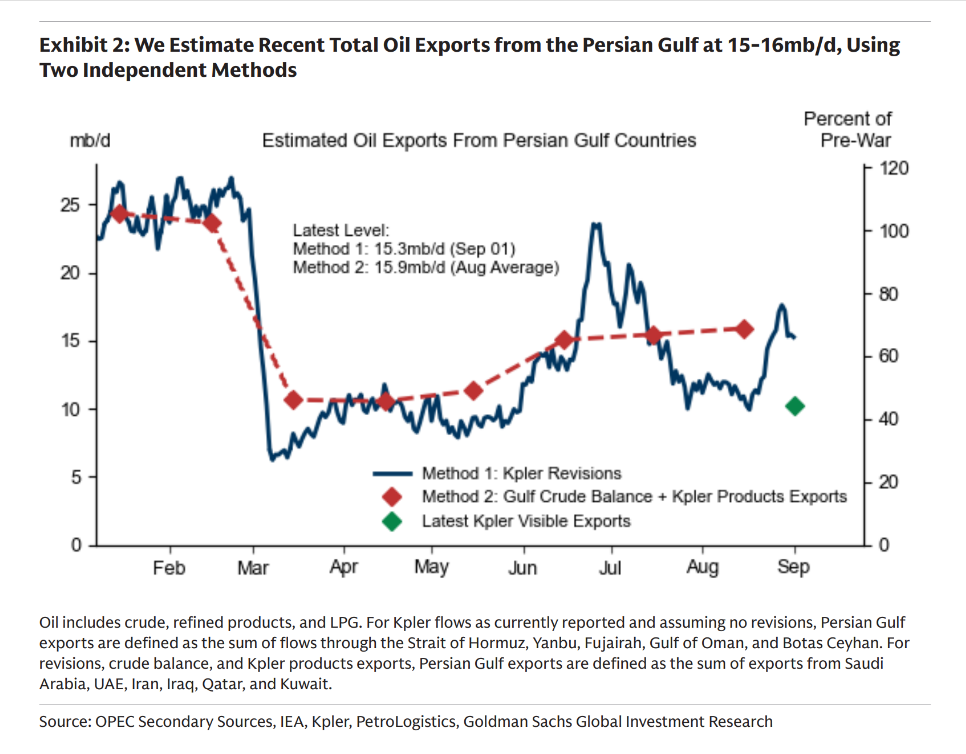
Goldman Sachs estimated recently Gulf oil exports at 15-16 million bpd
London-based analytics company Vortexa estimated total oil exports from the Gulf region reached 15 million bpd in August, still down by 10 million bpd from pre-war levels.
Crude and refined products volumes moving through the Strait of Hormuz on a seven-day moving-average basis were around 8 million bpd, the company said.



“Daily transits fluctuate strongly with substantial spikes and troughs,” said Vortexa analyst Pamela Munger.
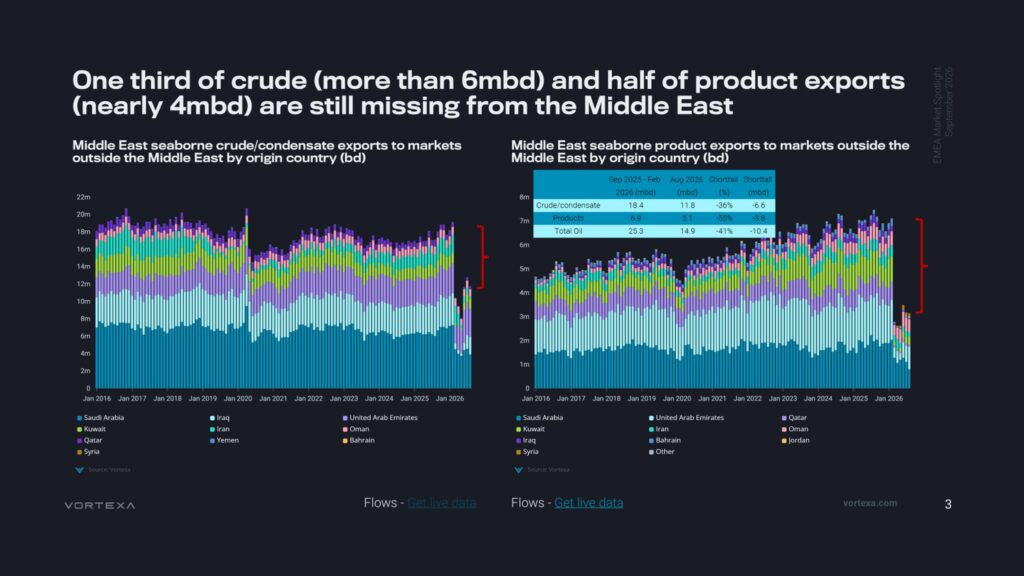
Over 10 million barrels a day still missing
Clarifying the 17 million to 18 million barrels figure, U.S. Energy Secretary Chris Wright told Fox News on Sunday the figure of 18 million bpd was for one 24-hour period last week.
The running average by all “waterborne routes” represented 9 million bpd, said Wright. That is much closer to industry consensus.
Analysts also find there is a discrepancy between peak daily flows and sustained exports.
Gulf crude exports reached as much as 14 million bpd on some days in early September, including secret tanker flows and Saudi Red Sea exports that avoid the Strait of Hormuz, according to figures from Kpler and an industry source.
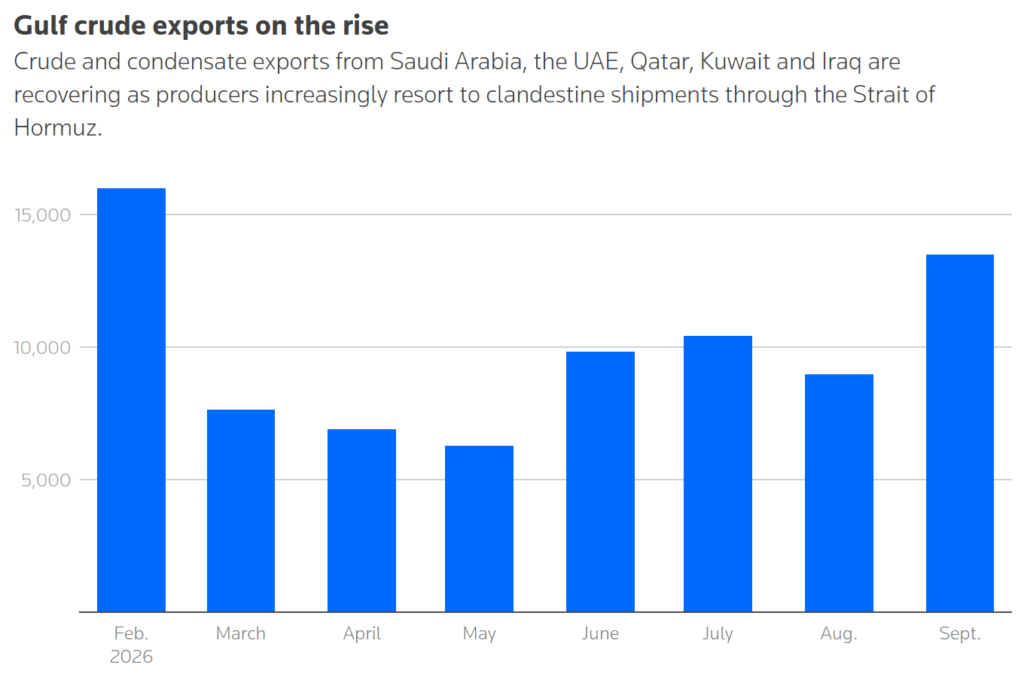
Note: in thousand barrels per day; Exports include flows from Saudi Arabia’s Yanbu and UAE’s Fujairah ports; Sept. figures are estimate based on preliminary Kpler data and from an industry source.
Source: Kpler, industry source | Reuters, Sept. 4, 2026 By Alex Lawler and Ahmad Ghaddar
Depending on the intensity of Iran’s tanker attacks, on other days, exports were much lower.
The covert shipments have become a constant and have allowed crude from Iraq, Kuwait, Qatar, Saudi Arabia and the United Arab Emirates to keep reaching global markets.
Reuters calculations on the basis of an average oil price of $80 per barrel and on a conservative assumption of 6 million barrels, or six large tankers, a day over the last 90 days, found dark shipments amounted to at least 500 million barrels in June to August. That would be worth at least $40 billion.
Reporting by Dmitry Zhdannikov and Anushree Mukherjee, editing by Alex Lawler and Barbara Lewis
Share This:


















Oil Prices Fly Blind as the Hormuz Enigma Deepens: Bousso