CDN NEWS |
  US NEWS







Of all the ways in which artificial intelligence might destroy humanity, its carbon footprint is far down the list for some of Wall Street’s most prominent climate experts.
Aniket Shah, the Jefferies executive who heads the bank’s strategy on sustainability and the energy transition, says he’s asking the global finance industry not to let AI overshadow talks about reducing planet-warming pollution. His comments, which feed into an already polarized debate, come just ahead of New York climate week, where more than 100,000 people are expected to gather over the coming days.
“Climate change is about 50 billion tons of greenhouse gases going to zero, and so we actually have to have a right framing of what is driving that,” said Shah. “Data center demand growth is actually not in the top five.”
The concern for Shah and those who share his point of view is that angst about the greenhouse gas emissions of AI data centers will drag attention away from areas with substantially higher emissions, like transport and heavy industry.
It’s a distinction that others are also starting to make. A recent report by the investment firm of former vice president turned climate campaigner, Al Gore, notes that the power needed to run air conditioning has far greater implications for energy consumption than AI.
Read More: Anthropic’s Warning of Existential Risk Hijacks Larger AI Debate
It’s “understandable” that AI data centers would be “a huge concern” for people worried about climate change, Gore said in an interview. “I just don’t think it’s a cause for panic.”
The energy use and emissions of AI data centers are dwarfed by numerous other activities, he notes. “Just to pick one example, the emissions from uncovered landfills around the world are a large multiple of the emissions from all of the AI data centers put together.”
Shah says he expects talks at New York climate week “to be all about data centers” and “all about AI.” And that would be an unfortunate distraction, he says.
“If you’re actually thinking about climate change globally speaking, data centers are just not that big of a deal, just like arithmetically, it’s not,” Shah said.
A definitive assessment of the greenhouse-gas emissions of AI has yet to be produced. In April, the International Energy Agency said that taking into account an expected doubling of electricity consumption by the end of the decade, data centers will account for just 3% of global demand by 2030. All in all, emissions associated with data centers — not just the ones feeding AI — are on track to make up about 2% of those released by the global electricity sector by 2035, the IEA also said.
In a report published last week, Gore’s Generation Investment Management noted that in most countries data centers are “not the most important” drivers of energy demand. The biggest contributor is a rise in air conditioning use, with electric cars and heat pumps — both important planks of the green energy transition — also identified as major guzzlers of electricity.
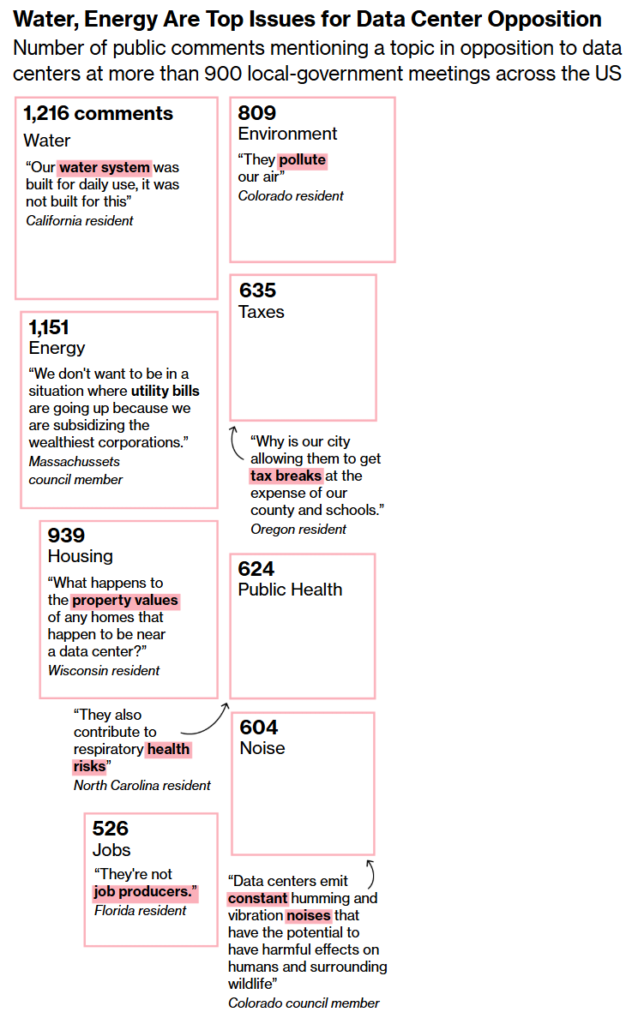
Such assessments clash with the popular perception of AI data centers, which are often criticized for their use of energy, water and land. Across the US, local communities have mobilized to protest against the construction of mega data centers in their backyards, with concerns often centered on spikes in utility costs.
Read More: Tech Deploys Charm Offensive to Combat AI Data Center Backlash



Source: Bloomberg analysis of Hamlet data
What Bloomberg Intelligence Says:
Satellite tracking suggests gross US AI data-center capacity additions could reach 16-18 gigawatts in 2026, below the roughly 21-GW pipeline, as land-clearing delays and advanced-packaging limits constrain deployment. GPU supply and advanced-packaging capacity should increase, yet bottlenecks could shift toward transformers and power generation, raising the risk of dark megawatts or stranded chips. Solar-plus-storage still dominates US grid additions, while gas is gaining share alongside fuel cells produced by Bloom Energy and competitors, which are becoming a quick-to-deploy option as hyperscalers race to secure power.
Investors have also voiced some concerns. A recent survey of asset owners by Morningstar Inc. showed that 25% cited the environmental impact of AI use as a risk, up from 12% a year earlier. Six in 10 said they’re worried that AI-driven demand for data centers and power generation will result in higher energy costs and inflation.
“Potentially the most significant impact” that the companies building AI infrastructure “will have on the climate is through the way that their AI products are used,” says Thomas Day, a climate policy expert with the New Climate Institute.
“We need a conversation about the extent to which AI companies should be responsible for who they provide their services to, and what they are used for,” which ultimately feeds into the bigger issue of “enabled emissions,” he said.
Celine Herweijer, visiting professor of energy, AI and geopolitics at the London School of Economics and former chief sustainability officer at HSBC Holdings Plc, says that electricity is becoming “the binding constraint.”
And “that’s why AI matters so much,” because “the power system we build for AI will affect everything else we plug into it,” she said.
The boom in AI digital infrastructure is expected to strain power systems and spur the buildout of capacity, BloombergNEF said in a report on Friday. BNEF also notes that the tech industry’s “hunger for cheap electrons” has improved the outlook for clean power. At the same time, gas is the fuel getting the “biggest boost” from AI power demand, BNEF said.
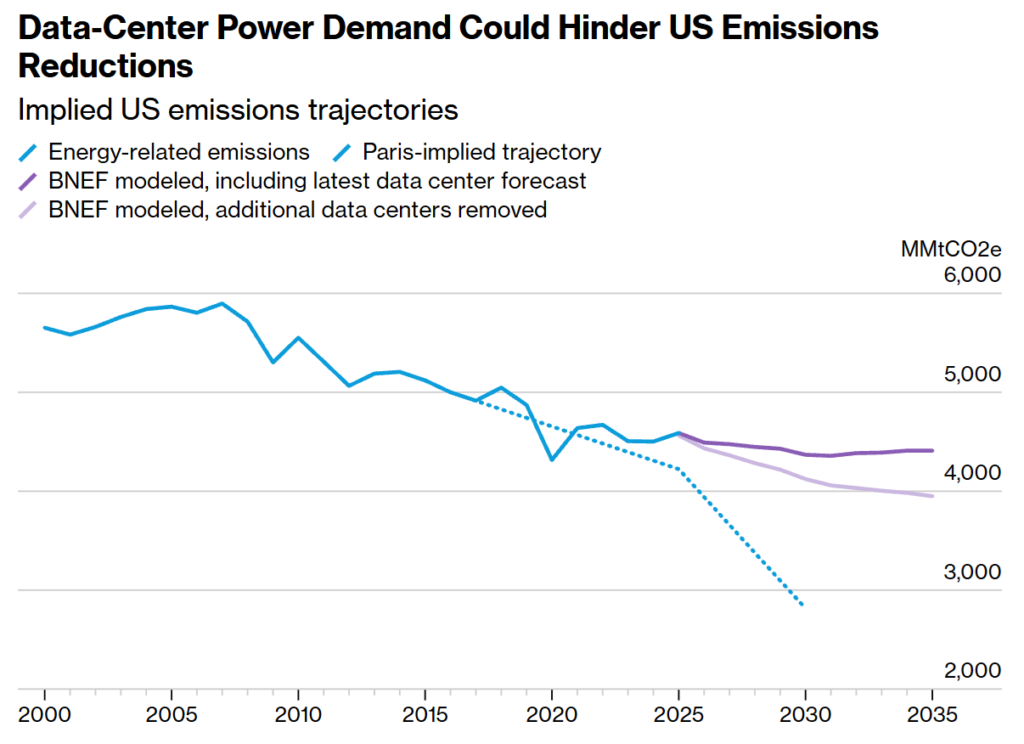
At the same time, the IEA notes that the extra demand from AI is feeding into grid bottlenecks that urgently need to be addressed. And that’s a topic that Wall Street’s biggest bank has made clear it plans to prioritize.
JPMorgan Chase & Co. expects to be talking about the grid “every day of New York climate week and every chance that we get,” says Heather Zichal, the bank’s global head of sustainability. “We look at modernizing the grid as the single biggest unlock for everything else: it helps national security, it helps energy affordability, and it helps speed to power.”
The bank, which last year launched a $1.5 trillion security and resiliency initiative designed in large part to secure the future of American infrastructure, is positioning itself for what Zichal says are “significant investment opportunities in capital market activity in a range of new technologies from carbon removal to nuclear to energy storage, geothermal, et cetera.”
New York climate week offers a venue at which to discuss such opportunities, she said, which is “why we’re showing up in force.”
(Updates with BI analysis in 13th paragraph.)
Share This: