


 CDN NEWS |
  US NEWS







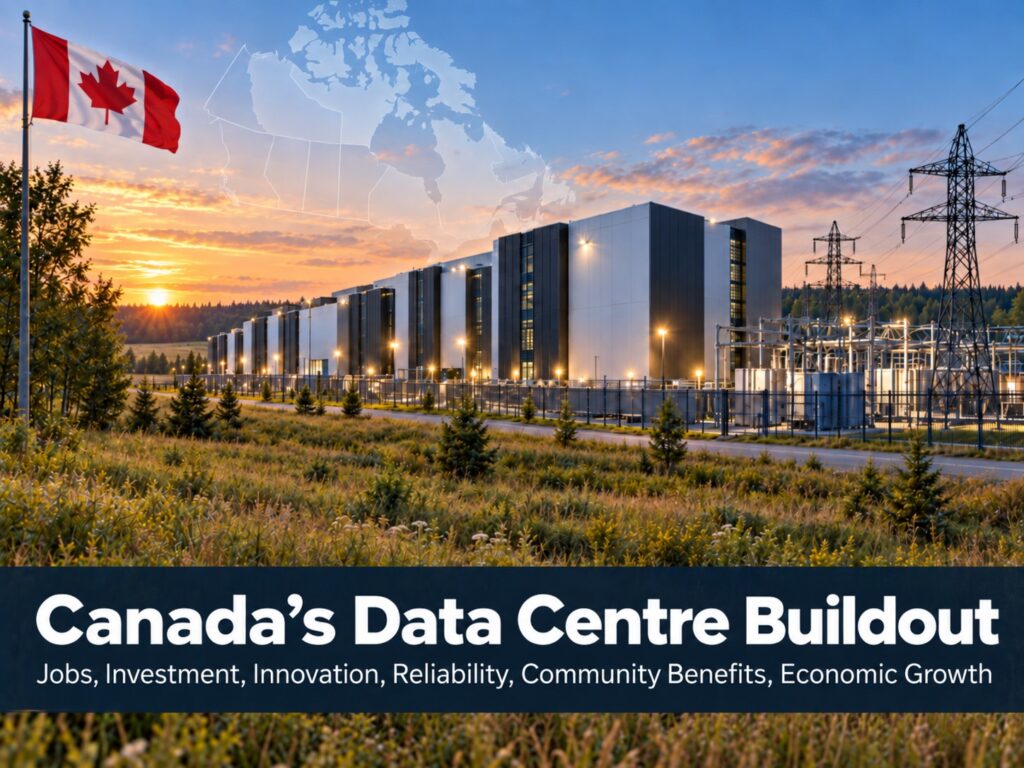
Special Report Summary
Canada is entering what could become one of the largest infrastructure investment cycles of the next decade. Artificial intelligence, cloud computing, digital banking, government services, scientific research and virtually every major digital industry require increasingly powerful data centres. Canada also has a strategic reason to build them: Ottawa says the country still relies significantly on computing, cloud and data-storage infrastructure located outside Canada, making domestic capacity increasingly important for economic resilience and data sovereignty.
The opportunity is enormous. Across North America, data-centre capacity in the major markets jumped 33.7% year-over-year in the first half of 2026, yet vacancy still fell to only 1.4%. More than 80% of capacity currently under construction has already been committed. Power availability—not land—is increasingly the factor determining where the next generation of facilities gets built.
Canada has several natural advantages: abundant energy, a relatively cool climate, large quantities of hydroelectricity, natural gas and uranium, political stability, proximity to the United States, strong fibre networks, an established AI industry and large amounts of industrial land. About 60% of Canada’s electricity is hydroelectric, while Ontario adds one of the world’s largest nuclear fleets.
But the industry has entered a more contentious phase. Communities are asking legitimate questions: Who pays for the new power plants and transmission lines? Will household electricity bills rise? How much water will these facilities consume? How many permanent jobs will actually be created? Will natural-gas-powered centres increase emissions? And why should a community allocate scarce electricity or water to a facility owned by a multinational technology company?
Those questions will ultimately determine which provinces win the Canadian data-centre race.
Why Data Centres Matter to Canada
It is useful to think of data centres less as warehouses full of computers and more as digital industrial infrastructure.
Canada once competed for automobile plants, refineries, pipelines, steel mills and petrochemical complexes. Increasingly, countries and provinces are competing for computing infrastructure.
Data centres support banking, telecommunications, health care, government records, cybersecurity, cloud computing, streaming, e-commerce and increasingly AI training and inference. Ottawa now explicitly calls data centres “critical infrastructure.”
There is another strategic issue: sovereign compute. Keeping sensitive Canadian government, corporate, defence, health and research data within Canada reduces dependence on foreign computing infrastructure and means that more of Canada’s AI economy operates under Canadian laws.
This is a major part of Saskatchewan’s strategy. Its new framework explicitly favours Canadian ownership, Canadian data sovereignty and Canadian-headquartered proponents.
The Investment Opportunity Could Be Enormous
Data centres themselves are only part of the investment.
A hyperscale AI campus can trigger spending on:
- data-centre buildings and computing equipment;
- natural gas generation, nuclear, hydro, wind and solar generation;
- batteries and other storage;
- transmission lines and substations;
- natural gas pipelines;
- transformers and switchgear;
- fibre-optic networks;
- cooling systems;
- roads and municipal infrastructure;
- cybersecurity;
- engineering and construction;
- land development; and
- Indigenous equity and infrastructure partnerships.
The scale is already visible.
Meta announced more than $13 billion for its first Canadian data-centre campus in Sturgeon County north of Edmonton. The associated 932-MW Greenlight Electricity Centre represents another approximately $4.6 billion of investment. The project is expected to employ more than 3,000 people during peak construction and about 300 permanently.
Saskatchewan and Bell, meanwhile, are developing a 300-MW AI data centre near Regina, with the province estimating more than 1,600 direct and spin-off jobs and as much as $12 billion of overall economic activity associated with the project.
There is, however, an important caveat.
Data centres are extraordinarily capital-intensive but not extraordinarily labour-intensive once completed.
A $10-billion facility might employ hundreds rather than thousands after construction. Therefore, governments should evaluate projects based not simply on the headline investment number but on property taxes, electricity revenues, local procurement, permanent employment, associated power infrastructure, fibre investment, Indigenous participation and whether the facility attracts a broader technology ecosystem.
Which Provinces Have the Best Potential?
| Rank | Province | Overall Potential | Principal Advantage | Main Constraint |
|---|---|---|---|---|
| 1 | Alberta | Exceptional | Natural gas, land, private generation, investment environment | Emissions/community acceptance |
| 2 | Quebec | Exceptional but constrained | Huge hydro system, Montreal tech ecosystem | Electricity increasingly rationed/priced |
| 3 | Ontario | Exceptional | Nuclear, customers, talent, fibre/connectivity | Grid expansion and power cost |
| 4 | Saskatchewan | Rapidly emerging | Land, gas, uranium, sovereign-AI strategy | Smaller existing ecosystem |
| 5 | British Columbia | Very strong but constrained | Hydro, cool climate, Pacific connectivity | Limited new power allocations |
| 6 | Manitoba | Underrated | Hydro, cold climate, inexpensive land | New generation required |
| 7 | Atlantic Canada | Select opportunities | Hydro/nuclear, land, transatlantic connectivity | Scale and transmission |
1. Alberta — Probably Canada’s biggest greenfield opportunity
For very large AI campuses requiring several hundred megawatts or even gigawatts, Alberta currently has perhaps Canada’s strongest proposition.
The reasons are straightforward: abundant natural gas, large industrial sites, relatively low land costs, extensive pipeline infrastructure, deregulated power generation and the ability for developers to construct dedicated generation.
Investor interest is extraordinary. As of July 30, 2026, approximately 19,565 MW of proposed data-centre demand was seeking connection to Alberta’s system. By comparison, Alberta’s record provincial electricity load is only about 12,785 MW. Alberta has therefore limited the first phase of large-load connections to 1,200 MW.
Those 19.6 GW are requests, not approved projects, and many will never be built. Nevertheless, they demonstrate the scale of interest.
Alberta is effectively telling developers:
Bring your investment—and increasingly bring your own power.
That model could become extremely important.
2. Quebec — possibly Canada’s best natural data-centre location, but electricity is no longer unlimited
Quebec combines a cool climate, Montreal’s established technology ecosystem and enormous quantities of renewable electricity.
Hydroelectricity accounted for roughly 94% of Quebec’s generation, and Quebec remains Canada’s largest electricity-producing province.
Historically, cheap hydro made Montreal one of Canada’s most attractive data-centre markets.
But Quebec has discovered the other side of the equation: cheap electricity becomes extremely valuable when dozens of industries all want it.
Hydro-Québec says data-centre peak demand is currently around 200 MW but could approach 1,000 MW by 2035. It has proposed a new rate for large data centres of approximately 13 cents/kWh, roughly twice the price previously paid by customers under its large-power rate structure.
That is a significant policy development.
Quebec is essentially saying:
Our electricity is an economic resource. Data centres can have it—but they have to create enough value to justify consuming it.
That philosophy could spread.
3. Ontario — Canada’s strongest technology/customer market
Ontario has advantages Alberta cannot easily reproduce: Canada’s biggest population, Toronto’s financial sector, extensive telecom infrastructure, major corporate customers and one of North America’s strongest technology ecosystems.
It also has an unusually low-carbon power system. About 91% of Ontario’s electricity generation was zero-carbon in the CER’s provincial profile, led by nuclear at 55% and hydro at 24%.
The problem is demand.
Ontario’s IESO expects electricity demand to rise substantially as data centres compete with EV manufacturing, mining, industrial electrification and population growth. Its high-demand scenario projects electricity use rising as much as 92% by 2050, with AI data centres among the major drivers.
Ontario therefore offers exceptional fundamentals, but additional nuclear generation, transmission and other resources will be required.
4. Saskatchewan — Canada’s emerging wild card
Saskatchewan has suddenly become one of the most interesting jurisdictions in Canada.
Bell’s 300-MW development outside Regina is under construction, and Saskatchewan released a dedicated Data Centre Framework on August 27, 2026.
And this answers an important question about how many Saskatchewan wants to build:
Saskatchewan has not established a fixed numerical target.
Instead, the province says it currently has more than 30 data-centre applications in its development queue.
SaskTel already owns and operates six data centres, while Bell’s 300-MW facility represents the major new AI development.
Perhaps most importantly, Saskatchewan’s new framework says future projects must generally supply their own power, protecting existing customers and Saskatchewan’s electricity export capacity.
Saskatchewan also has natural gas, world-leading uranium reserves, significant wind potential and a government interested in nuclear power.
If SMRs eventually become commercially competitive, Saskatchewan could conceivably combine uranium, nuclear generation, natural gas and data centres into a distinctly Canadian AI-energy industrial strategy.
5. British Columbia — attractive, but BC Hydro is deliberately rationing access
B.C. offers abundant hydroelectricity and attractive connections to Pacific markets.
But B.C.’s government has essentially acknowledged that there is not enough incremental electricity available to approve every project seeking power.
For the first two years of its new allocation system, B.C. has limited incremental electricity allocations to 300 MW for AI data centres and 100 MW for conventional data centres, using a competitive selection process for projects of 10 MW or larger.
That means B.C. will likely remain attractive—but highly selective.
6. Manitoba — perhaps Canada’s most underrated opportunity
Up to 97% of Manitoba Hydro’s electricity production comes from hydroelectricity, while Manitoba offers inexpensive land and one of Canada’s coldest climates.
Those are excellent data-centre fundamentals.
The limitation is supply.
Manitoba Hydro says the province requires additional electricity sources by approximately 2030. Its latest plan includes up to 600 MW of Indigenous-majority-owned wind and roughly 750 MW of natural-gas combustion turbines.
Manitoba also now subjects large power requests above 5 MW to additional review.
So Manitoba has tremendous potential—but only if new power development keeps pace.
How Should Canada’s Data Centres Be Powered?
There probably isn’t one Canadian solution.
Quebec and Manitoba can lean heavily on hydro. Ontario can combine nuclear and hydro. B.C. can rely predominantly on hydro. Alberta and Saskatchewan can use natural gas alongside wind, solar, storage and eventually potentially nuclear.
The crucial issue is firm power.
An AI facility may operate 24 hours per day with an enormous and relatively constant load. Wind and solar alone cannot guarantee that requirement every hour of the year without storage or firm backup.
This is why natural gas is becoming so important to Alberta’s strategy.
Meta’s Sturgeon County project, for example, is associated with the new 932-MW Greenlight natural-gas plant, while the full campus eventually could draw approximately 1.8 GW. The gas facility alone could consume roughly 150 million cubic feet of Alberta natural gas per day.
That creates an entirely new demand source for Western Canadian natural gas.
In that respect, AI could become an energy export without moving the molecule. Alberta gas is converted into electricity, electricity into computing capacity, and computing capacity into AI products and digital services sold worldwide.
That concept deserves far more attention from Canada’s energy industry.



Will Data Centres Increase Residential Electricity Prices?
The Concern is Legitimate—But Higher Prices are Not Inevitable.
Calling the issue pure fearmongering would be incorrect.
If a utility must build billions of dollars of new generation, transmission and substations for a data centre and then spreads those costs across every customer, household rates can rise.
There is another danger: stranded infrastructure. Imagine a utility builds transmission for a 1,000-MW AI campus and the developer cancels the project. Somebody still has to pay for the wires.
There is also an opportunity cost. Selling inexpensive Quebec hydro to a data centre means that electricity cannot simultaneously be exported, used to electrify industry or allocated to another project.
But good regulation can largely address those risks.
Ottawa’s new Responsible Data Centre Development Principles, announced September 3, explicitly state that data centres must not shift electricity-system costs onto Canadian households and existing businesses. Developers should pay for generation, transmission, substations and grid upgrades attributable to their projects.
Different provinces are converging on variations of the same model.
Saskatchewan is requiring self-supplied generation. B.C. is rationing power through competitive allocations. Quebec is proposing a premium data-centre electricity rate. Alberta is encouraging dedicated generation and requiring developers to pay their infrastructure costs.
Interestingly, Alberta argues the Meta project could actually lower the transmission component of household bills by as much as 6% because Meta is expected to pay nearly $200 million annually in transmission fees, spreading fixed network costs over a larger customer base. That refers only to the transmission portion of the bill, not a 6% reduction in the entire electricity bill.
So the more accurate conclusion is:
Data centres can raise electricity rates if they are poorly structured. They can be neutral or potentially beneficial to other ratepayers if developers pay the full incremental cost of serving them.
What About Water?
This may be the most misunderstood issue.
Some traditional data centres can consume enormous quantities of water because evaporative cooling towers continuously lose water into the atmosphere.
But water consumption depends heavily on the cooling technology.
New high-density AI chips are increasingly encouraging a move toward liquid cooling, in which coolant circulates directly near the chips.
A closed-loop liquid system combined with dry air coolers can reuse essentially the same cooling fluid rather than continually consuming freshwater.
Meta says its new Alberta campus will have no normal operational water consumption for cooling, although water will still be required for employees, maintenance and fire protection.
Bell says essentially the same thing about its Saskatchewan facility: its cooling water will remain in a sealed recirculating system and the facility will not use municipal water or groundwater for normal cooling.
That distinction is critical.
A discussion about “how much water data centres use” is increasingly meaningless without asking:
Which cooling technology? Which climate? Which workload? Which water source?
Canada’s colder climate gives it another advantage because outside air can reject heat efficiently for much of the year.
Nevertheless, communities are justified in requiring developers to publish annual water withdrawals and consumption rather than simply promising that a project is “water efficient.”
Ottawa’s new principles now call for exactly that kind of measurement and transparency.
Why Are Canadians Protesting Data Centres?
The opposition is not simply opposition to technology.
A proposal often arrives in a rural community looking like this:
A foreign technology company wants hundreds or thousands of acres, potentially a gigawatt of electricity, new transmission lines, perhaps its own natural-gas plant—and potentially significant water and road infrastructure.
Residents understandably begin asking what they receive in return.
Concerns generally revolve around electricity rates, water, natural-gas emissions, generator and cooling-system noise, farmland loss, property values, light pollution, diesel backup generators, visual impact, the number of permanent jobs and whether approval processes are moving too quickly.
Community acceptance has already affected Canadian projects.
Rocky View County rejected land-use changes for a proposed roughly 1,100-acre Alberta data-centre campus in September 2025. More recently, residents around Redwater and Morinville have raised concerns surrounding Alberta data-centre development.
This is becoming a major investment risk. CBRE now says community opposition and zoning have become almost as important to data-centre site selection as access to electricity and fibre.
A Canadian Formula for Community Acceptance
Successful projects will increasingly need something resembling a social licence agreement before construction.
Companies and governments should demonstrate in advance who pays for electricity infrastructure; projected water consumption; the type and source of generation; emissions; noise; construction and permanent employment; municipal tax revenue; Indigenous participation; road costs; decommissioning responsibility; and whether local residents will see electricity, water or tax costs increase.
Communities should also receive measurable benefits rather than vague economic-development promises.
The best projects could include Indigenous equity ownership, local procurement targets, apprenticeships, municipal infrastructure contributions, community investment funds and waste-heat utilization.
Waste heat deserves particular attention in Canada.
A data centre is essentially an enormous machine converting electricity into computing—and ultimately heat.
That heat can potentially supply district heating, greenhouses, industrial facilities, pools or adjacent buildings.
In Canada’s climate, throwing all of that thermal energy into the atmosphere may eventually be regarded as a wasted economic resource.
Other Canadian Issues That Deserve Attention
Data sovereignty and national security
Canada should distinguish between facilities that merely export computing services and facilities that genuinely increase Canadian sovereign computing capacity.
Government, defence, health, financial and sensitive corporate workloads could increasingly require Canadian-hosted infrastructure.
Foreign ownership
Canada wants foreign capital, but governments should consider whether strategic computing infrastructure becomes as important as telecommunications infrastructure.
Saskatchewan has already moved in this direction by making Canadian ownership and headquarters part of its assessment framework.
Transmission may be the actual bottleneck
Canada has enormous energy resources.
That does not mean the electricity is available where a data centre wants it, when it wants it.
Large transmission projects can require years to approve and construct. Industry research now identifies power availability and infrastructure-delivery timelines as the dominant data-centre location factors.
Transformers and electrical equipment
Transformers, switchgear, generators and other high-voltage equipment increasingly have long lead times. Canada’s opportunity therefore extends into domestic electrical-equipment manufacturing and supply chains.
AI technological risk
There is also a risk that governments overbuild.
AI computing technology is changing extremely quickly. Today’s GPU architecture may look very different five years from now. Governments should therefore be cautious about guaranteeing loans, subsidizing electricity or building taxpayer-funded infrastructure for speculative projects.
Make developers carry the demand risk.
Cybersecurity
As Canada concentrates banking, government systems, AI and corporate data inside massive facilities, physical security and cybersecurity become national infrastructure issues.
Canada’s Emerging Data-Centre Policy May Actually Be Taking Shape
One particularly significant development occurred only days ago.
On September 3, 2026, Ottawa introduced Canada’s Responsible Data Centre Development Principles.
They essentially say data centres should:
- create lasting benefits for communities;
- not shift electricity costs onto Canadians;
- minimize water use and environmental impacts;
- transparently disclose local impacts; and
- provide strategic value to Canada.
Those principles are surprisingly close to the approaches now emerging independently in Alberta, Saskatchewan, Quebec and British Columbia.
That may ultimately become Canada’s competitive advantage.
Rather than saying no to data centres, Canada could say:
Yes—but bring your capital, bring or pay for your power, protect our water, pay your infrastructure costs, partner with communities and Indigenous Peoples, create Canadian value and demonstrate why Canada benefits from the project.
Bottom Line
Canada should aggressively pursue data-centre investment.
The combination of natural gas, hydroelectricity, nuclear power, uranium, cold weather, available land, fibre infrastructure, political stability and an established AI ecosystem gives this country advantages few competitors can reproduce.
But the winning strategy is not simply to approve as many projects as possible.
The provinces that succeed will be those that treat computing capacity as another form of industrial infrastructure development.
Alberta currently appears best positioned for enormous greenfield AI campuses. Quebec remains exceptionally attractive for clean computing but is becoming more selective about electricity. Ontario offers perhaps Canada’s strongest combination of technology talent, customers and nuclear electricity. Saskatchewan is emerging rapidly and already has more than 30 applications awaiting assessment. B.C. is deliberately rationing scarce clean electricity, while Manitoba possesses enormous long-term potential if it can add sufficient generation.
And for Canada’s energy sector, the opportunity could be particularly significant.
The AI revolution will require electrons, molecules, transmission lines, pipelines, nuclear reactors, turbines, transformers and cooling technology before it ever produces a single answer from an AI model.
Canada happens to be unusually well supplied with nearly all of them.
Share This:


















Oil Prices Fly Blind as the Hormuz Enigma Deepens: Bousso