CDN NEWS |
  US NEWS







By Neil Ford

- Canada’s new national power strategy creates huge investment opportunities for grids and clean power while loosening restrictions on gas-fired plants.
July 7 – In May, Prime Minister Mark Carney announced plans to double national power generation and grid capacity by 2050 at an estimated cost of C$1 trillion ($729 billion).
The National Electricity Strategy aims to speed up the deployment of power infrastructure and curb rising energy costs in the face of rising electricity demand from data centers, electric vehicles and industrial customers.
Clean energy accounts for 80% of Canada’s power production thanks to a huge hydroelectric power fleet and Carney said investment in renewable energy, hydroelectric and nuclear power would dwarf new fossil-fired power capacity.
The Canadian Renewable Energy Association (CanREA) forecasts wind, solar and storage will provide more than 70% of new generation through 2050.
Ottawa aims to reduce greenhouse gas emissions through electrification while also pursuing the “economic growth and affordability” prioritized by the Trump administration, Monica Gattinger, Chair of Positive Energy at the University of Ottawa, told Reuters Events.
Unlike the Trump administration, Carney’s government will retain existing tax credits for clean power projects. Developers can gain Investment Tax Credits of up to 30% of the value of clean power projects and up to 60% of the value of carbon capture and storage projects.
Canada’s industrial carbon pricing scheme gives clean energy investors another long-term price signal and approval of key infrastructure projects will also be fast tracked through the federal Major Projects Office. Projects that will benefit include Ontario Power Generation’s first 300 MW small modular reactor at the Darlington nuclear power plant site, the 60 MW expansion of the Taltson hydro project in the Northwest Territories, Nova Scotia’s Wind West program with up to 5 GW and the 500 kV North Coast Transmission Line in British Columbia.
Join 1,500+ senior decision-makers across energy and finance at Reuters Events Energy LIVE 2026.
The Canada Infrastructure Bank is also a “powerful tool” that provides low-cost financing and is the principal lender to Indigenous communities, a CanREA spokesperson told Reuters Events.
Canada Infrastructure Bank is capitalized with C$35 billion, providing low-cost, long-term concessional debt across five priority sectors including clean power.
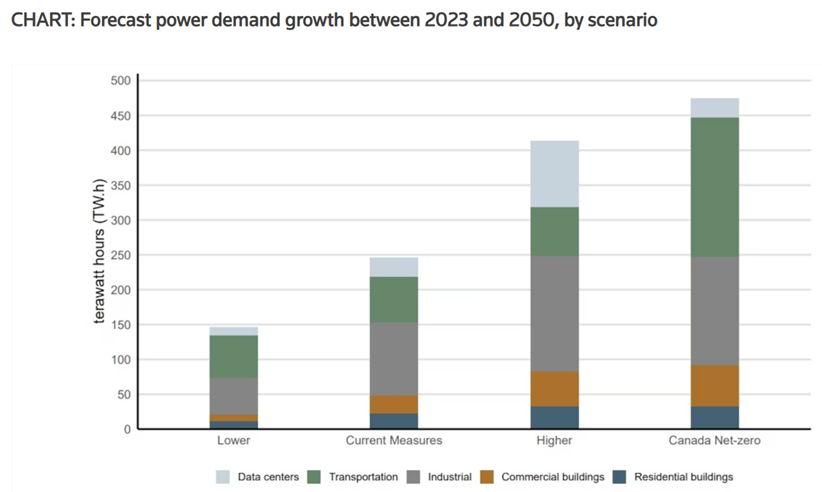
Source: Canada Energy Regulator
Many renewable energy developers are already active on both sides of the Canada–U.S. border, including EDF, NextEra, Boralex, Pattern, Capital Power, RES and RWE, the CanREA spokesperson said.
Canada’s tax credits offer “policy certainty” across a 20 to 30-year investment horizon and the signing in June of a 30-year Electricity Purchase Agreement between EDF power solutions, Saulteau First Nations and BC Hydro for the 200 MW Taylor South Wind Project is a “recent
example of the kind of long-horizon partnership Canada’s framework enables,” the spokesperson said.
Emissions challenge
Canada’s coal-fired power capacity has fallen sharply due to federal regulations mandating the phase-out of traditional coal plants by 2030, steadily rising national carbon pricing, and support for clean energy from most provinces. Meanwhile hydro production has increasingly been affected by droughts.
Canada aims to reduce greenhouse gas emissions by 40–45% below 2005 levels by 2030 and reach net zero electricity emissions by 2035 and a fully net zero economy by 2050.
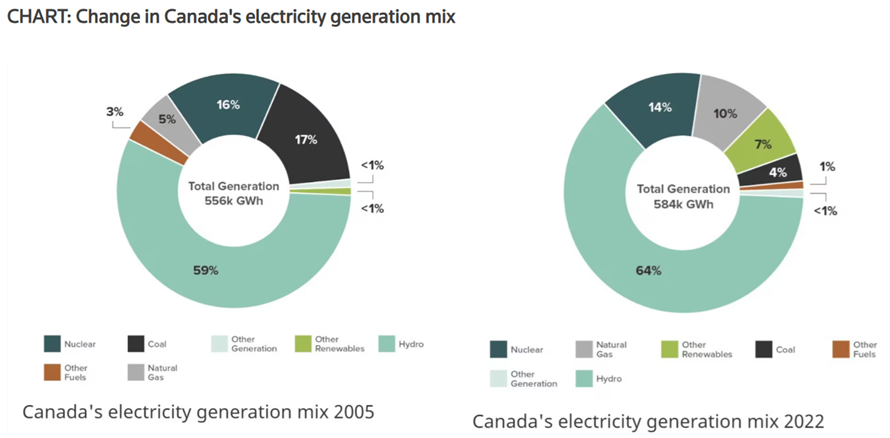
Source: Government of Canada



Carney’s government will however ease restrictions on emissions from gas-fired power production that were introduced by previous Prime Minister Justin Trudeau.
The U.S. is supporting a wave of new gas-fired power plants to meet soaring demand from AI and Canada’s oil and gas rich province of Alberta is set to be the country’s epicenter of data center deployment.
Carney’s government plans to announce more details of the changes following a public consultation held “over the next few months,” it said.
Provincial differences
The national electricity strategy aims to train 30,000 workers by 2028 and a further 100,000 by 2050 through specific training programs, labour partnerships and targeted immigration pathways.
Canada holds a wide range of natural resources and opportunities differ between province. Alberta is looking to optimize local gas supplies, Nova Scotia is supporting offshore wind development and Ontario is expanding its nuclear power capacity while also supporting wind, solar and storage through competitive procurement programs.
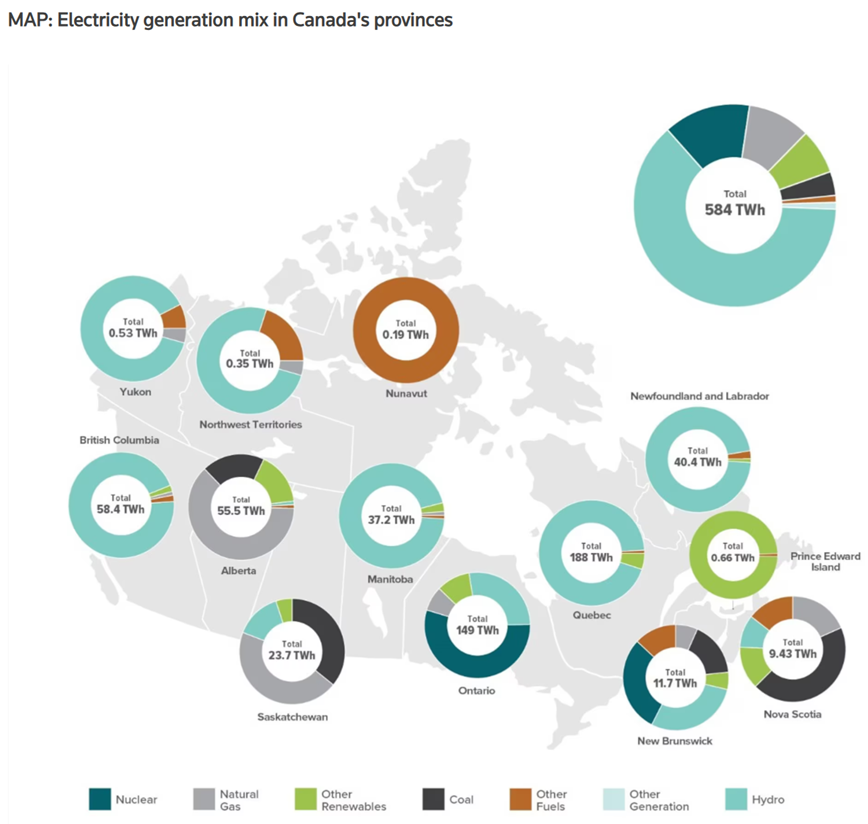
Source: Government of Canada
Ontario has focused on nuclear power to provide stable long-term power supplies but wind, solar and storage can fill the gap “quickly and affordably,” David Pickup, Director of the Electricity Program at clean energy thinktank the Pembina Institute, told Reuters Events.
Alberta, which produces 60% of its electricity from natural gas, had pushed for the lifting of emissions restrictions for gas-fired power plants. Alberta produces 60% of all Canadian gas and the regional government is keen to attract new data centers, impeding Carney’s stated intention that Canadian data centers would operate using “some of the cleanest power in the world.”
Canada hosts five hyperscale data centers and developers plan to deploy a further 100 in the years ahead, of which 90% would be in Alberta, according to York University research. Alberta’s cool climate can help reduce cooling costs for data centers and while tech firms are seeking to minimize carbon emissions, the Albertan government has said many companies are prioritising dispatchable power capacity.
On July 2, Alberta-based Pembina Pipeline and asset manager Kineticor took the final investment decision on a 932 MW gas-fired plant to supply a planned unnamed data center in Alberta, with the potential for another 932 MW unit at a later date.
Connecting regions
Canada’s National Energy Strategy aims to accelerate the construction of powerlines between provinces by using financial tools such as new ITCs passed into law in March.
Canada’s provinces trade significant power with the U.S. electricity network but Trump’s imposition of import tariffs have impacted trade relations between the U.S. and Canada.
Increased capacity between Canada’s provincial power networks would make renewable energy generation more cost-effective, Kathryn Harrison, Professor of Political Science at the University of British Columbia, told Reuters Events.
For example, British Columbia’s hydro capacity could act as energy storage to back-up potential wind and solar projects in Alberta, Harrison said.
This “could see electricity flow between the provinces in both directions, depending on conditions,” she added.
For exclusive energy insights, sign up to our newsletter.
Expanding grid capacity between regions will be challenging however, as it involves multiple stakeholders and the federal government lacks jurisdiction over power infrastructure planning under the Canadian constitution.
“The federal government is limited in how much it can directly shape the grid,” Gattinger said.
–Editing by Robin Sayles
Share This: