CDN NEWS |
  US NEWS







By Cody Good | Design Cynthia Tran Vo
Key Takeaways
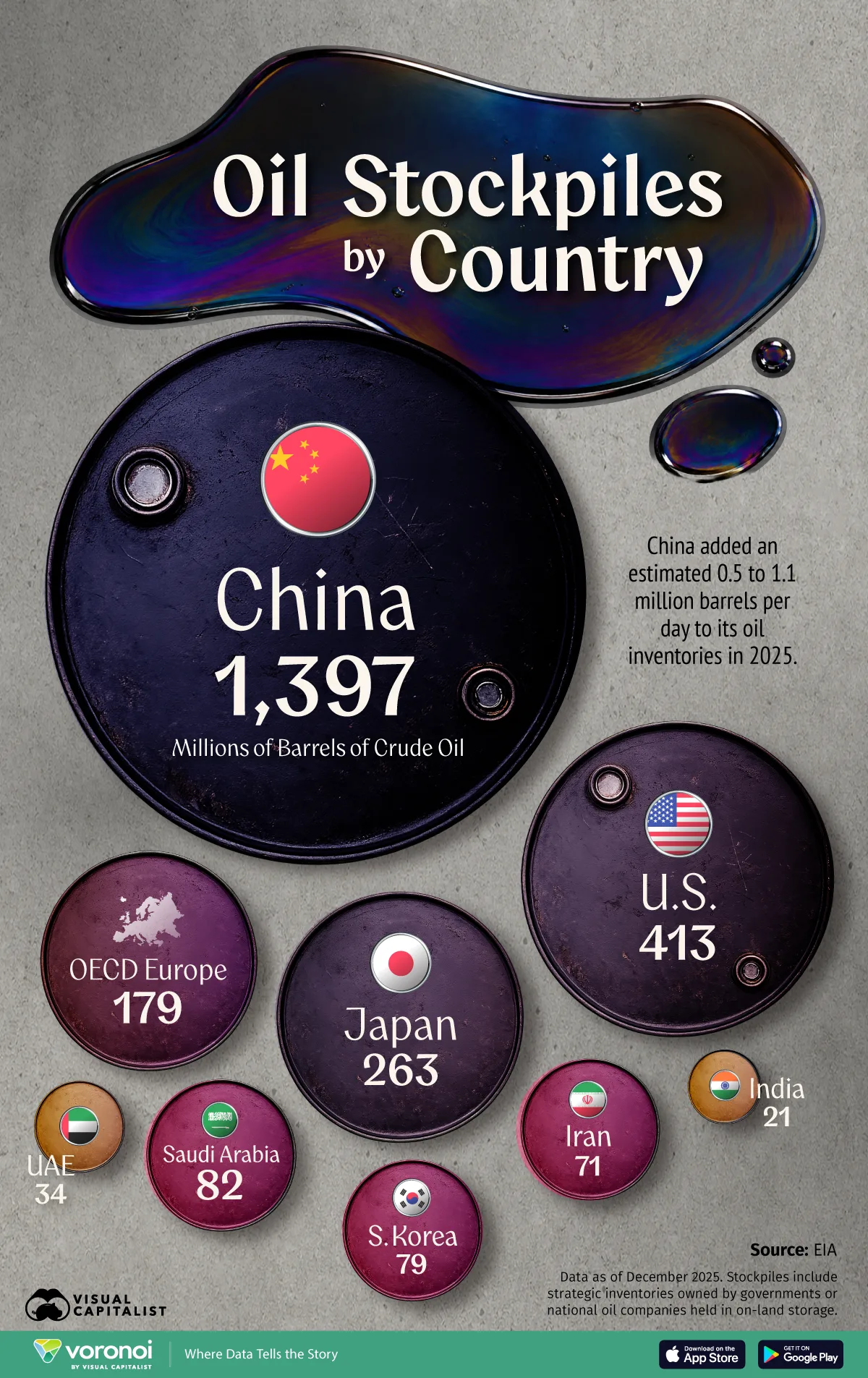
- China holds an estimated 1.4 billion barrels of strategic crude oil inventory, more than the next nine largest stockpiles combined.
- The U.S., Japan, and OECD Europe are the next-largest holders, reflecting decades of preparation for major oil supply shocks.
Global strategic oil inventories are one of the clearest indicators of how countries prepare for energy shocks and geopolitical uncertainty. These strategic reserves help governments stabilize domestic fuel supplies during wars, sanctions, natural disasters, or market disruptions.
According to the International Energy Agency (IEA), the world is currently facing one of the largest energy supply disruptions in modern history following the closure of the Strait of Hormuz, which has placed extreme strain on fuel markets and gasoline prices worldwide.
This visualization shows the largest estimated current strategic oil inventories in on-land storage using data from the U.S. Energy Information Administration. It highlights which countries were most prepared to weather disruptions to global oil supply.
The data does not account for the coordinated emergency release in March 2026 by IEA member countries.
China’s Massive Oil Inventory Dominates the Rankings
China’s oil stockpile is the standout figure in the ranking.
At an estimated 1.4 billion barrels, it is larger than the combined strategic inventories of the U.S., Japan, OECD Europe, Saudi Arabia, South Korea, Iran, the UAE, and India.
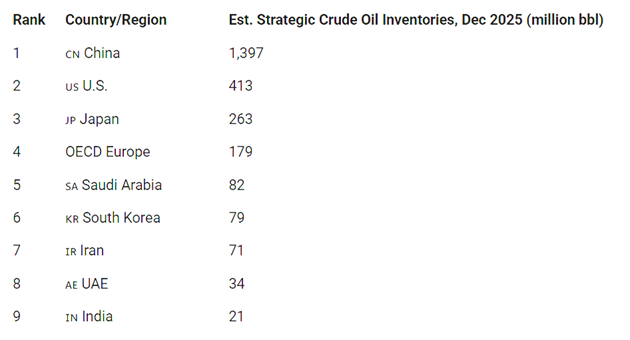
Today, the combined inventory of the countries listed above accounts for about 70% of the world’s total volume of oil in storage.



The scale of China’s reserve reflects its high dependency on overseas supply routes, including strategically sensitive maritime corridors like the Strait of Hormuz. The larger the stockpile, the more flexibility countries have to navigate periods of market volatility.
The U.S. Has the Second-Largest Stockpile of Crude Oil
The United States ranks second with 413 million barrels in its Strategic Petroleum Reserve (SPR), a network of underground salt caverns created after the 1973 oil embargo.
Japan ranks third with 263 million barrels, despite having limited domestic energy resources. Because the country imports nearly all of its crude oil, maintaining large emergency reserves has long been a national priority.
The collective of European countries in the OECD has the fourth-largest crude oil stockpile, at 179 million barrels.
Several Middle Eastern and other Asian countries also maintain sizable strategic reserves, highlighting the growing importance of energy security across both importing and exporting nations.
As global oil demand and geopolitical tensions persist, many countries are continuing to expand storage capacity to better protect against future supply disruptions.
A History of Oil Shocks and Strategic Releases
The 1973–1974 oil crisis, brought on by a global embargo of oil by major producers, caused global oil prices to spike by 300%. The crisis exposed how vulnerable many industrialized nations were to disruptions in oil imports.
In response, the IEA was created with one of its main goals being to establish strategic oil stockpiles in member countries to reduce the impact of future supply disruptions.
Since 1974, there have been six strategic oil releases:
- 1991: in the build-up to the Gulf War.
- 2005: after Hurricanes Katrina and Rita damaged oil infrastructure in the Gulf of Mexico.
- 2011: in response to the prolonged disruption of oil supply caused by the Libyan Civil War.
- 2022: following Russia’s invasion of Ukraine.
- 2022: a second release later that year as the energy crisis deepened.
- 2026 (the largest so far): following the closure of the Strait of Hormuz.
Share This: