


 CDN NEWS |
  US NEWS








Norway is putting pressure on the European Union to remove a moratorium on new oil and gas drilling in the Arctic where almost two thirds of its petroleum resources lie.
Norwegian politicians, civil servants, and environmental and industry lobbyists are increasingly visiting Brussels to influence EU institutions as the bloc gears up to unveil a new Arctic policy by the end of September.
Norway, which never joined the EU, is Western Europe’s largest exporter of oil and gas, with production from the Norwegian Continental Shelf meeting roughly 30% of EU and UK gas demand.
“Norway is very active and good at making its voice heard,” EU’s special envoy for the Arctic, Claude Veron-Reville, said in an interview in Brussels on Wednesday. “Norway knows very well how to intervene, they are very well organized and very present,” she said.
So far this year, 11 ministers have visited Brussels from Norway, on business ranging from the Arctic to trade and from energy to space.
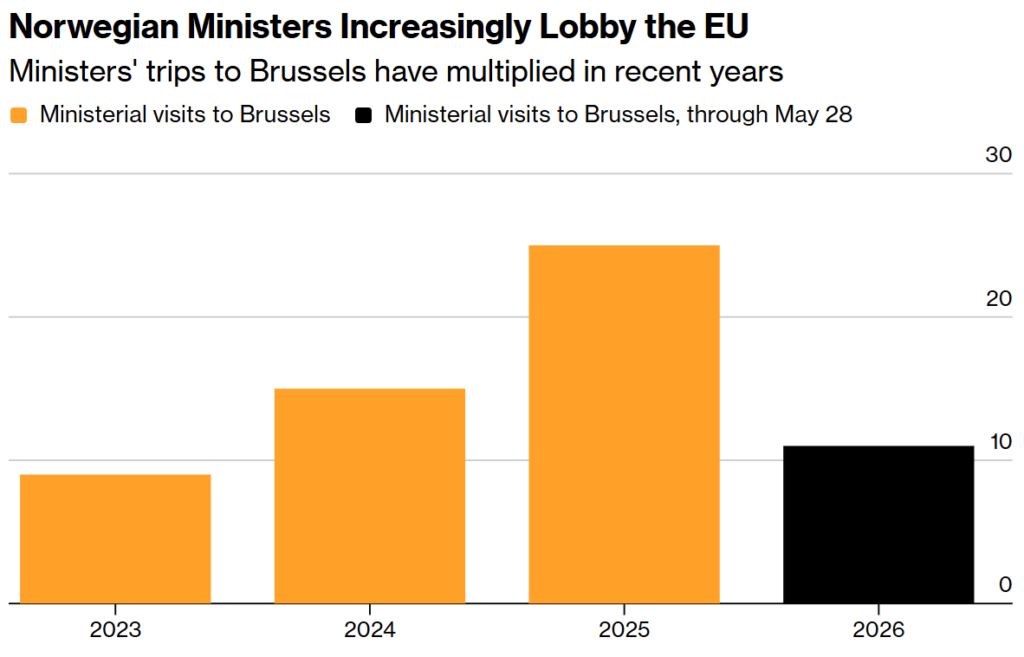
Source: Norwegian government calendar
The blockade of the Strait of Hormuz has handed Norway fresh arguments to persuade Brussels to drop the moratorium on new drilling in the Arctic, with the EU increasingly dependent on Norway’s gas exports.
The crux of the matter is climate and the environment. Critics argue that the Arctic region, which is warming three to four times faster than the global average, is more vulnerable to exploration activity and that more drilling risks the transition away from fossil fuels.



And the short term energy crisis is not a good reason to open up the Arctic for drilling, critics say.
The EU’s ban on new drilling, put in place in 2021, is in line with the bloc’s climate obligations, Veron-Reville said, adding that the decision to remove it is ultimately up to the EU member states. The EU defines the Arctic as the region above the polar circle.
Norway disagrees with what that definition means for drilling.
“There are no climate arguments for treating oil and gas produced north and south of a certain line differently,” Norway’s Foreign Minister Espen Barth Eide told Bloomberg. Eide said Norway’s policy is also to refrain from drilling “up in the icy wasteland” because of environmental concerns, but that Norway has a substantial population and active petroleum activity in the Arctic.
Norway’s Arctic drilling operations are in the Barents Sea, which is situated above Norway’s northernmost coastline. Norway has also argued that warmer Gulf Stream waters make conditions there comparable to those further south on the shelf — a consequence of climate change driven in large part by emissions from the fossil industry.
While its oil and gas production is set to fall in the years ahead, Norway recently opened up 70 new blocks for exploration in the North Sea, Norwegian Sea and Barents Sea. An estimate by WWF shows it takes about 18 years from finding an oil and gas field to production start in the Barents Sea.
Investors are taking notice. A number of asset managers joined academics and climate groups defending the moratorium in an open letter to the European Commission Wednesday, urging the EU to “maintain and reinforce” protections against new fossil fuel infrastructure north of the Arctic Circle.
The coalition said that expanded Arctic drilling risks “irreversible environmental damage,” exposing Europe to heightened security threats and risks locking in fossil fuel dependence beyond the EU’s 2050 net-zero target.
Financial-sector signatories include Nordea Asset Management, Norway’s largest pension company KLP, Danish pension providers including Sampension, AkademikerPension and Velliv, as well as lenders including Triodos Bank and Cultura Bank.
— With assistance from Evelina Youcefi
Share This:

















COMMENTARY: US Energy Dominance Descends Into Decadence