CDN NEWS |
  US NEWS







Canada’s oil industry is pushing back hard on proposals to impose a higher carbon tax, arguing the policy adds costs at a time when the world needs more secure and affordable sources of energy.
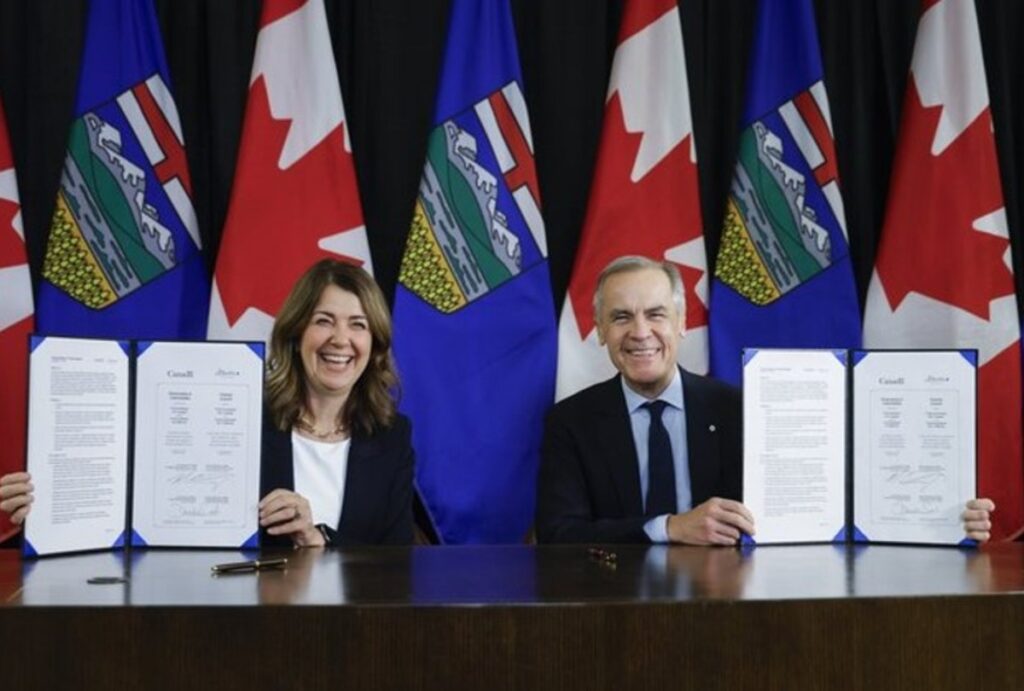
Prime Minister Mark Carney and Alberta Premier Danielle Smith agreed to a higher carbon tax for industrial emissions and a carbon storage project as part of a deal for Ottawa backing of a new oil-export pipeline to the Pacific coast. The proposed project would carry 1 million barrels or more, allowing Canadian energy producers to get more crude to global markets.
The Carney-Smith agreement foresees a minimum carbon price of C$130 ($96) per metric ton of CO2 equivalent. But the two governments are still negotiating the details, including how quickly it would reach that price.
Some oil companies would prefer that price be zero, or at least as low as possible. If they can delay the date at which the C$130 price would come into effect well into the future, that would also reduce the cost to them.
“Things like the industrial carbon tax are things that make us uncompetitive. And those are the things that need to be reformed or removed if we’re going to form capital in this industry and grow in a meaningful way,” Jon McKenzie, chief executive officer of Cenovus Energy Inc., said in an interview.
Oil executives know that the situation has turned in their favor.
Carney has staked his economic agenda on speeding up major infrastructure projects in the country and lessening Canada’s economic reliance on exports to the US. The negotiations with Alberta are also a move to defuse political and business tensions that boiled up under Justin Trudeau’s government, which put in new regulations on energy development. An Alberta separatist movement is also attempting to get a provincial referendum on leaving the country.
Meanwhile, the war in the Middle East makes the prospect of reliable supply from Canada more appealing to Asian refiners.
The negotiations on a carbon price are among the many issues still to be resolved. Another is the building of a C$16.5 billion ($12.1 billion) carbon capture and storage network called Pathways that would make Canada’s high-polluting oil sands projects cleaner.
Other major oil-exporting countries, including the US, don’t have similar requirements on producers.
“It’s hard to see how that would all work when you look at other areas of the world where you don’t have the sequestration project, you don’t have the carbon tax,” Brian Schmidt, chief executive officer of Tamarack Valley Energy Ltd, one of Alberta’s biggest non-oil sands crude producers. “At the end of the day, I don’t think the consumers are paying any more for barrels that have less carbon intensity.”



In a recent press conference, Smith acknowledged the carbon regime has created division. “Many of these energy companies are on both sides of it: not only are they going to have to pay it, but they’re also recipients of revenues when they invest in emissions reduction technologies,” she said. “So that’s part of the reason why we have some companies that are on board with the idea of a carbon price, but there are others who aren’t.”
Adam Waterous, executive chairman of oil producer Strathcona Resources Ltd., said instead of a carbon tax on emissions, Canada would be better off emulating the US, where former President Joe Biden passed legislation that offers subsidies for carbon emissions cuts.
“Whatever structure the provincial and federal government develops, it needs to be competitive with the United States,” he said.
Brian Jean, Alberta’s energy minister, said oil producers need to face the reality that Carney’s government believes a carbon regime is necessary, and the province is negotiating with the industry’s interests in mind.
“We need to make sure that it is competitive and it is climate competitive,” Jean said in an interview last week. “Because if it’s not, we’re not going to see any pipelines. We’re not going to see any investment, we’re not going to see any infrastructure.”
Federal Energy Minister Tim Hodgson told a gathering of oil and gas companies in Calgary on Friday that Canada and Alberta had a shared vision for a carbon regime that would “future-proof” the demand for Canada’s natural resources.
Canada, the minister said, needs to find a middle way for regulation between the rapidly shifting policies from the US and the European Union so that the country remains competitive, no matter how political tides change in trading partners. Having the “social license” to grow oil and gas production is a benefit that “dwarfs any incremental cost of carbon,” he said.
The Middle East war has added urgency to energy discussions in Canada. The conflict has focused countries on ensuring they can get oil supplies, and Carney and Hodgson have pitched the country as a reliable source.
The war “speaks to the No. 1 priority being energy security,” said Lisa Baiton, chief executive officer of the Canadian Association of Petroleum Producers. “So I think there has been a profound shift in prioritization over the last couple of years, but particularly over the last year and even in the last few weeks.”
The Pathways carbon capture project was proposed by the country’s largest oil sands producers several years ago, when the industry was facing investor pressure to become greener and curtail emissions. The idea was backed by the federal and Alberta governments with pledges for tax credits and other subsidies that would help cover more than half the expense.
In today’s environment, however, there is little financial upside to the project, Strathcona’s Waterous said. His company is not part of the Oil Sands Alliance but has proposed its own carbon capture project.
“There is no evidence anywhere,” he said, “that the market will pay a premium for decarbonized oil.”
— With assistance from Brian Platt and Iain Boekhoff
Share This: