CDN NEWS |
  US NEWS







By Paul Burkhardt, Julian Lee, Anthony Di Paola, and Elena Mazneva
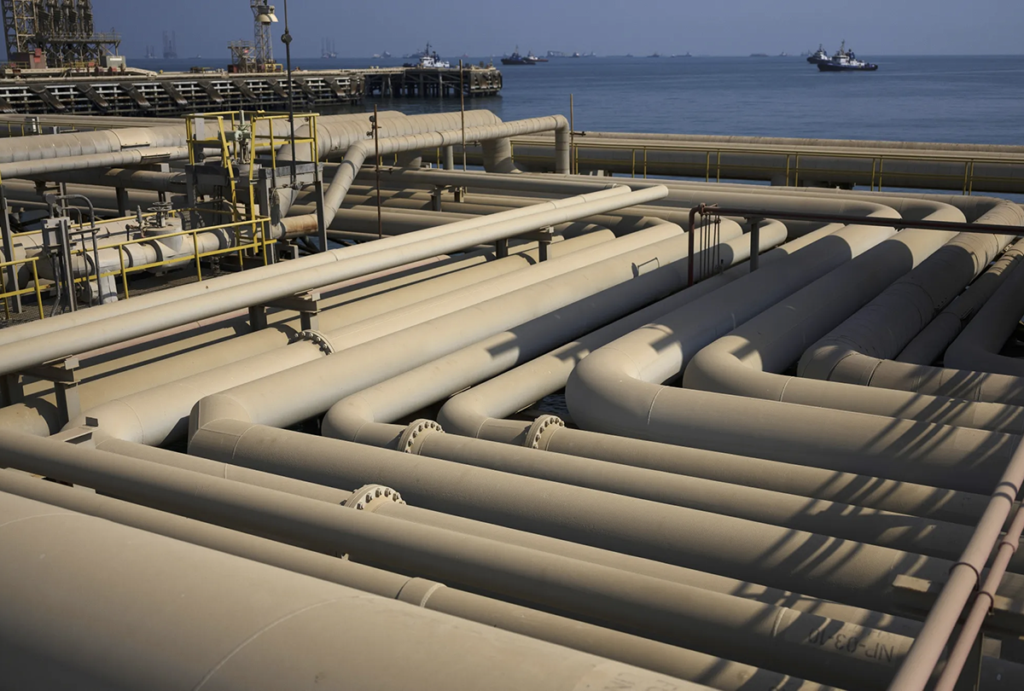
The Ras Tanura oil refinery and oil terminal in Saudi Arabia Photographer: Simon Dawson/Bloomberg
Oil and gas markets have been rocked by disruption to supply out of the Persian Gulf. Prices of both commodities have jumped since the US and Israel began their strikes on Iran.
Iran’s retaliation has involved the targeting of energy infrastructure across the Gulf, interrupting production and prompting closures as a precautionary measure. More significantly, tanker traffic through the Strait of Hormuz — a narrow waterway that handles around a quarter of global seaborne oil trade and a fifth of liquefied natural gas supply — has plunged to a near halt. Oil producers in the region, including the biggest, Saudi Arabia, are reducing output as storage fills up in onshore tanks and vessels at sea.
Iran War Has Driven Up Oil and Gas Prices
Traders have been rattled as exports and energy infrastructure are disrupted across the Persian Gulf
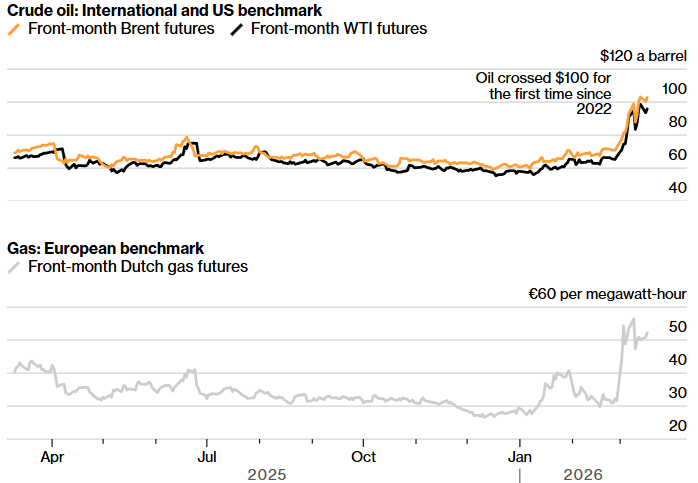
Note: Data as of March 17, 2026
Source: ICE, Nymex
What’s at stake for the oil market?
The war is causing “the largest supply disruption in the history of the global oil market,” according to the International Energy Agency. The Strait of Hormuz is a chokepoint for the bulk of oil exports from states around the Persian Gulf. Almost 90% of the crude and condensate transported through the waterway last year went to Asia.
Saudi Arabia can bypass Hormuz to a certain degree. It’s accelerating flows of oil through its East-West pipeline to the Red Sea port of Yanbu. This route carries its own risks, as the Iran-backed Houthi militants in Yemen have threatened to resume attacks on vessels in the Red Sea. Iran itself could target Yanbu. The United Arab Emirates has already suffered disruption from drone attacks at its Hormuz workaround, the port of Fujairah, which sits at the end of a pipeline that connects the UAE’s oil fields to the Gulf of Oman.
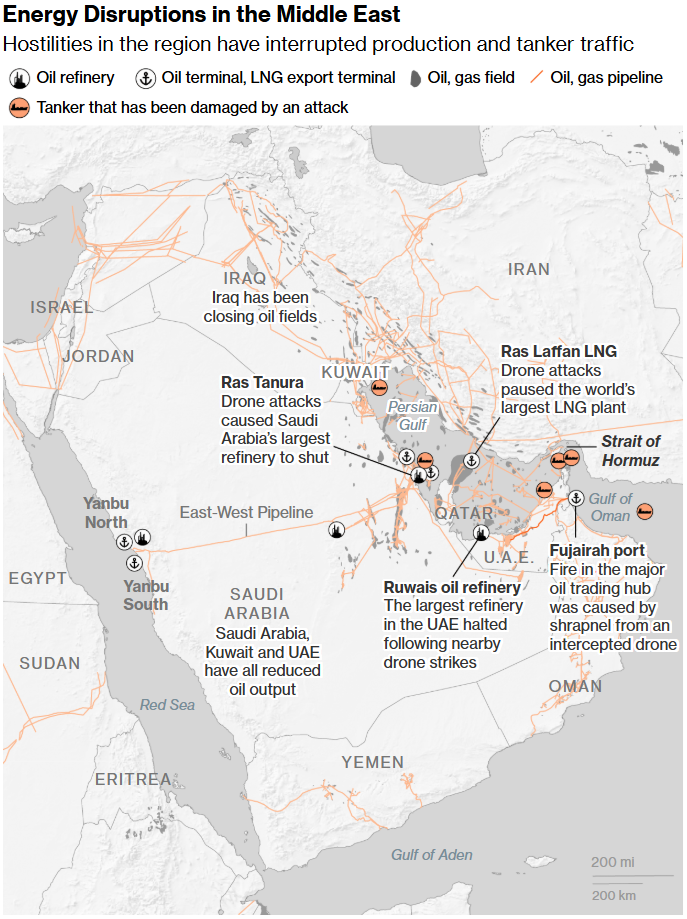
Sources: Bloomberg reporting, Institute for the Study of War and AEI’s Critical Threats Project; US Central Intelligence Agency; US Department of Energy
How are the US and oil importers reacting to the disruption?
Members of the IEA have agreed to release more than 400 million barrels of crude and oil products into the market from their emergency reserves — more than double the volume discharged to contain the price spike after Russia’s full-scale invasion of Ukraine in 2022. However, these barrels won’t all hit the market at once, and will likely only cover a portion of Gulf supply that’s being lost each day.
A resumption of traffic through the Strait of Hormuz is key. Iran has targeted ships in the region, and most shipowners aren’t sending vessels through the waterway for fear of losing their crews, cargoes and tankers. Some governments have been negotiating safe passage, allowing a trickle of ships to make the journey.
While the US is considering providing naval escorts, Energy Secretary Chris Wright has said that the navy will probably only be ready to do so by the end of March. President Donald Trump has called on countries in Europe and Asia to help restore traffic through the strait, arguing that the US shouldn’t bear the burden of protecting a route that other economies rely on for their energy. But there’s limited appetite among those nations to send ships to the region and risk being pulled into the wider war.
As Gulf oil supply is squeezed, buyers in Asia have turned to US barrels. Russian crude is also being snapped up, in particular by Indian refiners, after the Trump administration temporarily eased sanctions on cargoes already at sea.


Are there impacts for oil beyond crude?
The supply of refined petroleum products has been disrupted as well. Prices have increased for diesel, gasoline, jet fuel, shipping fuel, naphtha — used to make plastics and road fuel — and more.
Higher costs and tight supply will ripple across sectors, including freight transportation, aviation, agriculture and construction. Voters paying more at the pump could add to domestic pressures for Trump and his Republican Party, as affordability is set to be a key issue in the midterm elections later this year.
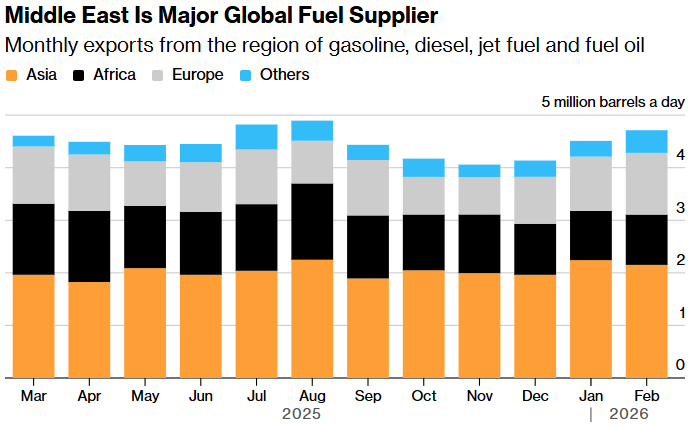
Source: Kpler
In Asia, which is particularly reliant on Gulf oil and petroleum products, suppliers of shipping fuel to cooking gas are beginning to cut back on sales to manage shrinking stockpiles. Governments are taking steps to help consumers with costs and conserve fuel. China has told its largest oil refiners to suspend exports of diesel and gasoline, according to people familiar with the matter.
How is the Iran conflict affecting the gas market?
The market is at risk of its biggest shock since Russia’s full-scale invasion of Ukraine upended global gas trade and sent Europe rushing to find alternative sources. Gas futures in Europe nearly doubled in the days after the Iran conflict began, hitting their highest levels since 2023.
The Middle East is a significant supplier of LNG thanks to Qatar, which was the second-largest producer last year after the US. QatarEnergy halted activity at the world’s biggest LNG export facility after it was targeted in an Iranian drone attack. The Ras Laffan plant accounts for around a fifth of global supply.
Most of the LNG exported from the Middle East is purchased by countries in Asia. If those buyers are unable to source cargoes from the Middle East — whether it’s due to shipping disruptions or production outages — it will increase competition for LNG produced elsewhere and push up prices worldwide.
That’s bad news for Europe. The region is exiting the colder months with unusually low levels of gas in storage, so it needs to import large volumes of LNG to replenish its inventories before next winter. That task could be more expensive in the face of greater competition from Asia.
Natural gas is also a key input for fertilizers. The war has disrupted the production of these crop nutrients in the Gulf, as well as manufacturing in other countries that rely on Middle Eastern LNG. Higher fertilizer prices could feed through to increased food costs.
US LNG producers stand to benefit from the current turmoil in the Gulf and any lingering concerns about the vulnerability of Middle East supply once the war is over. The gains in the short term will likely be limited as American export terminals are already operating near full capacity. New US LNG facilities set to start this year can only partially replace Qatari gas, so some consumers may have to cut their usage or find substitutes — if they can.
How important is Iran to global energy markets?
Oil exports remain a central pillar of Iran’s economy, despite years of the country trying to diversify its growth drivers. But Iran’s influence in the global oil market has waned due to prolonged international sanctions, limited foreign investment and aging infrastructure.
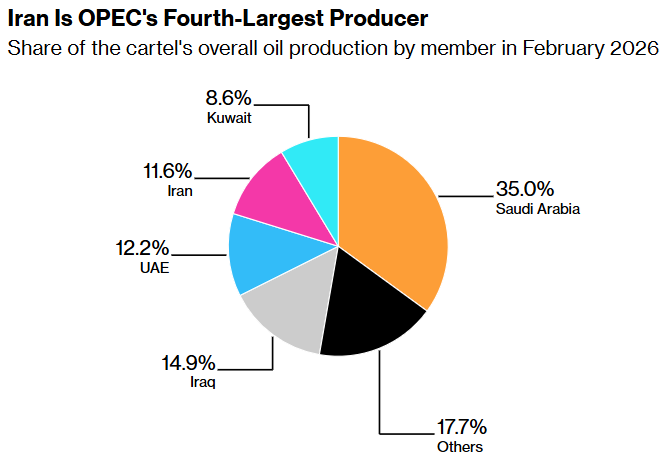
While it’s the fourth-largest producer in OPEC, it only churns out around 3 million barrels of crude a day, equivalent to 3% of the world’s output. About 90% of the country’s oil exports go to China, largely to independent refiners, who are willing to buy the sanctioned crude at a steep discount.
Source: Bloomberg
Iran has managed to keep shipping out at least some of its oil since the war began. However, its export operations are highly vulnerable to attack as they’re concentrated at the Kharg Island terminal in the northern Persian Gulf. While the US said it spared oil infrastructure from its recent bombing of the island, Trump indicated that those assets could be targeted in the future. Crude shipments from Kharg are continuing as normal following the strikes, according to Iran’s semi-official Fars news agency.
Share This: