CDN NEWS |
  US NEWS







Automaker is cancelling a planned electric F-Series truck and shifting production toward gas and hybrid vehicles
By Keith Naughton and Gabrielle Coppola
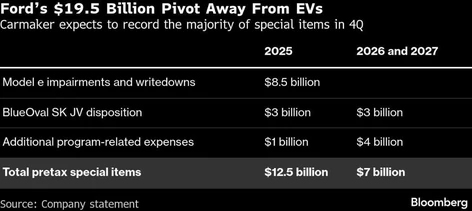
Ford Motor Co. will take $19.5 billion in charges tied to a sweeping overhaul of its electric vehicle business after struggling for years to make it profitable.
The majority of the charges will come in the fourth quarter, Ford said Monday in a statement. As part of the strategic shift, the automaker is canceling a planned electric F-Series truck, shifting production toward gas and hybrid vehicles and repurposing an EV battery plant.
Ford will also convert its signature electric F-150 Lightning pickup into an extended-range hybrid vehicle.
The magnitude of asset impairments and writedowns is a testament both to the degree of difficulty Ford has had trying to profitably build and sell EVs, and the extent to which U.S. President Donald Trump’s policy changes will only exacerbate those challenges.
In taking the charges, Ford is acknowledging it built far too much battery production capacity and was going down a dead-end with large EVs that were destined to lose more money.
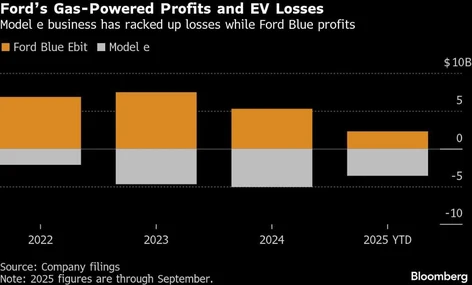
The moves will make Ford’s EV operations profitable by 2029, Andrew Frick, head of the unit, told reporters in a briefing. The division lost US$5.1 billion last year and the company expects losses could be worse this year.
“It didn’t make sense to keep plowing billions into products that we knew would not make money,” Jim Farley, Ford’s chief executive, said in an interview on Bloomberg TV. “We had to make this choice.”
The automaker boosted its 2025 guidance to US$7 billion before interest and taxes, up from a prior estimate of US$6 billion to US$6.5 billion. Farley attributed the increase to the progress Ford has made in lowering costs and its move “to more profitable vehicles.”
Ford shares rose one per cent in extended New York trading at 6:18 p.m. The stock had risen 38 per cent so far this year.
After many pivots and false starts, Ford now has a plan that pares back its exposure to EVs, while capitalizing on growth in hybrids, said Sam Abuelsamid, vice-president for market research at Telemetry, a Detroit-based consultant.
“This is probably the plan that will see them through to the end of the decade, with lots of focus on hybrids and” extended range electric vehicles, Abuelsamid said. “Ford’s perpetual problem is actually executing. They come up with lots of good plans, but then actually building the stuff seems to be more difficult.”
A new bet on batteries
Farley has predicted consumer demand for plug-ins will fall by half after Trump ripped up most of Joe Biden’s policy platform. Now companies are trying to find ways to limit the financial damage caused by idle plants. In October, General Motors Co. took US$1.6 billion in charges to write down EV assets.
One of the most promising options is converting EV battery plants to produce cells for stationary storage, where demand is booming thanks to growth in AI data centers and needed upgrades to the power grid. Utility-scale battery storage rose 50 per cent during the first 10 months of this year to nearly 39.3 gigawatts from the end of 2024, U.S. Energy Information Administration preliminary data show.


Storage cells can eke out more usage from the existing grid because big new power plants can’t be built fast enough to serve data campuses that use as much power as cities.
But to make a profit on the capital-intensive, technically challenging business of cell-making, manufacturers have argued that manufacturing tax credits are critical to make the plants economically viable.
Ford is halting production at its Glendale, Kentucky, electric vehicle battery plant, which will undergo a US$2 billion conversion to produce cells for energy storage to power the electric grid. The plant’s 1,600 workers will be laid off during the conversion, but Ford plans to hire 2,100 people to support its energy storage business when the facility reopens in 2027.
The automaker is taking control of side-by-side battery plants in Glendale, Kentucky, following the break-up last week of a joint venture with South Korean battery maker SK On. Just one of those plants is operating and Ford will switch its output to the lower cost lithium iron phosphate cells utilizing a licensing agreement it has with Chinese battery maker Contemporary Amperex Technology Co. Ltd. Those batteries will be sold solely for energy storage.
Its Marshall, Michigan, plant will now also build LFP cells for energy storage as well as a new line of small, lower cost EVs coming in 2027.
Leaning into gas and hybrids
Farley insisted Ford will still be able to compete against low-cost Chinese EV makers like BYD Inc., with those vehicles, which will start around US$30,000.
“We’re not going to cede our future to the Chinese,” Farley said, adding that Ford’s new line of lower cost EVs will be profitable.
Ford plans to convert a factory under construction in Stanton, Tennessee — its first new assembly plant in half a century — to build gas-powered trucks rather than pure electric pickups. The Tennessee truck plant will build a new model that’s not currently in the automaker’s lineup of small, medium and large pickups, the company said. Ford delayed the startup of that factory to 2029, from a previous plan to open in 2028 — which had been previously pushed back.
The company said the majority of the US$19.5 billion in special items will be recognized in its fourth-quarter earnings, with the remainder in 2026 and the following year. The company expects about US$5.5 billion of cash impact from the charges, paid primarily next year.
While impairment charges of this size are rare in corporate America, they’re not unprecedented. In March, Volkswagen’s top owner posted charges of about €20 billion (US$21.7 billion) for fiscal 2024 due to deteriorations in its investment holdings. Exxon Mobil Corp. incurred its biggest writedown in its modern history in 2020 — losses of up to US$20 billion — as it reeled from a collapse in energy prices.
Ford said that by 2030, it expects half of its global sales volume will come from hybrids, extended range electric vehicles and pure EVs, up from 17 per cent now.
“These are big decisions that we believe will pay off for years,” Frick said. “Rather than spending billions more on large EVs that now have no path to profitability, we are allocating that money into higher returning areas.”
With assistance from Josh Wingrove, Naureen S. Malik and Jeremy R. Cooke.
Bloomberg.com
Share This: