CDN NEWS |
  US NEWS







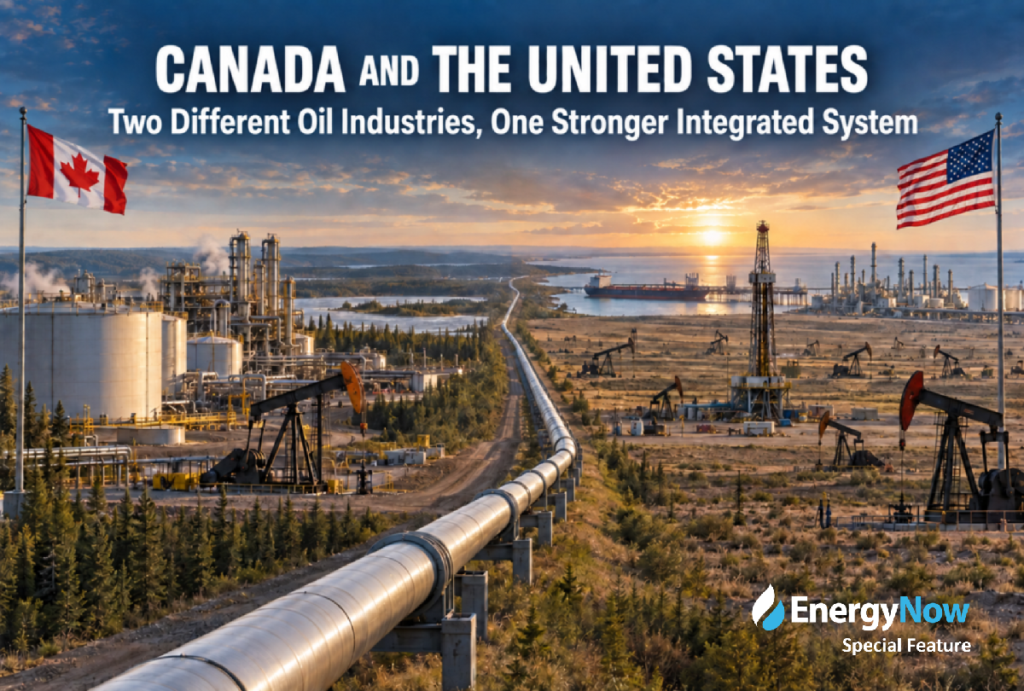
EnergyNow Media Feature
The two countries compete for investment and market share, but their oil industries are more complementary than competitive
The United States and Canada operate two of the world’s largest oil industries. The United States is the world’s leading crude oil producer, while Canada ranks among the top four and possesses one of the largest proven oil reserves.
On the surface, the two countries appear to be competitors. Both produce millions of barrels per day, compete for investment capital and sell crude into international markets. In practice, however, their industries have developed into a deeply integrated continental system.
The United States primarily produces large volumes of light, sweet crude from shale formations. Canada’s production is increasingly dominated by heavier crude from the oil sands. Many American refineries were designed specifically to process the type of heavy crude Canada produces.
That complementarity allows North America to match different crude qualities with the refineries best equipped to process them.
Two Very Different Production Profiles
The scale of the American industry is unmatched. U.S. crude production reached approximately 13.7 million barrels per day in 2025 and is forecast by the U.S. Energy Information Administration to average about 13.8 million barrels per day in 2026—another record. Nearly half comes from the Permian Basin of Texas and New Mexico. EIA data
Canada produced an average of 5.5 million barrels per day in 2024, followed by additional growth in 2025. The Canada Energy Regulator says Canadian production has established a new record every year since 2021. CER outlook
The most important difference is how that oil is produced.
United States
- Dominated by light and medium crude from tight-oil formations.
- Production is led by the Permian, Bakken and Eagle Ford.
- Shale wells can be drilled and completed relatively quickly.
- Production responds comparatively rapidly to oil prices.
- The Gulf of Mexico contributes almost two million barrels per day from longer-life offshore projects.
- Alaska and conventional fields provide smaller but strategically important volumes.
Canada
- Dominated by Alberta oil sands mining and in-situ production.
- Also includes conventional and tight oil from Alberta, Saskatchewan and British Columbia.
- Offshore Newfoundland and Labrador produces valuable light crude.
- Oil sands projects require much larger upfront investments and longer development periods.
- Once operating, oil sands facilities can produce for several decades with relatively low decline rates.
The U.S. industry is more responsive; the Canadian industry is generally more durable.
A shale producer can reduce drilling when prices fall, but production from individual wells declines quickly unless new wells are continually added. An oil sands facility is expensive to build, but once constructed it operates more like a manufacturing complex, producing relatively predictable volumes over a long period.
Where Does The Oil Go?
The United States has a major advantage in market access. Its producers are connected to the world’s largest domestic petroleum market, extensive pipeline and storage infrastructure, sophisticated trading hubs and large export terminals along the Gulf Coast.
American light crude is exported primarily to refineries in Europe and Asia. U.S. producers can access overseas buyers from Texas and Louisiana without crossing another country or relying upon a single export corridor.
Canada’s market position is more complicated.
Historically, the overwhelming majority of Canadian crude exports moved to the United States. The U.S. imported approximately 4.1 million barrels per day of Canadian crude in 2024, making Canada by far its largest foreign supplier. EIA trade analysis
The Trans Mountain Expansion has improved Canada’s position by nearly tripling the pipeline’s capacity to 890,000 barrels per day. According to the CER, the project increased total western Canadian export-pipeline capacity by approximately 13% and tidewater capacity on the West Coast by about 700%. CER market snapshot
This provides greater access to California, Washington State and Asian markets. Nevertheless, the United States remains Canada’s dominant and most economically natural customer.
Why Canada still exports oil to a record-producing United States
It can seem contradictory that the world’s largest oil producer still imports millions of barrels of Canadian crude. The explanation is crude quality and refinery configuration.
Much of the growth in American production has been light, sweet oil. Many large refineries in the Midwest and Gulf Coast were built or upgraded to process heavier, higher-sulphur crude historically imported from Mexico, Venezuela and the Middle East.



These facilities contain cokers and other equipment capable of turning discounted heavy crude into gasoline, diesel, jet fuel and other higher-value products. Canadian heavy oil is therefore not a direct substitute for much of America’s shale production.
The continental system effectively works like this:
- Canada supplies dependable heavy crude to complex U.S. refineries.
- The United States produces abundant light crude for domestic and overseas refineries.
- American refiners process Canadian crude into fuels for both domestic use and export.
- Integrated pipelines reduce transportation costs and exposure to overseas shipping disruptions.
- Storage, trading and refining hubs allow barrels to move toward the markets where they have the greatest value.
In some cases, the United States can import Canadian heavy oil while simultaneously exporting American light oil. That is not an inefficiency—it is crude-quality optimization.
Advantages Held by Each Industry
Canada’s Advantages
Canada has an enormous, long-life resource base concentrated in a politically stable country. Its principal advantages include:
- Multi-decade oil sands reserves and predictable production.
- Low geological risk in established oil sands deposits.
- Decline rates below those of shale wells.
- A secure land-based relationship with the world’s largest oil market.
- A highly skilled workforce and established technical expertise.
- Growing Pacific access through Trans Mountain.
- Transparent laws, contracts and environmental regulation.
Canada’s production is also unusually reliable. Unlike some major exporters, Canadian volumes are not routinely interrupted by civil conflict, sanctions, military action or OPEC production decisions.
United States’ Advantages
The American industry benefits from:
- The world’s largest and deepest oilfield service sector.
- Rapid drilling, innovation and deployment of new technology.
- Extensive pipelines, storage facilities and export terminals.
- Large domestic refining and petroleum markets.
- Strong access to capital and commodity-risk management.
- Multiple prolific regions rather than dependence on one producing area.
- The ability to increase or reduce shale drilling comparatively quickly.
The U.S. also controls several globally important oil-pricing, transportation and refining hubs. WTI futures, Cushing storage and the Gulf Coast export system give American producers direct influence over international oil trade.
Why North America Has an Advantage Over Other Producing Regions
Together, Canada and the United States offer a combination few oil-producing regions can match: production scale, resource diversity, political stability, advanced technology, integrated infrastructure and sophisticated refining capacity.
North American supply does not depend on tankers passing through the Strait of Hormuz, the Suez Canal or other distant chokepoints before reaching U.S. refineries. Most Canadian crude arrives through cross-border pipelines operating under long-term commercial arrangements.
Both countries also offer:
- Enforceable contracts and private ownership.
- Publicly traded companies and transparent financial reporting.
- Competitive service and technology sectors.
- Established environmental and worker-safety standards.
- Multiple grades of light, medium and heavy crude.
- The ability to supply both continental and overseas markets.
Neither industry is controlled by a national oil company, and neither government normally assigns production through an OPEC-style quota system. Investment decisions are primarily driven by companies responding to prices and market conditions.
The Weaknesses in Each Industry
Canada’s greatest weakness is market concentration. Even after the Trans Mountain Expansion, it remains heavily dependent on the United States. Limited pipeline competition has historically contributed to wide Western Canadian Select discounts when production exceeded transportation capacity.
Other Canadian challenges include:
- Lengthy regulatory and consultation processes.
- High capital costs for new oil sands projects.
- High emissions intensity at some oil sands operations.
- Limited pipeline access to Eastern Canadian refineries.
- Policy uncertainty involving emissions limits and carbon costs.
- A smaller domestic market and capital pool than the United States.
The U.S. industry has different vulnerabilities:
- Rapid decline rates from shale wells require continuous drilling.
- The best drilling locations are gradually being depleted.
- Consolidation may reduce the number of aggressive independent producers.
- Shale production can respond quickly to falling prices—but can also fall quickly if investment is cut.
- Permitting, water use and local opposition can constrain some producing regions.
- Gulf Coast infrastructure is exposed to hurricanes and severe weather.
- Some U.S. refineries need imported heavy crude despite record domestic production.
The Permian has delivered extraordinary growth, but the concentration of future U.S. growth in one basin is itself a risk. In 2025, the Permian accounted for approximately 48% of total American crude production.
The Stronger System is the Combined System
The United States has the clear advantage in production scale, market access, refining capacity and speed of response. Canada has the advantage in long-life reserves, low decline rates and dependable heavy-oil supply.
Canada would be weaker without access to American refineries. The United States would be less secure—and many of its complex refineries less competitive—without Canadian heavy crude.
The two industries will continue to compete for capital, workers and export customers, but that competition should not obscure the larger reality. Canadian oil sands production, American shale oil, Gulf Coast refining, cross-border pipelines and growing marine exports are components of a single North American oil system.
Its greatest strategic advantage is not that Canada or the United States can produce every barrel each requires. It is that together they can supply an exceptional range of crude qualities, move them through secure infrastructure and refine them within one of the world’s most sophisticated and reliable petroleum markets.
Share This: