


 CDN NEWS |
  US NEWS







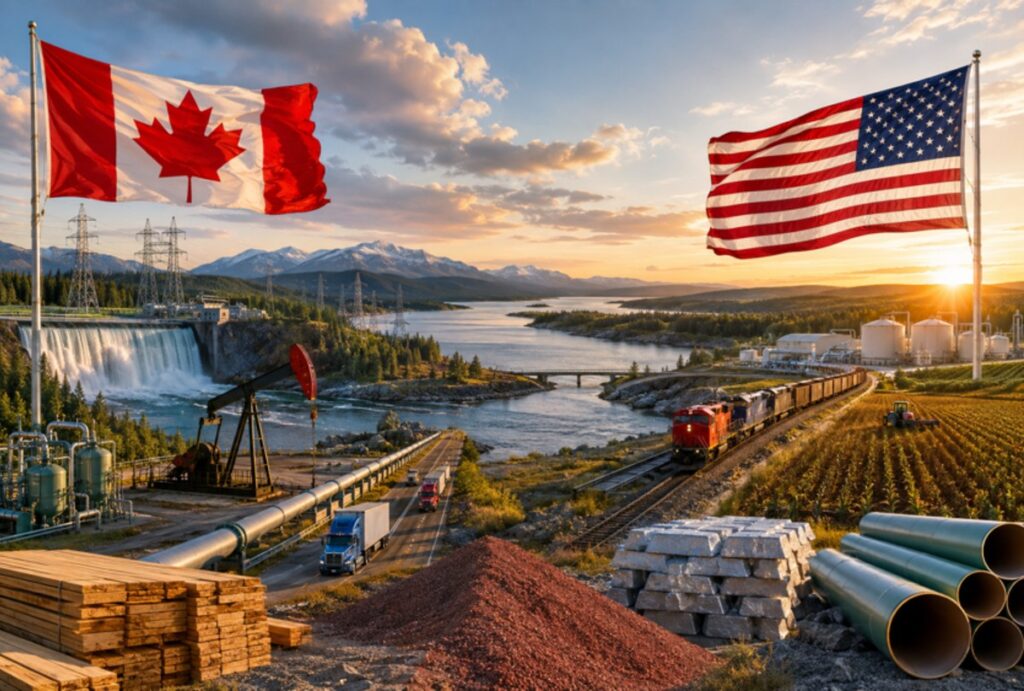
The United States could replace some Canadian resources but almost certainly not as reliably, efficiently or affordably. Canada, meanwhile, cannot afford to forget how much it benefits from American customers, capital and industrial capacity.
President Donald Trump frequently argues that the United States does not need Canadian energy or resources. America, he maintains, possesses more than enough oil, natural gas, timber and minerals of its own.
In theory, the United States could produce more domestically or purchase many of these commodities elsewhere. In practice, replacing Canada would require new mines, pipelines, transmission lines, transportation networks and processing facilities. It would also mean buying more from distant—and sometimes less dependable—suppliers.
That would take years and impose additional costs on American consumers and businesses.
The scale of the relationship is enormous. In 2025, two-way goods trade between Canada and the United States reached approximately US$715.5 billion. The United States exported US$333.6 billion in goods to Canada and imported US$381.9 billion, according to the Office of the United States Trade Representative.
This is not simply a story of American dependence on Canada. It is one of mutual benefit and deeply integrated supply chains.
Oil: Built for American refineries
Canada is the largest foreign supplier of crude oil to the United States. In 2024, American imports from Canada averaged approximately 4.1 million barrels per day, according to the U.S. Energy Information Administration.
Much of this is heavy crude delivered by pipeline to refineries in the Midwest and Gulf Coast specifically configured to process it. Replacing those barrels with lighter American shale oil is not necessarily a direct substitution.
The United States could import more heavy oil from Venezuela, Mexico or the Middle East, but those supplies may be less reliable, more expensive to transport or accompanied by greater geopolitical risk. Canadian oil provides secure, pipeline-delivered feedstock while supporting American refineries, workers and fuel exports.
Canada benefits just as clearly: the United States remains its largest and most valuable energy customer.
Natural Gas and Electricity: Quiet Pillars of Reliability
U.S. natural gas imports from Canada averaged 8.6 billion cubic feet per day in 2025. That supply helps balance markets in the Midwest, Pacific Northwest and Northeast, particularly during severe winter weather.
Electricity moves in both directions across the border, although the United States is generally a net importer. Canadian hydroelectricity provides dispatchable, relatively low-emission power to markets including New York, New England and the Upper Midwest.
America can build additional generation, pipelines and transmission—but not instantly or cheaply. Canada also relies on American gas and electricity in certain regions and during periods of peak demand. The grid already operates as a continental system; forcing it into two artificial halves would weaken both countries.



Potash and Critical Minerals
Approximately 90 per cent of U.S. net potash imports came from Canada in 2023, according to the U.S. Geological Survey. Potash is essential to fertilizer production and American crop yields. Alternative suppliers include Russia and Belarus—hardly an improvement in supply security.
Canada is also an important supplier of aluminum, nickel, zinc, uranium, cobalt and other materials needed for vehicles, aerospace, defence equipment, electricity infrastructure and advanced manufacturing.
The United States should expand its domestic mining and processing capacity. But permitting and constructing new mines can take a decade or longer. Canada offers something strategically valuable: large resource deposits located next door, governed by a stable democracy and connected to American factories.
Lumber, metals and manufacturing
Canadian softwood lumber supplies a substantial share of U.S. demand, particularly for home construction. Tariffs may protect some American producers, but restricting Canadian lumber also raises material costs for builders and homebuyers when housing affordability is already a national concern.
Canadian aluminum and steel feed American automotive, construction, packaging and defence industries. The auto sector is especially integrated: components can cross the border several times before a finished vehicle reaches a dealership. Tariffs imposed at each stage become cumulative costs, not an economic victory.
Canada also supplies agricultural products, seafood, grains, meat, chemicals, paper and manufactured components. In return, Canada purchases American machinery, vehicles, technology, agricultural products and consumer goods.
Fresh Water: Shared, Not Simply Exported
Fresh water requires an important distinction. Canada does not ship vast quantities of bulk water south as an ordinary commodity. However, the two countries share the Great Lakes and numerous rivers and watersheds.
The Great Lakes contain roughly 84 per cent of North America’s surface fresh water and support drinking water, shipping, agriculture, manufacturing, tourism and power generation on both sides of the border. Water security is therefore another area where cooperation—not commercial or political confrontation—is essential.
Interdependence is Not Weakness
Canada would suffer significantly from losing access to the American market. Its economy remains overly dependent on one customer, and the current dispute reinforces the need for more pipelines, LNG terminals, ports and overseas markets.
But American self-sufficiency is also more complicated than a political slogan suggests. Resources are useful only when they can be produced, processed and delivered in the right form, to the right location, at a competitive price.
Canada and the United States are not charitable suppliers to one another. They are customers, investors, competitors and partners whose economic infrastructure has been built together over generations.
Both countries should diversify and strengthen their domestic capacity. Neither should mistake diversification for economic separation.
The smartest path is not dependence at any cost or independence at any cost. It is a more balanced partnership that recognizes an enduring geographical fact: each country’s most secure, efficient and natural trading partner remains the one next door.
Share This:


















COMMENTARY: US Energy Dominance Descends Into Decadence