CDN NEWS |
  US NEWS







By Rakteem Katakey, Paul Burkhardt, Mark Burton, and Yuliya Fedorinova
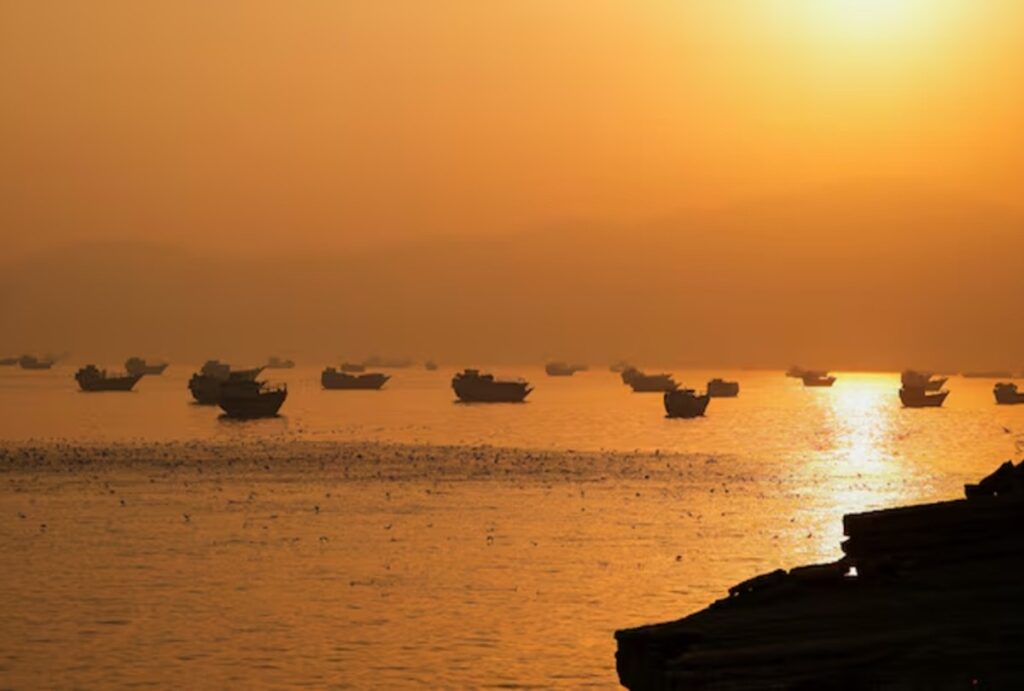
Since the start of the Iran war, Iranian attacks on vessels in the Strait of Hormuz and a US blockade on Iran’s ports have slowed the flow of energy exports and other commodities from the Middle East.
Even if diplomatic efforts succeed in restoring normal traffic to Hormuz, the conflict has exposed the risks of relying so heavily on a single route that can easily be closed or disrupted. While Hormuz will remain critical to the region’s ability to export at full capacity, Gulf countries are looking at a wide range of workarounds to ship out their oil, natural gas, metals and chemicals, goods essential to the global economy.
Governments are investing in pipelines, ports and other export infrastructure to allow exports to bypass the strait. But some of these routes come with risks of their own: Yemen’s Houthi militants have begun targeting tankers in the Red Sea and declared a blockade of the narrow Bab el-Mandeb strait on the sea’s southern end.
Sources: US Central Intelligence Agency, US Department of Energy, Bloomberg News reporting
Crude
Before the war started in February, about 20% of the world’s oil transited Hormuz, split between 15 million barrels a day of crude and another five million barrels of oil products. After the outbreak of war, Saudi Arabia and the United Arab Emirates, which together accounted for more than half of that crude volume, diverted much of their oil to ports sitting outside the Persian Gulf, through pipelines that were built years before.
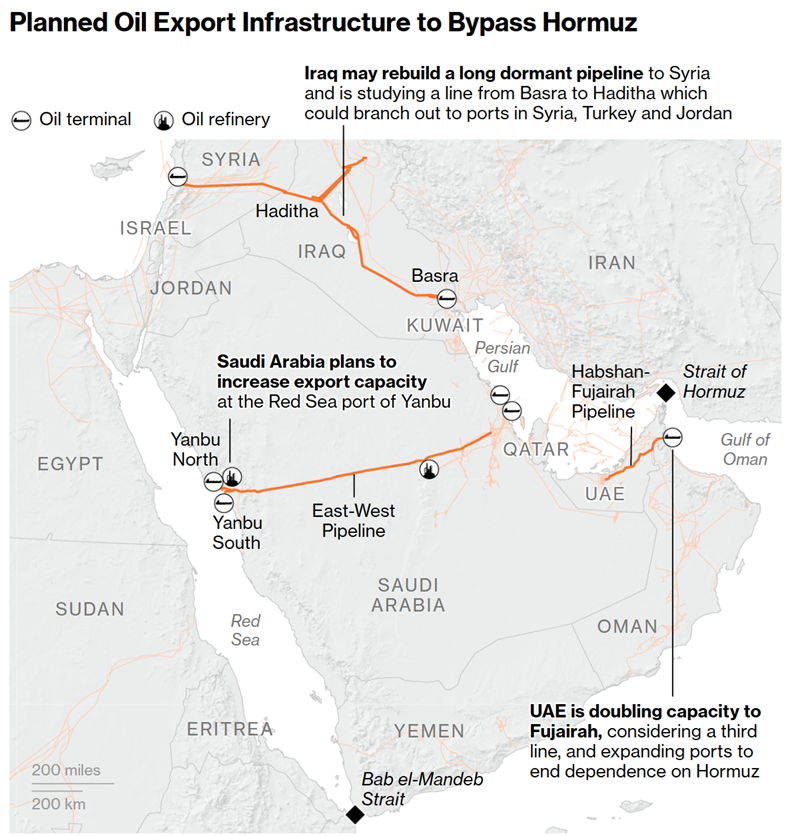
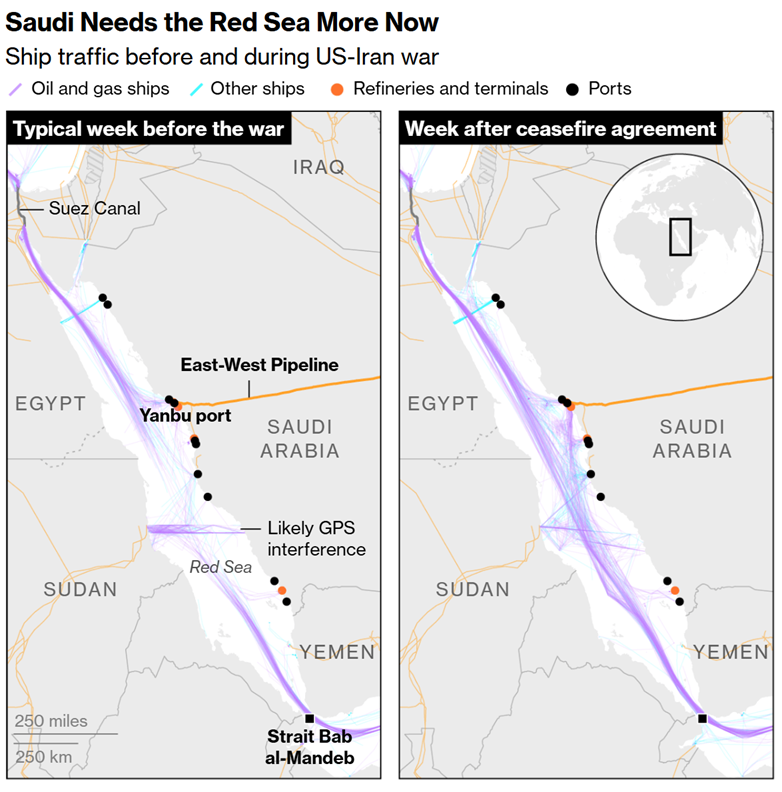
Saudi Arabia’s East-West pipeline has the capacity to transport seven million barrels a day from its oil production heartland to the Red Sea port of Yanbu. Before the war, only two million barrels per day were moving through it, but by the end of March, the kingdom had cranked it up to full capacity. The pipeline now moves close to five million barrels a day for exports and two million for local refineries along the coast, and the country is considering expanding it.
The kingdom also plans to raise export capacity from Yanbu, according to state-controlled oil company Saudi Aramco.
Note: Only tanker, cargo and passenger ships of 5,000 deadweight tons or more are shown. Ship traffic shown before the war from June 21–27, 2025 and the week after ceasefire agreement from June 21–27, 2026.
Sources: Bloomberg (oil refineries and terminals); US Department of Energy Global Oil & Gas Features Database (pipelines); S&P Global Energy and WoodMac data
Those actions represent a solution to the Hormuz problem, but not to the threat posed by Houthi militants in the Red Sea. As a result, some shippers are now experimenting with longer routes. A Saudi crude supertanker bound for Asia in late July crossed the Suez Canal at the northern end of the Red Sea and transited the Mediterranean before continuing around Africa, avoiding Bab el-Mandeb at the cost of a longer and more expensive voyage. But this route, too, appears susceptible to attack: Two liquefied natural gas carriers were struck on July 29 at Egypt’s Damietta port near the mouth of the Suez Canal.
The UAE has also been using its own, smaller pipeline to Fujairah on its eastern coast to bypass Hormuz. Before the outbreak of war, the pipeline was transporting 1.1 million barrels per day, leaving at least a third of its capacity unused, according to the IEA. In June, exports from Fujairah’s terminals, which also draw on a nearby storage complex, climbed to nearly double that level, according to ship tracking data. A new line is scheduled to be completed by early next year, which would increase Abu Dhabi’s transit capacity to roughly four million barrels per day. The government is also considering a third link and has plans for major expansions of ports along the country’s eastern coast that would drastically reduce its dependence on Hormuz, UAE officials have said.
The Saudi and UAE bypass routes have already played significant roles in keeping markets well supplied and preventing even sharper increases in oil prices. Their investments could reduce oil flows through Hormuz to less than half of pre-war levels by 2030, according to Eurasia Group. By keeping crude exports flowing, they’ve also likely ensured that the two countries will be quicker to recover from the economic impact of the war than regional neighbors Kuwait and Iraq.
Kuwait is entirely dependent on passage through Hormuz to export its oil, and the near closure of the strait during the height of the war plunged the country’s production to lows last seen in the early 1990s. It is discussing bypass options with Saudi Arabia.
Iraq, which transported about 90% of its 3.7 million barrels of crude exports per day through Hormuz in 2025, has more ambitious plans. With support from the US, the country is considering rebuilding the Kirkuk-Baniyas pipeline, which has been shut for more than two decades. The pipeline links Iraq’s Kirkuk fields to Syria’s Mediterranean coast. Baghdad is also studying a potential pipeline from its biggest oil production region of Basra in the south to Haditha in the north, from where it could branch out toward Syria, Turkey or Jordan.



Since the outbreak of war, Iraq has been able to export some oil through the Kirkuk-Ceyhan pipeline, which connects Kirkuk to Turkey’s Ceyhan port on the Mediterranean. Though the pipeline’s technical capacity is 1.5 million barrels per day, exports were running only at about 180,000 barrels per day in June, the director general of Iraq’s State Oil Marketing Organization said at the time. In early August, Iraq and Turkey reached a deal to continue using the pipeline and increase flows through it.
The plans from Saudi Arabia, the UAE and Iraq are expensive propositions, requiring multibillion-dollar investments to build and then maintain them for years to come. Investors will need to consider political and security-related risks because these pipelines cross international borders and areas where militant groups remain active, making them vulnerable to attacks.
Liquefied natural gas
About a fifth of the world’s LNG supply moved through Hormuz before the war. The majority of it came from Qatar, which operates the world’s biggest export facility, Ras Laffan, in the northeast of the country. The UAE also exported LNG from its much smaller plant.
Unlike oil, however, it is difficult to transport LNG through pipelines. The fuel is made by turning natural gas into liquid at -162C (-260F), requiring specialized tankers to keep the fuel in that state during transport. Maintaining long-distance pipelines at such temperatures would be very expensive. That leaves LNG exporters heavily dependent on Hormuz for the foreseeable future.
It is possible for countries to build pipelines to transport the fuel in gas form before converting it into liquid form at plants outside Hormuz, but that would require the building of new liquefaction plants, and make redundant massive existing plants inside the Persian Gulf. Both Qatar and the UAE began investing billions of dollars before the war in their LNG export capacity within the Gulf.
Petroleum products
Before the war, the Middle East was transporting about 5 million barrels a day of refinery products such as gasoline, diesel, jet fuel and liquefied petroleum gas through Hormuz, mostly bound for Europe. The shuttering of Hormuz and Iranian attacks on several refineries across Saudi Arabia, the UAE, Kuwait and Bahrain severely constrained those flows. According to BloombergNEF, the war has knocked out as much as 40% of oil processing capacity. Refineries such as Abu Dhabi’s Ruwais and Saudi Arabia’s Ras Tanura, some of the world’s biggest, were damaged in attacks.
Efforts underway to repair the damage and ramp up output, along with Riyadh’s plans to raise export capacity at Yanbu, could help restore oil product shipments. In addition, a UAE official said in June that one of its planned new pipelines might be used to transport oil products, which could theoretically then be sent out from ports in the Gulf of Oman. The UAE plans to expand those ports.
Iraq has been sending out fuel oil — petroleum products used widely in ships and power plants — on thousands of trucks across the border to Syria, making the port of Baniyas on the Mediterranean a major hub for the product. But these volumes are far smaller than what tankers can transport through Hormuz, making sea voyages the most likely route to keep transporting the bulk of cargoes in the future.
Aluminum
The Middle East accounts for nearly a 10th of global aluminum production, and smelters in the region — particularly those in UAE, Bahrain and Qatar — have an even more outsized role as suppliers of specialized aluminum products used extensively in car-making, construction and aerospace.
The war’s overall supply impact on the market for commodity-grade aluminum has been partially blunted by logistical workarounds in the Persian Gulf. The effective halt on incoming flows into the Gulf of raw materials such as alumina, the key raw material used in aluminum smelting, threatened widespread smelter shutdowns in the region, but as the war has dragged on, producers have managed to stabilize raw material supplies via imports from alternative ports. Oman in particular has served as a key logistics hub where bulk vessels unload cargoes of alumina that can be trucked inland to smelters in the Gulf.
Still, regional producers have had to curtail capacity, and restoring full output could prove difficult while disruptions to Hormuz flows continue.
Fertilizers
The Persian Gulf is home to some of the world’s largest nitrogen and phosphate fertilizer producers, including Qatar Fertiliser Co., Fertiglobe Plc and Saudi Basic Industries Corp., and Iran itself was also a significant exporter before the war. Roughly one-third of global seaborne fertilizer trade passed through Hormuz before the outbreak of the conflict.
The war initially sent nitrogen and phosphate fertilizer prices to multiyear highs as farmers in the Western Hemisphere were preparing for seasonal fertilizer applications. Although prices returned to a more normal range after the Strait was briefly reopened, the market has remained tight since tensions flared again in July.
The renewed uncertainty comes at a particularly sensitive time: import demand from major Southern Hemisphere agricultural producers such as Brazil and Argentina is accelerating ahead of the planting season.
While the UAE’s state-backed fertilizer producer, Fertiglobe, is rerouting some exports over land to ports on the Gulf of Oman, this alternative is significantly more expensive, more logistically complex, and offers limited capacity. Saudi Arabia has started to rely on Red Sea routes to ship some fertilizer exports, though the resumption of Houthi attacks has also heightened risks along this corridor. As a result, the uninterrupted flow of maritime traffic through Hormuz remains critical to maintaining a stable global fertilizer supply.
— With assistance from Tom Fevrier
Share This: