CDN NEWS |
  US NEWS







By Melissa Garside | Design Cynthia Tran Vo
Key Takeaways
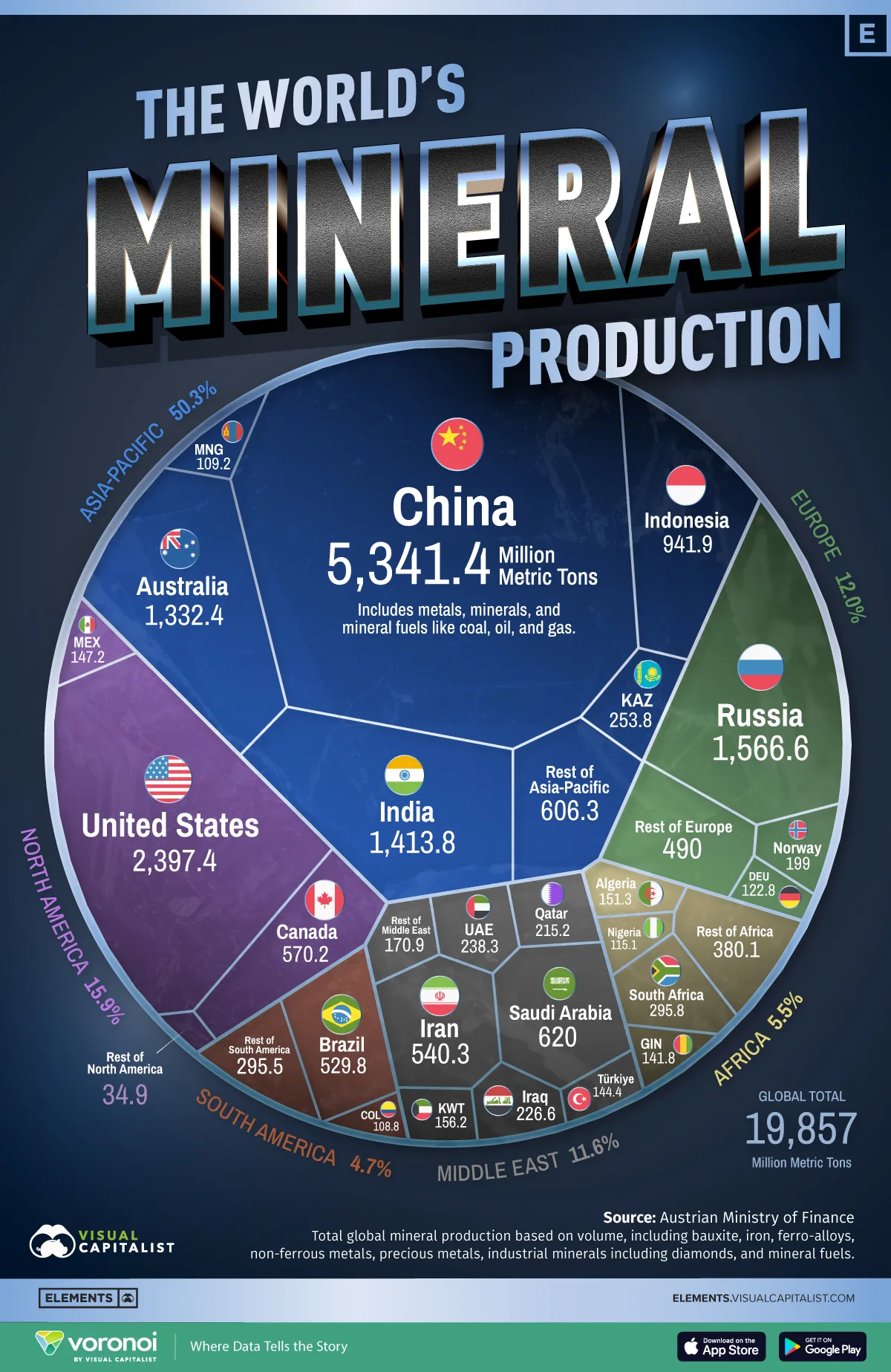
- China produced 5.3 billion metric tons of minerals in 2024—26.9% of the global total.
- The top five producers accounted for 61% of global mineral production.
- Asia-Pacific generated just over half of the world’s mineral output.
Minerals are essential to energy systems, construction, manufacturing, and advanced technologies. Yet production is highly concentrated among countries with large resource endowments and major fossil fuel industries.
This visualization ranks global mineral production by country in 2024, measured by total production in metric tons. The data comes from the Austrian Ministry of Finance and includes all metals, industrial minerals such as bauxite and diamonds, and mineral fuels such as coal, crude oil, and natural gas.
Because this analysis is based on production volume, the rankings reflect total tonnage rather than the value of mineral output. This means bulk commodities such as coal carry much more weight than precious metals like gold.
China Leads Global Mineral Production With Coal
China led global mineral production by a wide margin in 2024, producing 5.3 billion metric tons, or 26.9% of the global total. Most of this volume came from coal production, which reached nearly 4.8 billion metric tons.
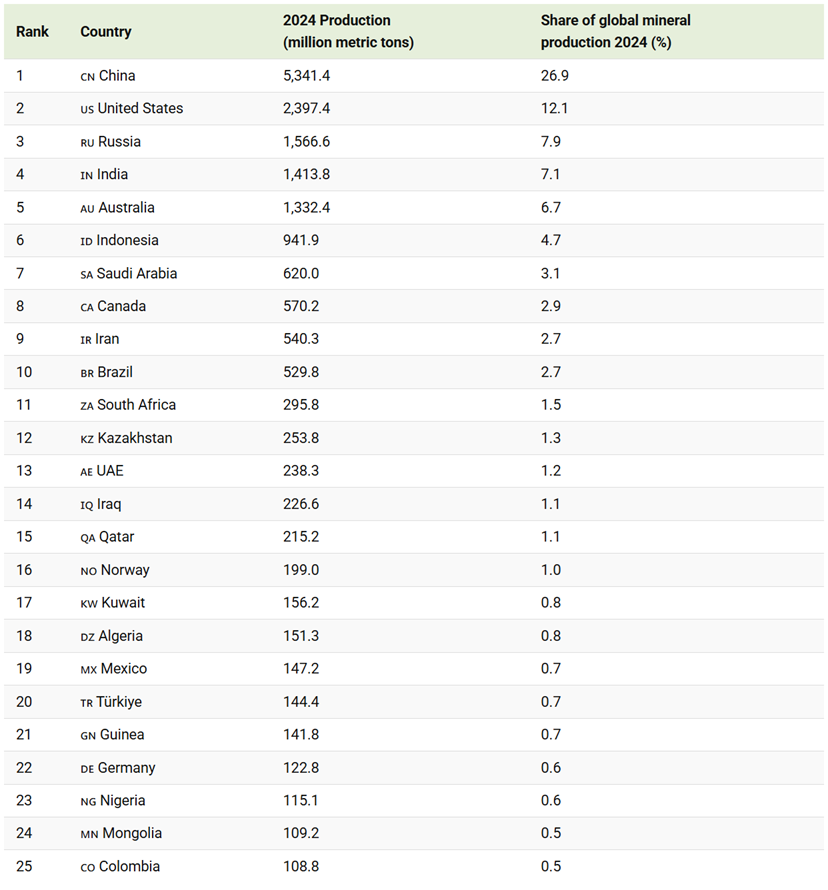
The United States ranked second with 2.4 billion metric tons, or 12.1% of the global total, less than half of China’s output. Its high ranking reflects substantial fossil fuel production, particularly its world-leading crude oil and natural gas output.
Russia, India, and Australia rounded out the top five. Russia is a major producer of fossil fuels, gold, and base metals, while India is the world’s second-largest coal producer. Australia leads global production of bauxite, iron ore, and lithium.



Several other major energy producers appear in the top 10. Saudi Arabia produced 620 million metric tons, while Iran produced 540.3 million metric tons, reflecting the inclusion of mineral fuels in the dataset. Indonesia ranked sixth and is both a major fossil fuel producer and the world’s leading nickel producer.
Asia-Pacific Produces Half of the World’s Minerals
Asia-Pacific accounted for 50.3% of global mineral production in 2024, equal to nearly 10 billion metric tons. The region’s total was driven by China, India, Australia, and Indonesia.
Even excluding China, Asia-Pacific produced 4.7 billion metric tons, or 23.4% of the global total, showing that its lead extends beyond a single country.
North America ranked second with 15.9% of global production, followed by Europe at 12.0% and the Middle East at 11.6%.
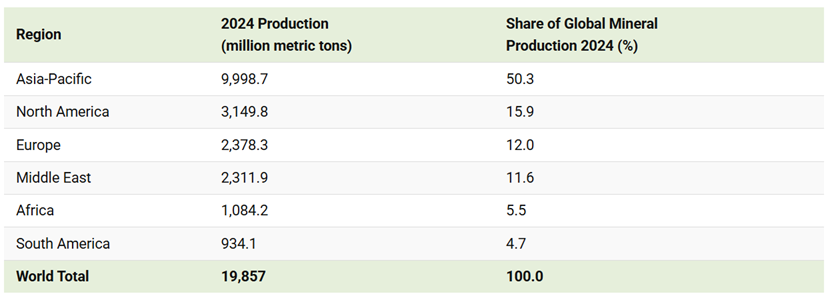
Africa accounted for 5.5% of total output despite being a major producer of lower-volume commodities such as cobalt and platinum-group metals. South America, a leading region for copper and lithium, represented 4.7%.
Global Mineral Production Is Highly Concentrated
The top 25 countries accounted for nearly 90% of global mineral production in 2024. On a volume basis, most of the world’s output therefore comes from a relatively small group of producers.
This concentration reflects differences in geology, energy reserves, industrial capacity, and the scale of domestic demand. It also means that major producers remain central to global supply chains for energy, infrastructure, and manufacturing.
Share This: