CDN NEWS |
  US NEWS







Summary
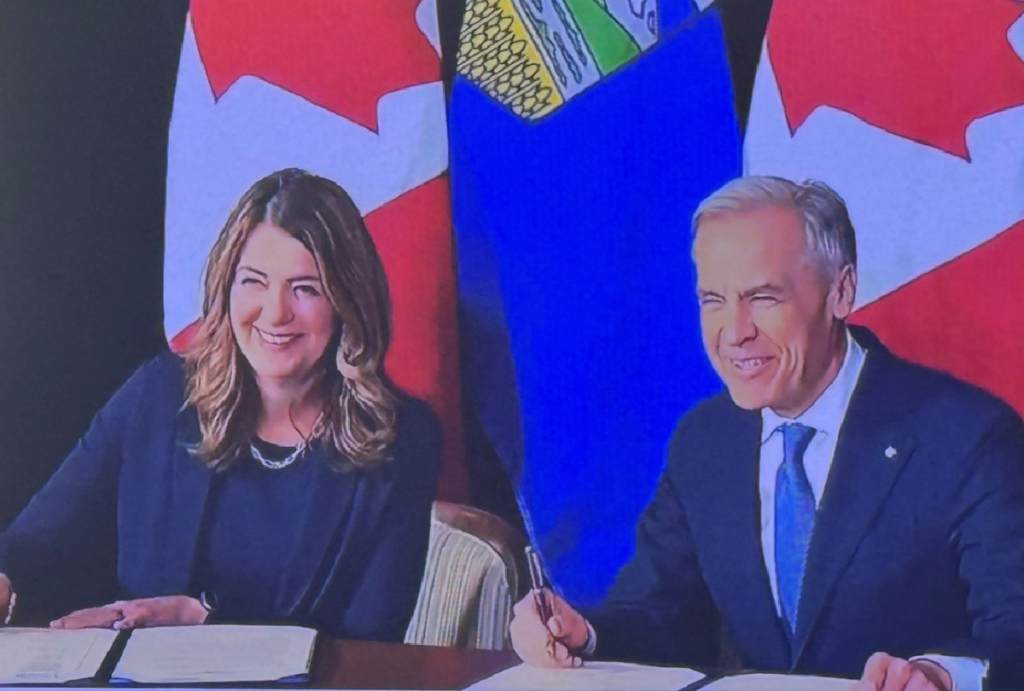
- Agreement Signing: The implementation agreement for the West Coast oil pipeline signed today, outlines a pathway to construction beginning as early as September 01, 2027.
- Pipeline Submission: Alberta will submit the comprehensive pipeline proposal to the Federal Major Projects Office (MPO) by July 01, 2026.(Canada Day).
- Project Designation: Canada will pursue national interest designation for the pipeline under the Building Canada Act by October 1, 2026.
- Industrial carbon price will remain at $95/ton until end of 2026.
- Increase by $100 over the next three years, reaching $130/ton by 2035.
- Target for effective carbon price is $130/ton by 2040, with binding annual benchmarks.
- Avoids previous federal plan of $170/ton by 2030.
- Compliance Cost Savings: Alberta industry partners will save approximately $250 billion in compliance costs over the next two decades, through to 2050.
- Methane Emissions: Agreement aims to reduce methane emissions from oil and gas by 75% below 2014 levels by 2035.
- Carbon Contracts: 75 million tons of carbon contracts for difference will be issued to support major carbon capture and emission reduction projects, with costs shared equally between Alberta and Canada.
- Job Creation: Package expected to generate up to 50,000 jobs in Alberta and across Canada.
- GDP Growth: Carbon capture and storage initiatives projected to generate over $16 billion in GDP.
- Electricity Working Group: Establishing a group with the federal government to explore new low emissions technologies (nuclear, geothermal, abated natural gas, wind, solar, hydrogen).
- Impact Assessment & Methane Equivalency: Key agreements with the federal government on cooperation and methane equivalency expected to be finalized in 2026.
- Oil Sands Alliance: Both governments remain committed to advancing the world’s largest carbon capture, utilization, and storage project.
Premier Danielle Smith Press Conference Statement
I’m happy to share with Albertans that we’ll be signing an agreement today that clearly sets out a pathway to the construction of a new oil pipeline to Asian markets, commencing as early as September 1, 2027.
The proposed West Coast oil pipeline would transport more than 1 million barrels of oil per day. This landmark agreement builds on the collaboration between the federal and provincial governments following the signing of the Alberta Canada Energy Agreement, which was signed in November of 2025.
Our governments have agreed to make targeted changes to our respective environmental policies that will lead to tangible outcomes that reduce regulatory uncertainty and create the conditions necessary for Alberta to significantly increase its energy production and exports to Asian and other markets.
Today’s implementation agreement also results in Alberta avoiding a significant increase to the federally mandated industrial carbon price, saving Alberta’s industry partners approximately $250 billion in compliance costs over the next two decades to 2050 under the new carbon pricing agreement.
The industrial carbon price will be substantially lower than the previous federal policy, which would have required a carbon price of $170 per ton by 2030. The headline carbon price will be substantially rolled back. It will stay at $95 until the end of this year, and then it will increase by $100 for the next three years, and reach 130 per ton by 2035.
This gives industry the time and certainty needed to plan, invest, and deliver real emissions-reducing projects without undermining competitiveness. It means that we’re much closer to attaining our joint ambition to make Canada into a global energy leader and a trusted supplier of responsibly produced lower emissions energy in the world. We’ve accomplished a lot together in less than six months.
We’ve removed barriers that were holding back investment, like the clean electricity regulations and the proposed oil and gas emissions cap, and we’ve reached key agreements with the federal government on impact assessment cooperation on methane equivalency, which we expect to finalize this year.
Both governments also remain committed to working together with the Oil Sands Alliance, formerly Pathways Companies, to advance the completion of the world’s largest carbon capture utilization and storage infrastructure project.
At the same time, we’re advancing the final submission to the West on the West Coast pipeline to the Major Projects Office by July the first, we’re also establishing an electricity working group with the federal government to explore new low emissions technology, including nuclear, geothermal, abated natural gas, wind, solar, and hydrogen.
As this work advances, the governments of Alberta and Canada remain committed to respecting constitutionally protected rights, engaging in early, consistent and meaningful consultation with First Nations and working with Indigenous communities to support opportunities for ownership and partnership.
I do want to sincerely thank the Prime Minister and his officials for approaching these negotiations in a genuine spirit of collaboration and in pursuit of a stronger, more secure, and an independent future for Canada. I also want to thank people across Alberta for their patience and for keeping faith throughout this process. Thank you.
Prime Minister Mark Carney Press Conference Statement
I want to thank you, Premier, on behalf of the people of Canada and on behalf of my colleagues, both in Parliament and my officials and your officials, for the cooperative spirit and the hard work to get us where we are.
As you said, we’ve accomplished a lot in the last six months, and we’ve accomplished it together, and I think that’s the important point. Last week, the head of the International Energy Agency, Fatih Birol, visited Canada, and he spoke about the most important commodity in the world, something that Canada has in abundance, something that we’re building today, and that’s trust.



Trust to double the reliable and affordable energy available to Albertans, as the Premier just said, drawing on all the resources of this great province, natural gas, renewables, extending potentially out to nuclear, geothermal, and beyond.
We’re building trust of investors that Alberta and Canada are reliable and attractive destinations, where opportunities are plentiful. The rules are clear, and one project means one review. It’s a trust of Asian countries who want our energy, because they know that we are a safe, stable, reliable partner.
Today’s implementation agreement is comprehensive and is interconnected. It covers, amongst other things, regulation, markets, methane, renewables, and carbon capture. It includes, as you just heard, Alberta’s commitment, Alberta’s commitment to submit a comprehensive proposal for a bitumen pipeline to the Federal Major Projects Office by Canada Day by July 1 this year, and Canada’s commitment to pursue the designation of that proposal as a project of national interest under the Building Canada Act by the first of October.
Now earning trust, as we all know, it requires more than just ambition. It requires partnership, and it requires cooperation. Cooperation that respects our duty to consult and ensure indigenous economic benefits and opportunities for co-ownership exist in every project. Cooperation that recognizes British Columbians should share in substantial economic benefits from projects that impact them, and cooperation that will create tens of thousands of high-paying, not just jobs, but careers across the skilled trades, engineering, and beyond.
Today’s agreement is also about creating a better world for our kids and our grandkids through major investments that will help put Canada on the path to net zero through a methane equivalency agreement that will lower methane emissions from oil and gas by 75% below 2014 levels by 2035 and through carbon markets that work.
When we signed the MOU in November, an oversupply of credits had driven prices as low as $20 a ton, $75 below the headline price. And today, as you’ve just heard, Canada and Alberta have agreed to create markets that deliver an effective carbon price of $130 per ton by 2040 with binding annual benchmarks along the way.
We will also issue 75 million tons of carbon contracts for difference to support major carbon capture, clean energy, other emission reduction projects, with the cost shared equally between us. In other words, we will have skin in the game, so that the market actually works.
The largest global initiative for carbon capture and storage, and the proposed pipeline depends on that alliance, which will achieve emissions reductions equivalent to taking 90% of the vehicles off Alberta roads, while generating over $16 billion in GDP as part of this overall package, which can create up to 50,000 jobs in Alberta and across Canada.
This brings me to Canada today, about building trust in a Canada that works, a Canada rooted in cooperative federalism where we build together pragmatically and ambitiously to achieve our shared ambitions, a Canada where our differences are strengths to be nurtured and respected, not risk to be managed.
A Canada that’s strong but good. A Canada that’s not just prosperous but fair, not just for some most of the time, but for all, all of the time.
Let me finish on a personal note. Some of you know I was born in Fort Smith, just north of the Alberta border. I was almost born in Alberta, was born in Northwest Territories, but in many ways just not far from the oil sands, and when I was born, the oil sands were a concept, a curiosity to most, a dream for but a few builders at the time.
By the time I was in junior high school in Edmonton, the oil sands had been transformed already by that point to one of Canada’s largest industries, and it happened because of the brilliance of our scientists, the drive of our entrepreneurs, the support of provincial and federal governments, and the dedication of our skilled workers.
And that’s the legacy that we’re building on today. Carbon capture that creates an entirely new industry, an affordable low-carbon grid that’s doubled that draws on all of Alberta’s strengths, and a low carbon oil pipeline that bolsters our independence, building big, building fast, building bold again, building with trust an Alberta strong and a Canada strong for all. Thank you very much.
Share This: