CDN NEWS |
  US NEWS







By Shadia Nasralla, Stephanie Kelly and Dmitry Zhdannikov

- Europe’s top-three majors made billions trading in Q1, sources say
- BP flags ‘exceptional’ trading results
- Shell, TotalEnergies also report strong trading results
- Chevron, Exxon fail to capitalise on crisis, shares trail
LONDON, April 17 (Reuters) – The trading desks of Europe’s top three oil majors have reaped billions of dollars from the energy supply crunch caused by the Iran war, eclipsing their more cautious U.S. rivals and helping offset the conflict’s impact on their production operations.
The war launched by the United States and Israel in late February and Tehran’s retaliation against its neighbours have damaged oil and gas infrastructure, disrupted shipping through the Hormuz strait and kept a large chunk of Gulf production off the market.
But the resulting energy price volatility has also been an opportunity for traders.
Together, the trading desks at British majors BP (BP.L) and Shell (SHEL.L) and France’s TotalEnergies (TTEF.PA) made at least $2.5 billion in the first quarter, according to Reuters calculations based on information from sources at each company.
All of the sources asked not to be named as oil companies do not disclose detailed trading results, which they consider strategically sensitive.
European majors have spent decades building trading desks, employing hundreds of people who buy and sell crude, fuels and gas to take advantage of price gaps across regions and time periods, while also taking positions in derivatives markets.
Companies with large trading operations can turn volatility into earnings – a model that has paid off amid the Iranian crisis, which has created the largest global oil disruption in history.
U.S. majors Exxon Mobil (XOM.N) and Chevron (CVX.N), by contrast, mainly use traders to optimise flows within their own networks of production, refineries and fuel retail outlets. That approach prioritises predictability but limits opportunities to profit from extreme market moves.
EUROPEANS SCORE TRADING WINS, SHARES SURGE
These divergent strategies have in recent weeks been reflected in the companies’ stock performance, with shares in BP, TotalEnergies and Shell all gaining significantly since the start of the conflict, while Exxon and Chevron have both slipped.
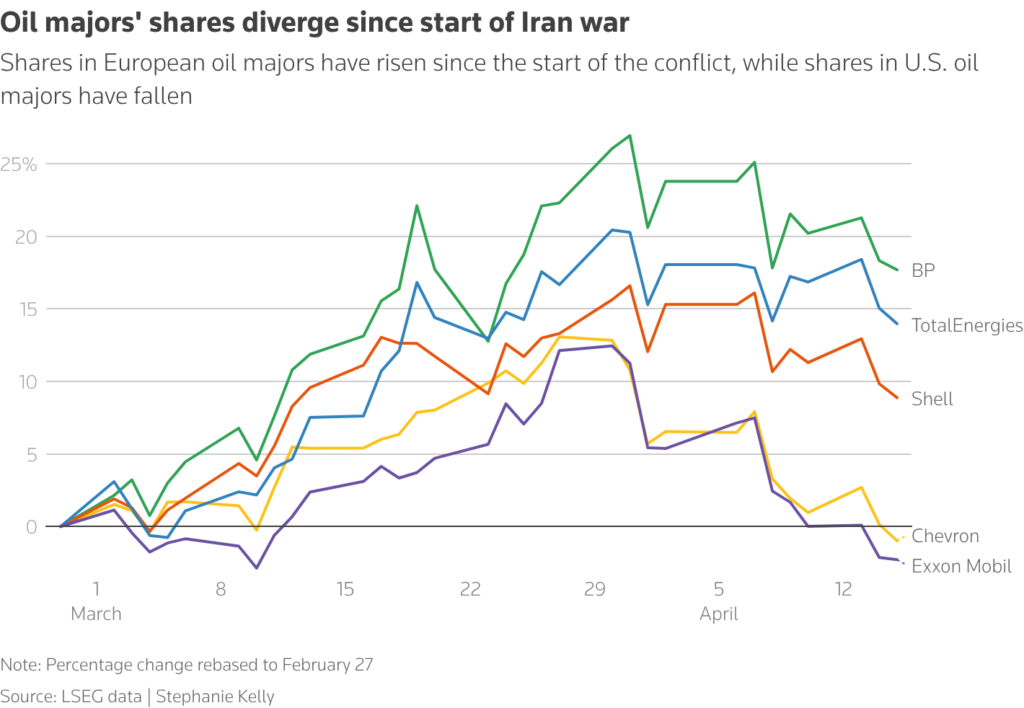
A graphic shows shares in oil majors since February 27
Without giving away details, the Europeans have flagged their trading windfalls in recent outlook updates.
BP this week said its oil trading performance in the first quarter was “exceptional” – language it has not used for oil and gas trading in its quarter-on-quarter comparisons since the peak of the Ukraine war-induced energy crisis in 2023, usually limiting its comments to weak, average or strong.



“BP is not given to hyperbole. So calling its results ‘exceptional’ is telling,” said David Hewitt, senior consultant at Hewitt Energy Perspectives.
BP, which produced 2.3 million barrels of oil equivalent of oil and gas per day last year, has said that in recent years it has traded around 10 times its oil production and eight times its refined product capacity, or around 9 billion barrels per year.
Shell, the world’s biggest liquefied natural gas trader, said strong first-quarter oil trading should help counter the impact on its earnings from production outages linked to the war.
Last year, it produced around 2.8 million boed of oil and gas and refined around 1.2 million bpd. It traded around 12 million bpd.
TotalEnergies expects a significant boost to first‑quarter earnings from trading, even as the war shut in about 15% of its production. The company, which produced 2.5 million boed last year, said it traded 8 million bpd of physical oil volumes and 85 million bpd in derivatives.
Norway’s Equinor (EQNR.OL) has also said trading will lift earnings, helped by oil price volatility tied to the Middle East conflict and gas price spikes in Europe.
CAUTIOUS U.S. MAJORS EXPECT BIG QUARTERLY EARNINGS HITS
Exxon, the largest U.S. oil producer, has historically approached trading with caution.
After Chief Executive Darren Woods took office in 2017, it sought to expand its trading unit, but then scaled back those efforts during the downturn provoked by the coronavirus pandemic, sources said at the time.
“U.S. majors have traditionally treated trading as an optimisation tool to avoid large swings in quarterly earnings,” said Hewitt, who once worked for Chevron.
Neither Exxon nor No. 2 U.S. producer Chevron made reference to trading gains in their outlook statements ahead of first‑quarter results.
Instead, Exxon warned that its first-quarter earnings could take a hit of around $5.3 billion mainly due to timing impacts from derivatives and, to a lesser extent, undelivered cargoes linked to the war.
Chevron also flagged that similar timing effects from hedging could hit after-tax earnings by $2.7 billion to $3.7 billion.
Both said they expected the timing impacts to unwind and lead to profitability in later quarters.
BP reports results on April 28, followed by TotalEnergies on April 29, Exxon and Chevron on May 1, and Shell on May 7.
Reporting by Shadia Nasralla and Stephanie Kelly; Additional reporting by America Hernandez; Editing by Joe Bavier
Share This: