CDN NEWS |
  US NEWS







The formation in BC and Alberta is a giant for gas and liquids
By Resource Works
More News and Views From Resource Works Here
No wonder that our Resource Works founder and CEO, Stewart Muir, called the Montney natural-gas reserves in Canada “British Columbia’s economic crown jewel.”
The Montney Formation in BC and Aberta has an area of 130,000 km², about the size of New Brunswick and Nova Scotia combined.
That’s roughly two-thirds the size of the famed Permian Basin in Texas and New Mexico. But “The Montney” now is, by volume, the dominant natural-gas resource in North America.
The Montney play is experiencing rapid expansion, with projections suggesting up to 32,000 new wells could be drilled by 2050 to support liquefied natural gas (LNG) exports.
And the federal government notes: “The Montney has the potential to produce a total of 449 trillion cubic feet (Tcf) of natural gas with modern technology, making it one of the biggest gas resources in North America. . . .
“Because of the large size of the Montney’s core area, companies will likely take many years to fully drill areas with the best reservoirs before they start drilling areas with lower reservoir quality. Therefore, it is likely that Montney well performance will continue rising as technology continues to evolve.”
Our gas output grows
A new outlook from the Canada Energy Regulator (CER) sees our natural-gas output, driven by LNG exports, growing by 47 per cent by 2050, and perhaps as much as 75 per cent.
Natural-gas production increases in all CER scenarios, from a record high of 18.3 billion cubic feet a day (Bcf/d) in 2024. Growth could hit as much as 32 Bcf/d in 2050 (up some 75 per cent from 2024). And even in the lowest scenarios output could still be around 21 Bcf/d in 2050, up by close to 15 per cent from 2024.
Canadian LNG, to many, means the LNG Canada plant at Kitimat BC, the Cedar LNG plant being built (with the Haisla Nation) near Kitimat, the Woodfibre LNG operation under construction near Vancouver, and the planned Ksi Lisims LNG plant (with the Nsga’a Nation) in northern BC.
But the gas they liquefy and export comes, or will come, via pipeline from “The Montney.”
And, as Stewart Muir noted when he called the Montney play BC’s economic crown jewel, there’s much more to the Montney than natural gas:
“The Montney’s liquids-rich gas underpins both propane and LNG exports, linking upstream production success with Prince Rupert’s strategic deep-water port advantage.
“This synergy positions Prince Rupert as a northern counterpart to Vancouver’s resource-driven metropolitan economy — a vital service and logistics hub for the clean-energy century.”
Asian demand surging
Asia imports over 73% of the world’s LNG. And while struggling these days with the impact of the war on Iran, Asian demand for natural gas has been surging, driven by a desire for energy security and lower emissions. And in Canada’s case, shorter shipping times (some 10 days compared with 16–30 days from the US and Middle East). Japan and other Asian nations see Canada as a stable and reliable supplier of LNG. And as a supplier of natural-gas liquids that are also in demand in Asia.
Japan, for one, uses propane for a range of purposes, including household use for cooking, water heating, and room heating, as well as for industrial applications, as a raw material for municipal gas production, and as fuel for most taxis.
South Korea uses propane and butane in petrochemicals and transportation. China’s rapidly expanding propane dehydrogenation industry — a process for making plastics — has been growing at 15 per cent annually since 2020. They are being supplied, increasingly, from the northern coast of British Columbia.
B.C. production doubles
Stewart Muir again: “What I find striking, having followed this file for many years, is how completely the inland story has been ignored. B.C.’s natural gas production has more than doubled since 2010. The Montney holds roughly 70 per cent of the remaining gas resource in the play, one of the longest drilling inventories on the continent.



“ARC Resources, Tourmaline, Ovintiv — these are not speculative ventures. They have been methodically developing the resource in anticipation of export demand that, until very recently, wasn’t there.
“For years they drilled into a price paradox: Canadian gas, among the most abundant and technically accessible in the world, trading at a persistent discount to U.S. benchmarks simply because there was nowhere for it to go.”
Now the Montney natural gas has somewhere to go, and is moving, via a number of pipeline systems, from the Montney plants that first clean the gas, removing sand, water and water vapour, carbon dioxide, hydrogen sulphide, and nitrogen.
For BC’s growing LNG industry, the gas comes by way of the Coastal GasLink pipeline from the Montney gas-producing region near Dawson Creek BC.
Those Montney cleaning plants also separate the valuable natural gas liquids (NGLs): ethane, propane, butane, and pentanes. These move primarily by rail, and notably to REEF — the Ridley Island Energy Export Facility project, a terminal near Prince Rupert BC being built by AltaGas to export bulk NGLs to global markets.
Origin of Montney gas
The natural gas in the Montney was formed over millions of years from decomposing marine organic matter, deposited in fine silt and mud on the bed of what was actually a shallow sea, 247-252 million years ago. The deep burial led to increased pressure and heat, transforming the organic material into natural gas, natural gas liquids, and oil. And the silt and mud became geological rock formations, mostly siltstone and sandstone, with some shale in the easternmost area. The gas is found as much as four kilometres below the surface, with the gas-bearing formation itself being 100 to 300 metres thick.
The Montney producers have developed and refined techniques to extract the gas from Montney’s “tight” geological rock formations, a mix of mostly siltstone and sandstone, with some shale in the easternmost area.
The techniques include hydraulic fracturing (often called ‘fracking”) and more than 11,500 wells that, below ground, spread into connected horizontal networks, some exceeding eight kilometres in length.
Fracking uses a mixture of water, sand, and chemical additives to reduce friction and prevent corrosion. The mixture is pumped into the gas-bearing rock at high pressure, breaking it apart. After injection, this fluid returns to the surface as “flowback” or “produced water,” which contains contaminants that require specialized treatment and disposal.
Groundwater not affected
Opponents of natural gas and LNG development love to brand “fracking” as a dirty word, saying, for example, that it contaminates groundwater — but the BC government says: “There has never been a confirmed case of groundwater contamination in BC as a result of hydraulic fracturing.”
And: “The hydraulic fracturing injection method takes place far below the location of potable water sources and domestic water wells.
‘Typically, these water sources are between 18-150 metres below the surface. Shale rocks in B.C. are found deep below the surface. For example, shale rocks are located at 1.7 – 4 kilometres (kms) below the surface in the Montney area. . . . These are the depths where the hydraulic fracturing injection method takes place.”
The government points out that “British Columbia has been a leader in safe, responsible natural gas development for decades,” with the hydraulic-fracturing process first used in August 1950.
And as Stewart Muir notes: “The Montney is real. The Asian demand is real — global gas consumption continues to grow, much of it driven by countries trying to replace coal with something that actually works when the wind isn’t blowing, and Asian LPG import needs are projected to grow by more than 40 per cent by 2040.
“BC’s Pacific location gives Canadian exporters a genuine structural advantage over Gulf Coast competitors. The resource, the geography, and the market are all present.
“The coast is where the story becomes visible. But it starts, as it has always started, somewhere you’ve probably never been (the Montney region), beneath the farmland and the boreal forest, hundreds of kilometres from the sea. Getting it from there to here is the work. The work is not finished.”
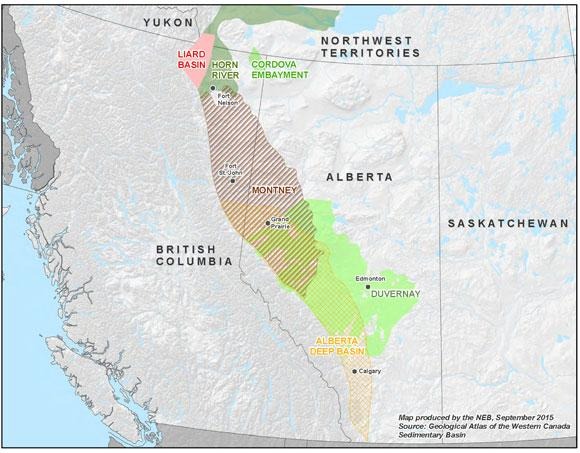
The Montney Formation, and neighbouring natural-gas reserves
Don MacLachlanis a writer for Resource Works, a non-partisan organization that champions responsible resource development in British Columbia and Canada. Reach him via [email protected]
Share This: