CDN NEWS |
  US NEWS







Industrial facilities that handle flammable and toxic gases face an ongoing risk of leaks that can escalate into fires, explosions, environmental impacts, and catastrophic loss. Process industries, including oil and gas, petrochemicals, and power generation, must therefore implement robust gas safety systems that not only detect leaks early but also deliver actionable alerts and mitigate risk. A layered gas detection strategy has emerged as a recommended design philosophy for achieving this level of protection.
Why Layered Gas Detection Is Critical
Gas leaks pose diverse hazards due to the unpredictable behaviour of gases after release. Variables such as wind direction, temperature, equipment layout, and release source influence how a gas cloud disperses. Because no single detector technology can reliably detect every leak scenario under all conditions, industry practitioners favour combining multiple detection methods into a cohesive system.
A layered gas detection system is based on the concept of defence in depth: independent yet interrelated safety layers that together reduce the likelihood of undetected gas releases and improve response confidence. These layers are more than just detectors; they are part of an integrated safety architecture that includes process design, alarm management, emergency shutdowns, and response procedures.
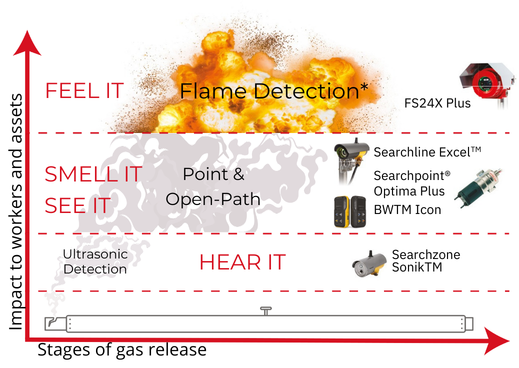
Within this overall safety framework, gas detection and flame detection are treated as separate protective layers. If one fails to identify a leak and a fire ignites, flame detection can still alert operators and safety systems to a hazardous event , acting as the final protective measure before consequences escalate.
Core Gas Detection Technologies
A layered gas detection system typically combines several technologies, each with distinct operational strengths and limitations. Engineers select and position detectors based on a detailed risk assessment that considers the nature of gases present, likely leak sources, airflow patterns, and the operational environment.
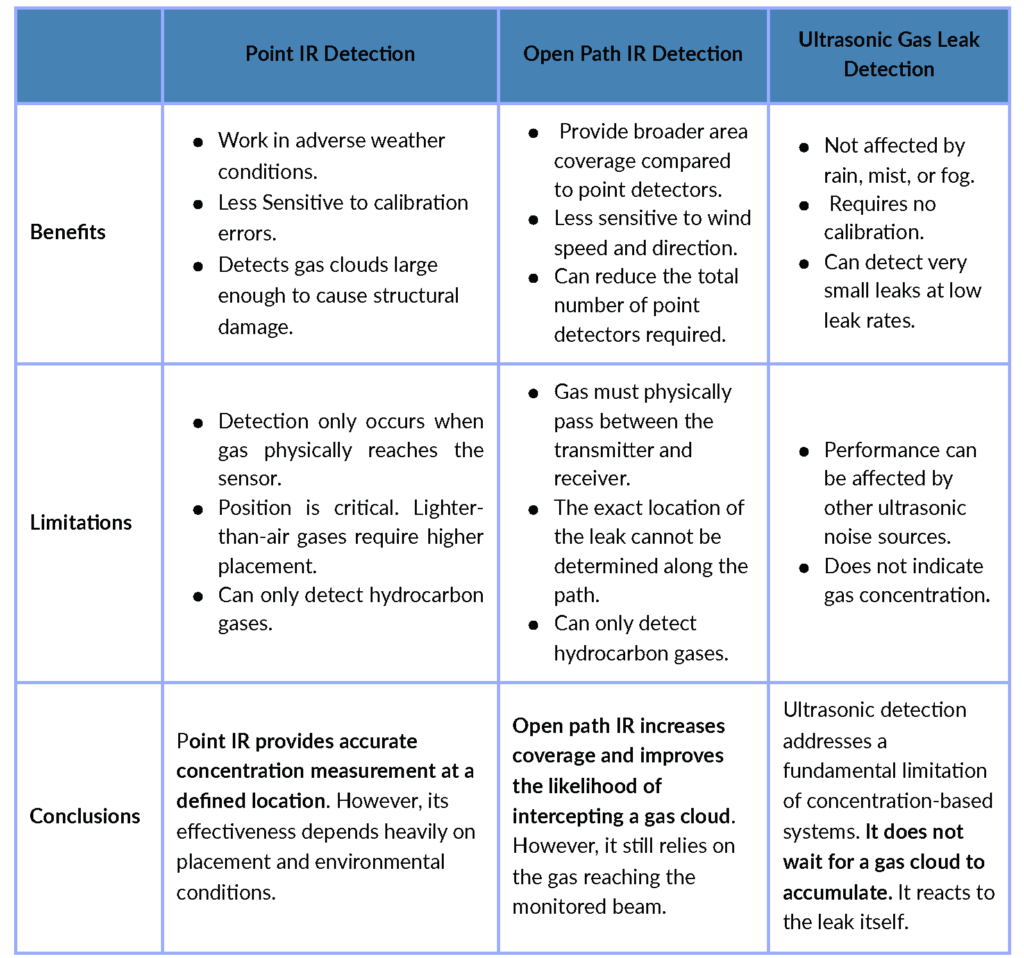
Why does technology mix matter?
Each of these technologies compensates for the others’ limitations.
The white paper recommends combining them within a layered gas protection strategy:
- Open-path IR can serve as a primary or secondary layer of boundary protection.
- Point IR should be deployed at defined risk points such as valves, flanges, and pumps.
- Ultrasonic detection acts as a tertiary layer, particularly in areas with high air flow, where gas dispersion may reduce the effectiveness of traditional detection
Microwatt Controls.
Your trusted provider of industrial processes, instrumentation, and safety solutions.
Talk to Our Gas Detection Specialists
Stay on the loop
Share This: