CDN NEWS |
  US NEWS







Ron Wallace and Tammy Nemeth
“Investors can’t ignore the commercial constraints imposed by the MoU. My concern is that the MoU does not address the key federal barriers that preclude a free-market approach to the energy industry. Key federal barriers have become conditional, reversible, or deferred.” Bryan Gould, Executive Chairman Aspenleaf Energy.
As Alberta struggles to come to terms with an MoU that would apparently require Canadian taxpayers to cover approximately 62% of the $16.5-billion Pathways Alliance CCUS project, elsewhere there was welcome news. After several years of project delays, the Bay du Nord deepwater oil project on the Canadian east coast has reached a key milestone. While the partners have yet to reach a Final Investment Decision (FID), the recent signing of a benefit agreement between Newfoundland and Labrador and Equinor, nonetheless marks a significant step forward for the $11.9 billion project.
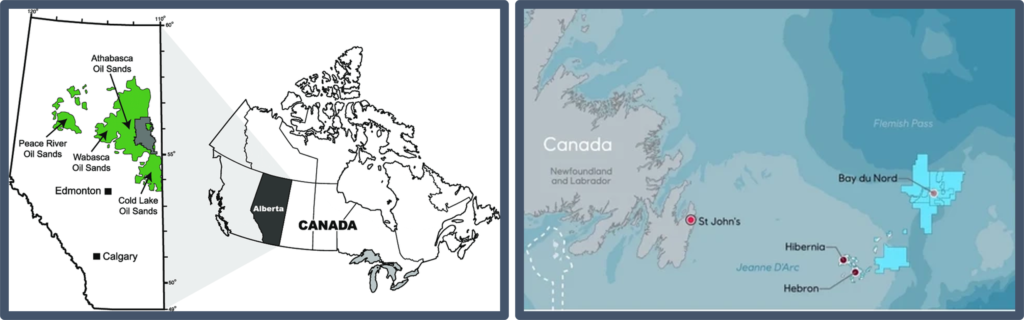
The Bay du Nord project, approved by Canada in 2022, is located approximately 500 kilometres east of St. John’s in the Flemish Pass Basin. It represents a significant potential offshore oil production site that would link multiple subsea drill centres back to a single floating production, storage and offloading (FPSO) vessel. First oil from Bay du Nord could be produced by 2031 with a production capacity of up to 160,000–175,000 bbl/d. As part of efforts to make Canada an energy superpower Natural Resources Canada commented that it: “… is committed to helping de-risk this project to enable this important investment in Canada’s energy future to move forward.”
Meanwhile, the LNG tanker Maran Gas Hector, having sailed roughly 25,750 km from Gladstone, Australia, has delivered the first recorded shipment of Australian LNG to Canada into the Port of Saint John, New Brunswick. LNG tankers of this class (Maran Gas series) typically carry ~170,000–180,000 cubic metres (m³) of LNG. That Canadian port, which already hosts a large Repsol LNG import terminal, has previously received LNG shipments of approximately 286,000 tonnes in 2024 and 176,000 tonnes in 2023, respectively. It may be useful to recall that Canada has the 10th-largest natural gas reserves in the world and is also the fifth-largest producer of natural gas.
Concurrently, the Suezmax Tanker SFL Albany loaded with approximately one million barrels of Saudi crude is reported to have departed the Persian Gulf port of Ras Tanura. Having rounded the Cape of Good Hope the tanker is bound for Canaport (Saint John, N.B.) with an arrival date for late March 2026.


What do these seemingly unrelated events have in common? First, none of these announcements involve Alberta directly and second, at no point have the terms “Decarbonization” or “Carbon Capture and Storage” been invoked for these developments.
Alberta and Canada are negotiating terms and conditions under an MoU signed on November 27, 2025, with far-reaching implications for carbon pricing, major infrastructure, methane rules and the future of oilsands decarbonization. Those terms would commit western Canadian oil producers to a steep Industrial Carbon Tax needed to underpin massive investments for a “decarbonized” oil export pipeline from Alberta. The MoU aligns federal–provincial climate policies for industrial carbon with Alberta’s Technology Innovation and Emissions Reduction (TIER) Program with a minimum effective credit price of $130 per tonne. This would represent a significant increase from Alberta’s current market credit price.
Meanwhile, the Bay du Nord project, and the importation of LNG and oil from international sources, remain free from any such considerations.
There is yet another wrinkle to these announcements: Because the Bay du Nord project is located outside Canada’s 200 nautical-mile offshore continental boundary, it appears to subject to terms under UNCLOS Article 82 whereby coastal states agree to pay a per centage of their resource value (effectively a royalty) to the International Seabed Authority (ISA). Thus, Canada is poised to be “the first country in the world to make international royalty payments required for resource extraction in its outer continental shelf.” The federal government has announced that it is prepared to “de-risk” the project by covering fees required under that United Nations convention on behalf of the company and province. Those obligations, which could reach $1 billion over the project’s lifespan, were confirmed by Federal Fisheries Minister Joanne Thompson. However, while offering to “derisk” the project the federal government does not foresee the need for this Canadian, or other internationally produced offshore, oil to be “decarbonized.” This two-tiered policy reinforces the conclusion that offshore oil production—including imported oil and LNG—is subject to different treatment than oil produced in western Canada.
The Canada-Alberta MoU sets out monumental conditions that include the Pathways CCUS project, one that burdens western Canadian oil producers with a high-cost, high-risk project with no commercial return. While Alberta may be required to “decarbonize” the 20% of GHG emissions that occur during production, oil produced offshore or LNG and oil imported into Canada from overseas (that produce 80% of emissions from combustion) face no equivalent economic penalty.
Policies that require massive expenditures to produce “decarbonized” oil in western Canada, while simultaneously permitting the production and importation of “non-decarbonized” oil and LNG into eastern Canada, are not only inconsistent they are significantly unbalanced, even discriminatory. Nor will those policies achieve their aims. The PBO estimates that Canada’s projected 2030 emissions will exceed the legislated target by 49–102 Mt., meaning Canada would achieve only 31.5–33.5 percent reductions below 2005 levels, far short of the required targets of 40–45 percent. In short, the federal government’s net‑zero agenda is marked by a growing inconsistency: It promises a rapid economic transformation while relying on inefficient policy instruments that independent analyses suggest are unlikely to meet Canada’s own emissions targets.
The federal government has committed to “derisk” the Bay du Nord project with massive federal subsidies but does not require offshore producers or importers to “decarbonize” their oil. Alberta is, by contrast, being held to a far higher regulatory and economic standard under the MoU. The federal government argues that projects like Bay du Nord, with their projected low upstream emissions intensity of under 8 kg CO₂e per barrel, qualify as “low emission” oil and thus do not require the same mandatory decarbonization measures. One could understand how Alberta might regard this rationale as unfair regional favoritism: These are policies that saddle Western Canadian producers with billions in abatement costs to “earn” new export market access while the federal government subsidizes Eastern Canadian offshore developments. These arbitrary, inconsistent policies may be politically expedient, but they risk a deepening economic alienation in western Canada. Energy Minister Tim Hodgson admitted to the IEA last week that global buyers are not yet paying premiums for decarbonized oil or low-emission LNG. Nonetheless, his government believes they will do so.
Executives repeatedly cite regulatory uncertainty as a key deterrent to investment, seeking predictability, clarity, stability and consistency in standards. Arguably, Canada continues to fall far short of those objectives. There are material policy and cost implications of Carney’s call to produce “decarbonized” oil. Alberta’s 2026 budget confirmed that expenditures need to be addressed to avoid mounting deficits and potential credit downgrades. Is this a time to embark on massive expenditures required to selectively “decarbonize” western Canadian oil? Is it fair and equitable that Western Canadian oil be “decarbonized” while eastern Canadian importers and oil producers are free from any comparable regulatory or financial burdens? And, importantly, do these policies threaten the competitiveness of Canadian oil exports? Canada is fast becoming an international outlier in the global oil export market. It remains to be seen if we will address the self-imposed barriers that preclude a balanced, consistent and free-market approach for the energy industry.
Dr. Ron Wallace is a former Member of the National Energy Board. Dr. Tammy Nemeth is a UK-based energy and ESG analyst.
Share This: