CDN NEWS |
  US NEWS







By Bo Erickson, Maayan Lubell and Parisa Hafezi

- US-Israeli war on Iran enters third week, boosting global oil prices
- Several allies decline US call to escort shipping in Hormuz
- Israel has at least three weeks of plans for military strikes
- Iran fires at Israel, launches drone attacks on UAE and Bahrain
WASHINGTON/TEL AVIV/DUBAI, March 16 (Reuters) – Several U.S. allies rebuffed Donald Trump’s call on Monday to send warships to escort shipping through the Strait of Hormuz, drawing criticism from the U.S. president, who accused Western partners of ingratitude after decades of support.
The U.S.-Israeli war on Iran is in its third week with no end in sight, largely shutting the Strait of Hormuz, through which 20% of the world’s oil and liquefied natural gas flow, raising energy prices and fears of inflation.
Israel said on Monday it had drawn up detailed plans for at least three more weeks of war as it pounded sites across Iran overnight, while Iranian drone attacks temporarily shut Dubai airport and hit a key oil facility in the United Arab Emirates.
A number of U.S. partners including Germany, Spain and Italy said they had no immediate plans to send ships to help reopen the strategic waterway, which Iran has effectively shut with drones and naval mines.
“We lack the mandate from the United Nations, the European Union or NATO required under the Basic Law,” German Chancellor Friedrich Merz said in Berlin, adding that Washington and Israel had not consulted Germany before launching the war:
“That is why the question of how Germany might become militarily involved here does not arise.”
Trump, speaking at a news conference in Washington, said many countries had told him they were prepared to help, but voiced frustration with some long‑standing allies hosting large numbers of U.S. troops:
“Some are very enthusiastic about it, and some aren’t. Some are countries that we’ve helped for many, many years. We’ve protected them from horrible outside sources, and they weren’t that enthusiastic. And the level of enthusiasm matters to me.”
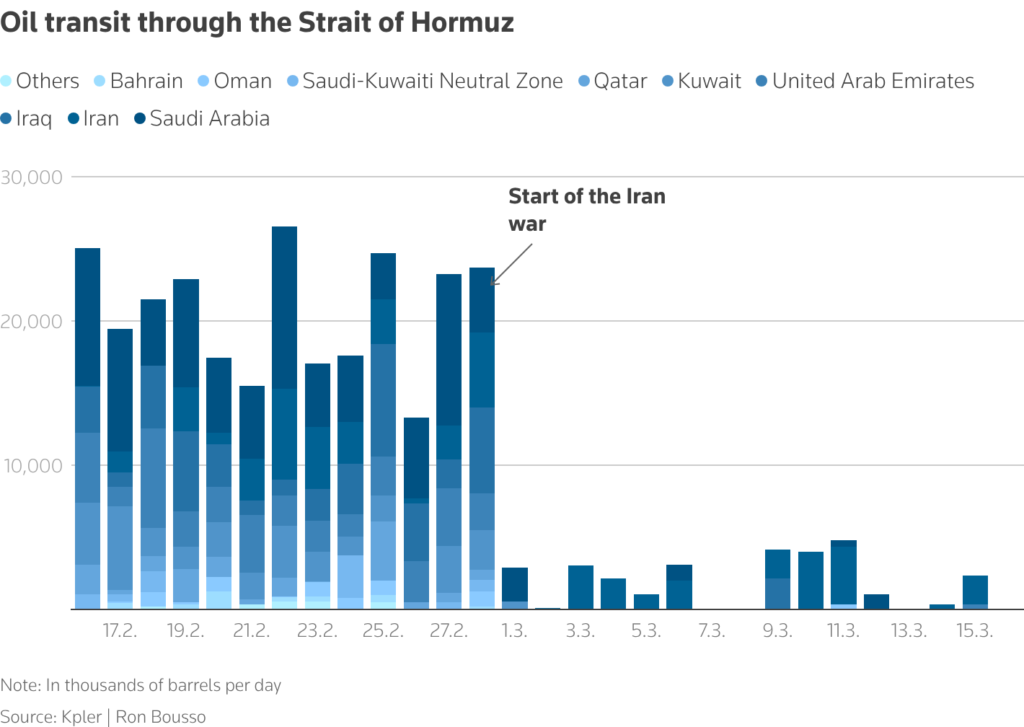
Oil exports via the Strait of Hormuz
ISRAEL STILL HAS ‘THOUSANDS’ OF TARGETS IN IRAN
Israeli military spokesperson Lieutenant Colonel Nadav Shoshani told reporters there were detailed operational plans for the next three weeks in Iran, and other plans extending further.
Israel has said it wants to weaken Iran’s capacity to threaten it, striking ballistic missile infrastructure, nuclear facilities and the security apparatus, and that it still has thousands of targets to hit.
“We want to make sure that they are as weak as possible, this regime, and that we degrade all their capabilities, all parts and all wings of their security establishment,” Shoshani said.
Iran’s Islamic Revolutionary Guard Corps (IRGC) said it would target U.S. industrial facilities in the Middle East and urged people living near U.S.-owned plants to leave.
Foreign Minister Abbas Araqchi said Tehran had not asked for a ceasefire or exchanged messages with the U.S., according to Iran’s semi-official Student News Network.
In a post on X, Araqchi also said that some “neighbouring states” that host U.S. forces and permit attacks on Iran were also actively encouraging the killing of Iranians.


He said 200 children were among the hundreds of Iranian civilians killed in U.S. or Israeli bombings.
Iran’s Mehr news agency said five people had been killed and seven wounded in overnight strikes on Markazi province in central Iran. Fars News Agency reported that several civilians had been killed in a strike near Tehran’s Martyrs’ Square, without giving figures.
Rescue workers in Tehran worked to pull people from the wreckage of a building in what an Iranian Red Crescent aid worker said was an entirely residential alleyway.
ISRAEL CLAIMS STRIKES ON IRAN’S SPACE PROGRAM
The Israeli military said it was carrying out air strikes on Shiraz, Tabriz and Tehran.
The head of a U.N. investigation said in Geneva that an Israeli air strike in June on the notorious Evin prison, where many political prisoners have been held, was a war crime that had killed 80 people including a child and eight women, and that the latest war could lead Iran to crack down even harder on dissent.
In response to the U.N. report, an Israeli military spokesman said, “The strike was carried out in a precise manner to mitigate harm to civilians imprisoned within the prison to the greatest extent possible.”
Israel said its air force had struck sites linked to Iran’s space program, including destroying a research facility in Tehran involved in developing a satellite launched in 2024.
One Tehran resident told Reuters that there had been no internet overnight and Iranians felt isolated from the world.
“People are being killed,” Shahnaz, 62, said via WhatsApp. “Just days before Nowruz (Iranian New Year, on March 20), but people are not in the mood to celebrate. When will this end?”
Asked if she supported the Islamic Republic, Shahnaz said: “No, I don’t. How can I? They killed my granddaughter in (January’s) protests. We want this regime to go. We want this misery to end.”
SOME RELIEF FOR OIL PRICES AND STOCKS
In Israel, air raid sirens warned of Iranian missiles. The IRGC said Iran had launched attacks on areas in Tel Aviv, the U.S. al-Dhafra air base in Abu Dhabi, the U.S. naval base in Bahrain, and Bahrain’s Sheikh Issa air base.
Furthermore, oil loading operations at the UAE port of Fujairah on the Gulf of Oman were suspended following an Iranian drone strike.
Fujairah is a key exit point for the UAE’s Murban crude – a volume equivalent to roughly 1% of global demand.
Flights at Dubai International Airport, one of the world’s busiest, were suspended for several hours after a drone strike on a nearby fuel storage facility sent plumes of black smoke into the sky. Saudi Arabia intercepted 34 drones in its eastern region in one hour, state media said. No injuries were reported in either incident.
Despite the turbulence, oil prices which had been above $100 a barrel, fell and stocks rallied after U.S. Treasury Secretary Scott Bessent told CNBC the U.S. was “fine” to let some Iranian fuel vessels through the strait, and believed Indian and Chinese tankers had also passed through.
(This story has been corrected to clarify that Israel struck Evin prison in 2025 but did not strike it again today, in paragraphs 21, 22 and 23)
Reporting by Reuters bureaux; Writing by Lincoln Feast, Sharon Singleton and Crispian Balmer; Editing by Kevin Liffey
Share This: