CDN NEWS |
  US NEWS







By Niccolo Conte | Design Sam Parker
Key Takeaways
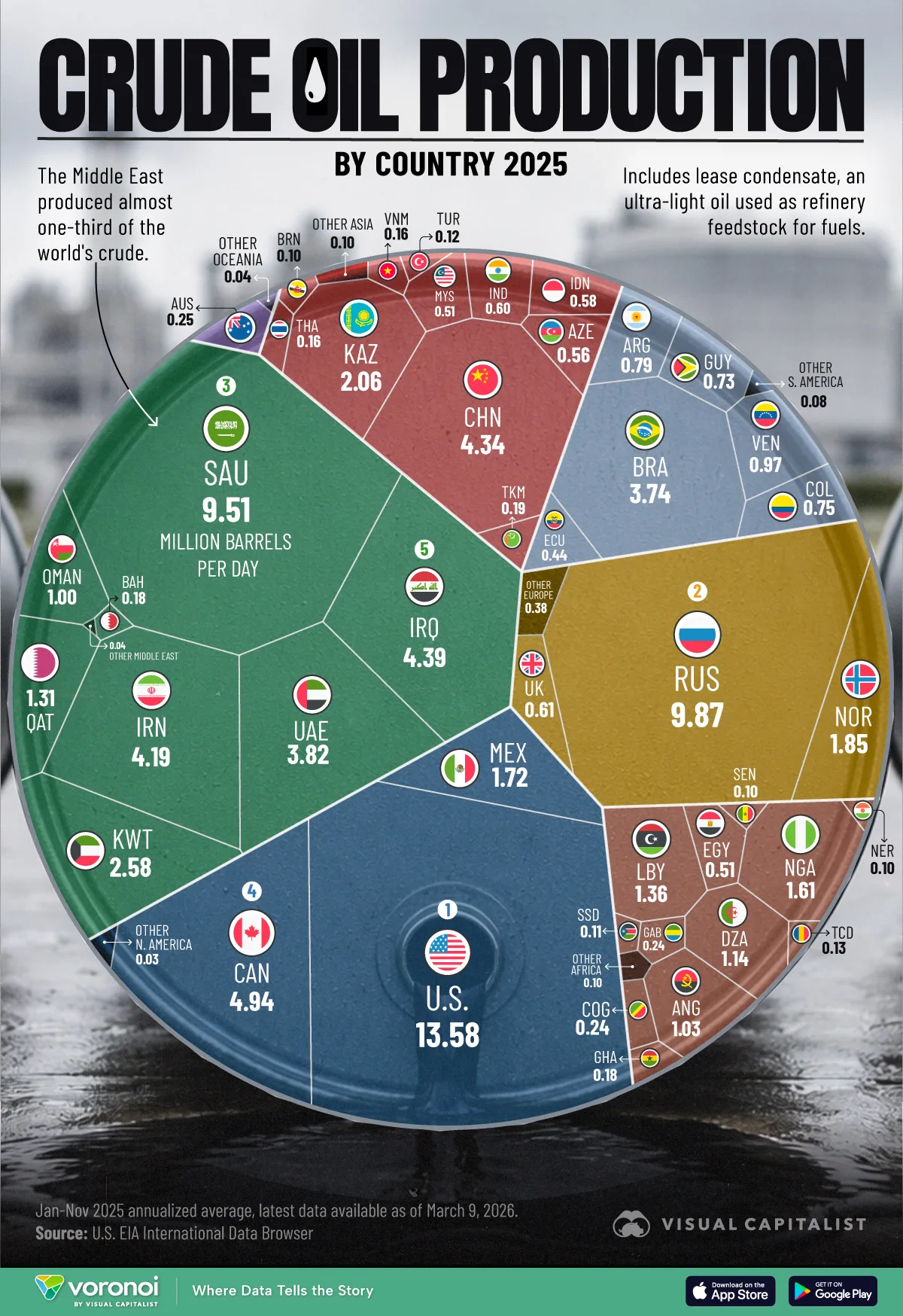
- The U.S. was the world’s largest crude oil producer in 2025 at 13.58 million barrels per day, ahead of Russia (9.87) and Saudi Arabia (9.51).
- Middle Eastern countries produced 32.1% of global crude oil in 2025.
Just five countries produced half of the world’s oil in 2025, with the U.S., Russia, and Saudi Arabia alone accounting for nearly 40% of global supply.
That level of concentration means a small number of countries have an outsized influence on global oil supply.
This visualization shows global crude oil production including lease condensate by country in a single chart with countries organized and colored by region.
The data for this visualization comes from the U.S. Energy Information Administration, and is a Jan-Nov 2025 annualized average of crude oil and lease condensate production by country, the latest data available as of March 9, 2026.
U.S., Russia, and Saudi Arabia Lead Crude Oil Production
The U.S. was the world’s largest producer of crude oil and lease condensate in 2025, producing 13.58 million barrels per day (mb/d), comfortably ahead of Russia at 9.87 mb/d and Saudi Arabia at 9.51 mb/d. Combined together, those three countries were responsible for 39% of global crude oil production in 2025.
The data table below shows the world’s crude oil production in 2025 by country in million barrels per day (mb/d) and each country’s share of global production:
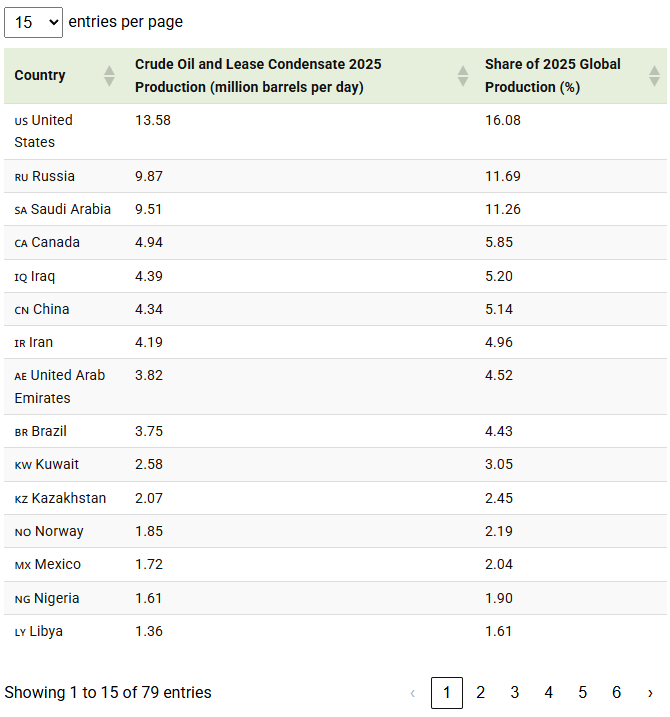


After that top tier, production drops sharply. Canada ranked fourth at 4.94 million barrels per day, followed by Iraq (4.39) and China (4.34). In other words, the U.S. alone almost produced more crude than Canada, Iraq, and China combined.
Iran was the seventh-largest producer of crude oil in 2025, pumping 4.19 mb/d which equates to 5% of the world’s production last year.
The Middle East is the Largest Oil-Producing Region
While the U.S. was the single biggest producer, the Middle East remained the largest regional bloc in the ranking. Countries from the region produced 32% of the world’s crude oil in 2025, or nearly one-third of the global total.
Saudi Arabia, Iraq, Iran, the United Arab Emirates, and Kuwait all landed in the top 10. That clustering helps explain why Middle Eastern supply continues to play an outsized role in global oil balances, even with the U.S. holding the top spot individually.
The war in Iran has led to significant disruption in crude oil production and trade in 2026, with many Middle Eastern countries’ production facilities shut down or destroyed.
Even if the war were to end soon, many facilities will require significant reinvestment and time to repair, along with high levels of uncertainty across the key energy trade route that is the Strait of Hormuz.
After the Top 10, Oil Production Falls Off Quickly
The concentration of output in a few countries and regions becomes even clearer lower down the ranking of oil producers. The top 10 countries accounted for 72.2% of global production, meaning all remaining producers combined contributed less than 28%.
That long tail includes countries such as Kazakhstan, Norway, Mexico, Nigeria, Libya, and Guyana, each of which adds meaningful barrels to the market without approaching the scale of the leading producers.
The result is a global crude market where a handful of countries still matter most for overall supply trends.
Share This: