CDN NEWS |
  US NEWS







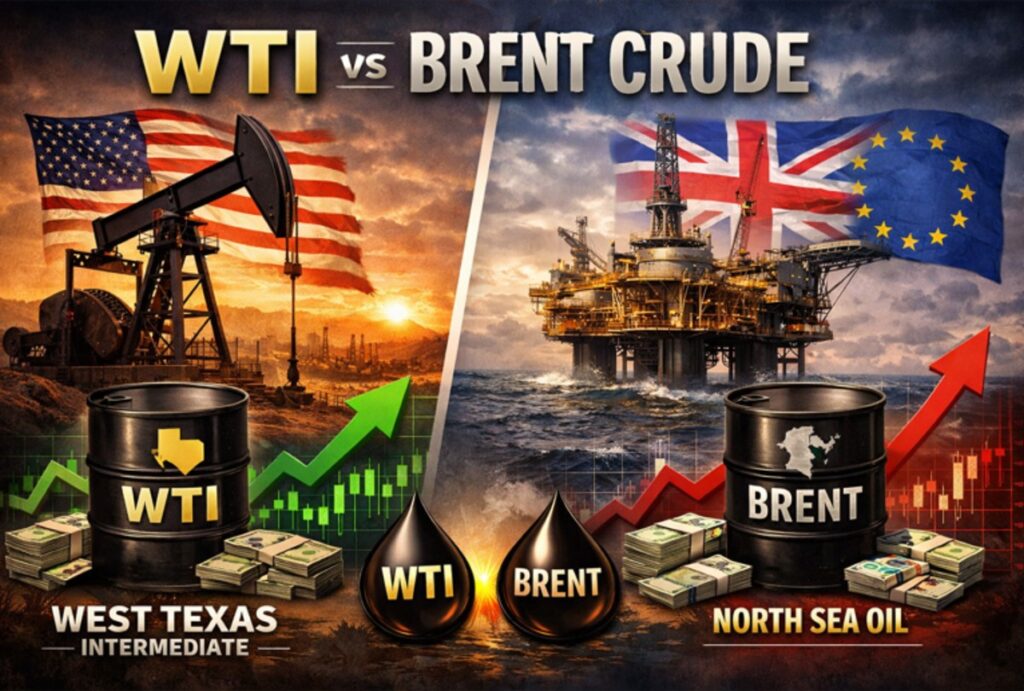
Understanding the relationship between West Texas Intermediate (WTI) and Brent Crude is essential for navigating energy markets. These two benchmarks represent different regions, qualities, and logistical realities, and their price difference—the Brent-WTI spread—serves as a vital indicator of global energy health.
Core Differences Between WTI and Brent


- Geographic Origin:
- WTI: Primarily sourced from U.S. fields in Texas, Louisiana, and North Dakota. It is landlocked, with its main trading and storage hub in Cushing, Oklahoma.
- Brent: A blend of oils from the North Sea (UK and Norway). It is waterborne, extracted from offshore fields like Brent, Forties, Oseberg, and Ekofisk.
- Quality and Composition:
- Both are “light” and “sweet,” meaning they have low density and low sulfur content, making them easy to refine.
- WTI is slightly lighter and sweeter (0.24% sulfur) than Brent (0.37% sulfur), theoretically making WTI more valuable for gasoline production.
- Trading Platforms:
- WTI futures trade on the NYMEX (New York Mercantile Exchange).
- Brent futures trade primarily on the ICE (Intercontinental Exchange) in London.
Pricing and Market Drivers
- How They Are Priced:
- Brent serves as the benchmark for roughly two-thirds of the world’s internationally traded crude, including most oil from Europe, Africa, and the Middle East.
- WTI is the primary benchmark for the North American market.
- What Affects Their Pricing:
- Logistics: Because Brent is produced near the sea, it can be easily loaded onto tankers for global shipment, keeping its transportation costs lower and its reach wider.
- Infrastructure: WTI is sensitive to U.S. pipeline capacity and storage levels at Cushing. If storage fills up, WTI prices often drop relative to Brent.
- Global vs. Domestic Factors: Brent is highly sensitive to international geopolitical events, while WTI is more influenced by U.S. production levels (like the shale boom) and domestic demand.
Impact of the 2026 Iran War on the Brent-WTI Spread
As of March 2026, the ongoing war involving Iran has dramatically widened the spread between Brent and WTI.
- Soaring Brent Prices: Brent has surged significantly higher than WTI, recently trading at roughly $114.91 per barrel compared to WTI’s $97.30.
- Strait of Hormuz Disruption: The effective closure of the Strait of Hormuz has halted approximately 20% of global oil supply, directly impacting the seaborne markets that Brent benchmarks. This has added a massive “geopolitical risk premium” to Brent.
- Widening Spread: The Brent-WTI spread has widened to roughly $10–$20 per barrel, its largest gap in years.
- U.S. Insulation: While WTI prices have risen due to global sentiment, the U.S. remains somewhat insulated because WTI is domestic and landlocked. Increased U.S. production and the Jones Act waiver have helped stabilize domestic supply even as international markets face a severe shock.
Share This: