CDN NEWS |
  US NEWS







By Ron Bousso
LONDON, March 16 (Reuters) – The U.S. is rapidly running out of shock absorbers to cushion the oil market from the loss of Middle Eastern crude supplies as the Iran war rages, raising the risk of a deeper global economic slowdown if demand destruction accelerates.
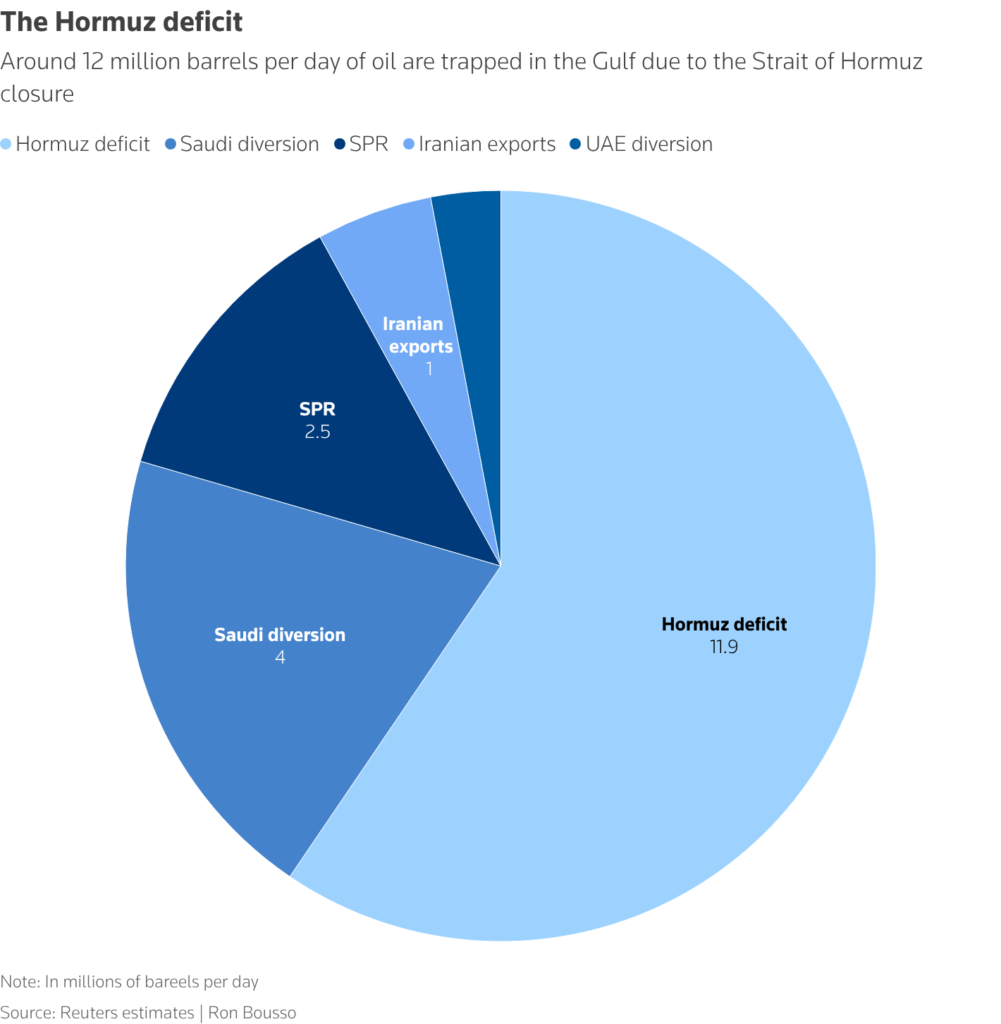
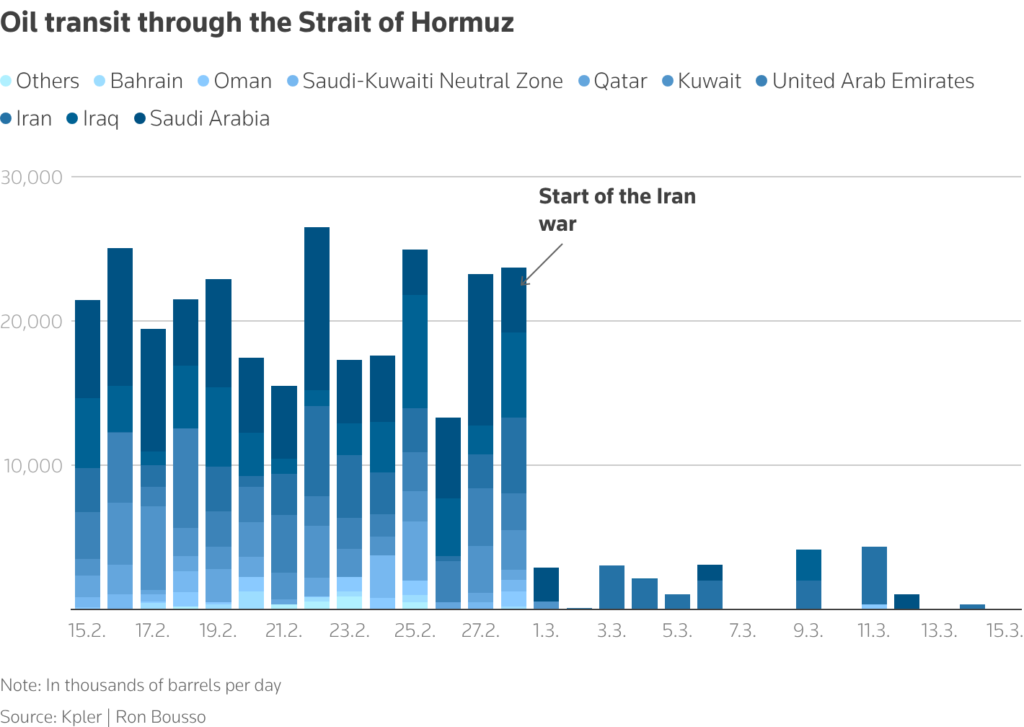
As the U.S.-Israeli war on Iran enters its third week, at least 15% of the world’s oil supplies remain effectively trapped inside the Gulf following the closure of the Strait of Hormuz, the region’s vital maritime chokepoint, according to Reuters calculations.
Saudi Arabia, the world’s largest oil exporter, is scrambling to divert as many as 5 million barrels a day to the Red Sea port of Yanbu. The United Arab Emirates is also diverting some extra crude exports through the Fujairah oil terminal. Even so, roughly 15 million bpd of Middle Eastern supply remains shut out of global markets – a disruption without precedent in the post-World War II era.
The shock has pushed Brent crude above $100 a barrel, while global prices for refined fuels such as diesel and jet fuel have surged even more sharply, reflecting fears of sustained shortages.
Iran’s new Supreme Leader Mojtaba Khamenei has said the Strait of Hormuz will remain closed as Tehran seeks to exert pressure on the United States and Israel, though he has indicated that individual countries could coordinate ship movements with Iran’s navy.
Washington has acknowledged that the U.S. Navy is currently unable to forcibly reopen the waterway.
While the U.S. has offered financial guarantees to insure vessels against war-related losses in an effort to restart transit, most commercial shippers appear unwilling to take the risk. President Donald Trump has also urged allies to deploy warships to secure Hormuz alongside the U.S., though any such operation remains weeks away.
In past crises, the world has typically looked to the spare production capacity held by the Organization of the Petroleum Exporting Countries and allied producers, collectively known as OPEC+. But it is not much help in this situation.
According to the International Energy Agency, there was about 3.9 million bpd of spare capacity before the war, the overwhelming majority of which was held in the Middle East, with around 1.7 million bpd in Saudi Arabia alone.
The Hormuz deficit
TRYING TO FILL THE GAP
The Trump administration – acutely aware of the political sensitivity of rising gasoline prices – has spent the past two weeks pulling nearly every available lever to relieve pressure on the market.
On Thursday, Washington issued a allowing countries to buy sanctioned Russian crude oil and petroleum products currently at sea. The U.S. Treasury had already issued a similar 30‑day waiver specifically for India.
The volume under discussion is significant. Russian crude and refined products on tankers, as of March 12, totalled about 245 million barrels – roughly equivalent to the volume of Middle Eastern supplies lost so far, according to shipping analytics firm Kpler.


But the headline number overstates the likely relief, even if the waiver is extended. China, India and Turkey have already been buying the bulk of Russia’s oil despite Western sanctions, meaning the waiver releases far fewer incremental barrels onto the market than the total volume suggests.
The IEA has also moved aggressively. On Wednesday, it announced plans for its 32 members to release 400 million barrels from emergency reserves – an unprecedented drawdown equivalent to roughly one‑third of total strategic petroleum reserves managed by the agency.
The United States will contribute 172 million barrels, the largest share by far, from its 415‑million‑barrel Strategic Petroleum Reserve. That leaves Washington with only around 100 million additional barrels that could be tapped easily due to technical and operational limits, according to a JPMorgan note.
The Trump administration is also considering a temporary waiver of the century‑old Jones Act, which would allow foreign‑flagged vessels to move fuel and agricultural products between U.S. ports. While that could ease regional bottlenecks – particularly by moving fuel from the Gulf
Coast refining hub to the East and West Coasts – its impact on crude prices would likely be marginal.
The same is true for most of the other options the U.S. has, such as allowing winter‑grade gasoline to be sold during the summer driving season or urging Congress to cut gasoline and diesel taxes.
Oil exports via the Strait of Hormuz
DEMAND DESTRUCTION
Taken together, these measures underline a stark reality: Washington is running out of tools capable of meaningfully offsetting the compounding impact of the Hormuz closure on the global oil market.
And when supply fails to meet demand, not only do prices go up, but consumption typically drops. In the context of oil, that can hammer economic activity.
Asia is most vulnerable. The region relies on the Middle East for roughly 60% of its crude imports, and the full impact of the disruption is only beginning to be felt. Tanker journeys from the Gulf to Asia typically take about a month, meaning flows will start to dwindle sharply in the coming two weeks.
Without further supply relief, governments from South Korea to Sri Lanka may be forced to begin rationing fuel, damaging already fragile economies.
Countries including Thailand, Japan, Vietnam and India are already moving in that direction. Refineries across Asia have cut operating rates to conserve crude. Some governments have ordered employees to work from home, discouraged the use of escalators, and, in certain cases, scrapped fuel duties to shield consumers from soaring prices.
With no clear sense of when Hormuz will be reopened, the pressure on the global oil supply chain is intensifying. As the U.S. exhausts its emergency options, the upward pressure on oil prices will likely grow, putting even more political pressure on Washington.
(The opinions expressed here are those of Ron Bousso, a columnist for Reuters.)
Ron Bousso; Editing by Kirsten Donovan
Share This: