CDN NEWS |
  US NEWS







LITTLETON, Colorado, March 18 (Reuters) – As the U.S.-Israeli war against Iran heads towards its fourth week, pressure is mounting on major economies dependent on fossil fuels to keep their power sectors, transport fleets, and homes and businesses running.
Global prices of natural gas, fuels, fertilizers, industrial acids and other products have all surged since the closure of the Strait of Hormuz on March 2, leading to a sharp drawdown in local inventories and lengthy resupply delays.
To assess which of the United States, Europe and China are likely under the most pressure from the fallout from the war, it is important to determine how much of an economy’s total energy supplies comes from domestic sources and how much come from imported commodities.
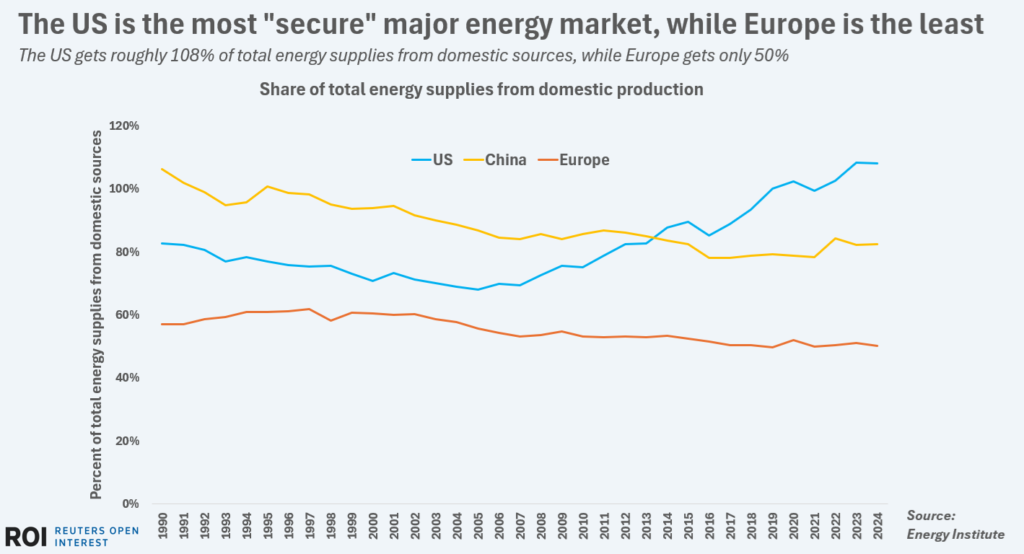
The US gets roughly 108% of total energy supplies from domestic sources, while Europe gets only 50%
This measure of energy import reliance reveals the energy security level of key countries, with nations that are heavily dependent on foreign fuels deemed far less energy secure than those endowed with ample domestic supplies.
Here is a breakdown of where the energy markets of Europe, the U.S. and China sit in terms of energy security.
HAIL THE SHALE REVOLUTION!
The U.S. ranks highly among major economies on the energy security spectrum, thanks in large part to the shale revolution which triggered a surge in oil and natural gas production since the mid-2000s.
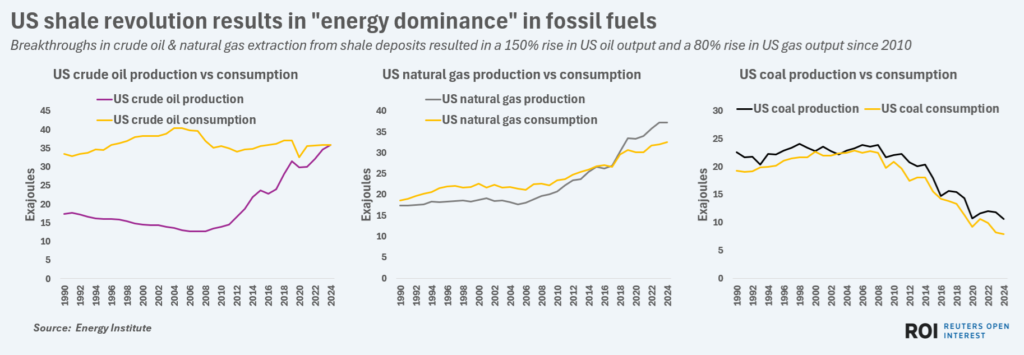
Breakthroughs in crude oil & natural gas extraction from shale deposits resulted in a 150% rise in US oil output and a 80% rise in US gas output since 2010
Indeed, the share of total U.S. energy supplies that come from domestic sources has jumped from 75% in 2010 to over 108% in 2024, according to the Energy Institute, thanks to a 166% rise oil output and 80% climb in gas output over that period.
However, higher energy security does not necessarily equate to lower consumer costs for energy products.
Indeed, U.S. fuel consumers remain fully exposed to the gyrations in global oil markets, as U.S. oil refiners purchase their crude at global prices rather than at local rates.
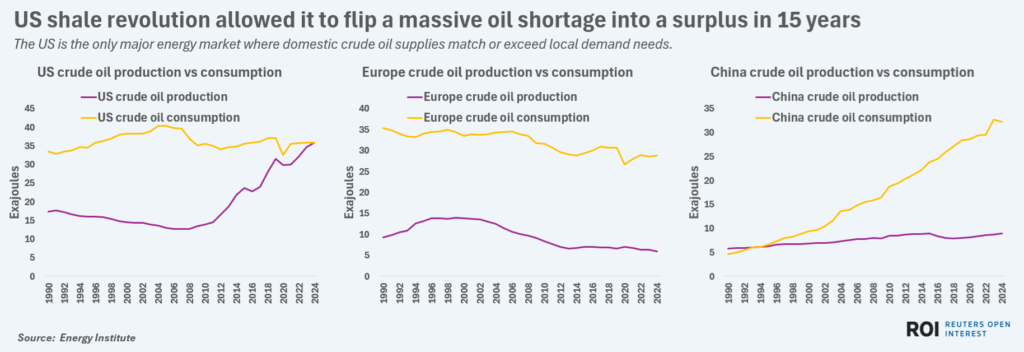
The US is the only major energy market where domestic crude oil supplies match or exceed local demand needs.
U.S. gasoline and diesel prices have surged by over 50% from a month ago in line with global market reactions to the Iran crisis, and have spurred officials to weigh sales from strategic reserves to shield buyers from further price gains.
However, as long as U.S. refinery costs remain tied to global oil markets, U.S. fuel buyers will remain as exposed to the fallout from the Iran war as those in more import-dependent countries.
GASSED UP
The upswing in U.S. natural gas production has arguably been even more impactful for U.S. energy security than the surge in oil output, as the U.S. now produces a surplus of gas that has fostered the emergence of the world’s largest LNG export sector.
Surging local gas supplies since 2010 have allowed natural gas to boost its share of electricity production from around 24% in 2010 to a record of over 42% in 2024, data from Ember shows.
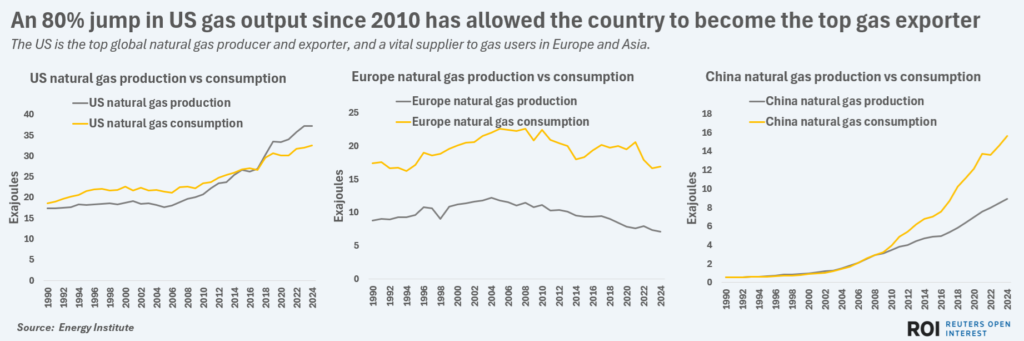
The US is the top global natural gas producer and exporter, and a vital supplier to gas users in Europe and Asia.


On top of feeding that growth in domestic use, the U.S. gas sector has also propelled liquefied natural gas exports steadily higher, from less than half a million metric tons in 2015 to roughly 108 million tons in 2025, according to Kpler.
That surge in LNG flows lifted the U.S. to the top of global LNG exporter rankings since 2023, and has cemented its position as the fastest-growing supplier of the super-chilled fuel.
EUROPE’S INSECURITY
Europe lies closer to the other end of the energy security spectrum, and has been a major buyer of U.S. LNG in recent years as the region attempted to wean itself off Russian gas following Russia’s invasion of Ukraine in 2022.
However, while U.S. LNG has plugged some of the gaps left by the drop in Russian supplies, the fact that Europe’s energy consumers have merely switched gas dependence from Russia to the U.S. means the region remains as energy insecure as before.
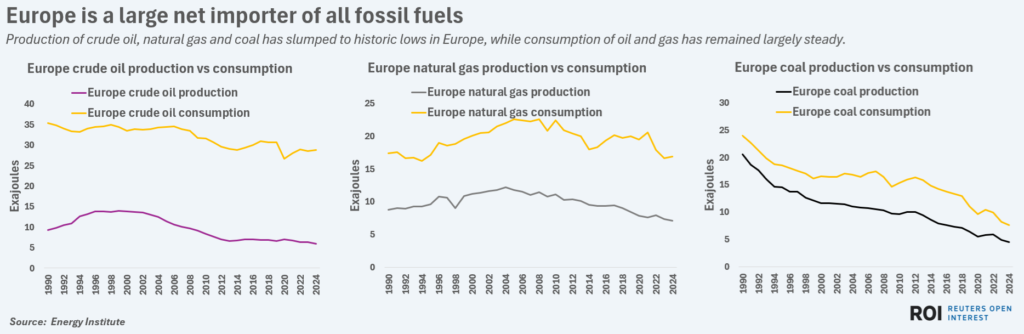
Production of crude oil, natural gas and coal has slumped to historic lows in Europe, while consumption of oil and gas has remained largely steady
Indeed, only half of Europe’s total energy supplies come from domestic sources, as the region’s production of oil, gas and coal has slumped to historic lows in recent years.
That means that roughly half of European energy supplies need to be imported, which in turn has resulted in rising regional power costs that have undermined business competitiveness and saddled households with hefty inflation.
To reduce that heavy import reliance, European utilities have ramped up generation from renewable energy sources while officials are currently designing policies aimed at electrifying more industries that currently burn fossil fuels for power.
Even so, Europe will likely remain one of the world’s most energy-insecure major markets, with Germany a particularly vulnerable economy that relies on imported energy for roughly 75% of its total energy needs.
Such an acute dependence on outside markets for energy means that governments and businesses alike are fully committed to boosting local energy supplies and security as quickly as possible.
But over the near term at least, that import dependence also means that Europe will likely feel the effects of the Iran war more acutely than most other regions.
CHINA’S SHIELD
China – the world’s largest energy consumer – consistently ranks as one of the world’s largest importers of oil, gas and coal.
However, those imported volumes play a relatively small role in terms of China’s total energy needs, as domestically sourced coal and clean power supplies account for around 83% of China’s total energy supplies.
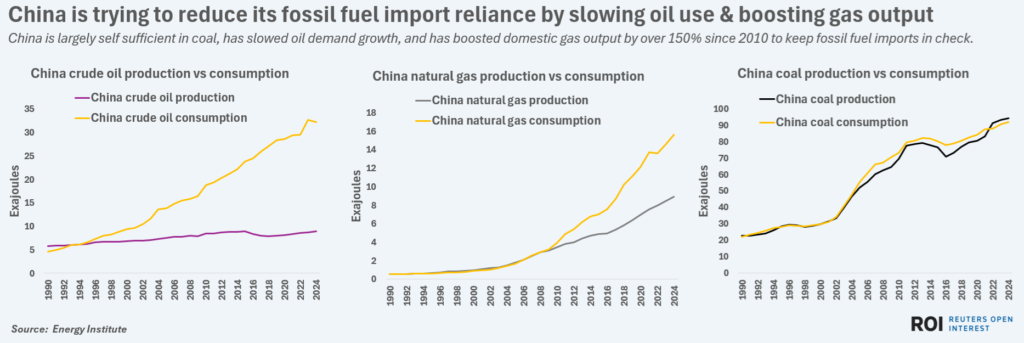
China is largely self sufficient in coal, has slowed oil demand growth, and has boosted domestic gas output by over 150% since 2010 to keep fossil fuel imports in check
China has also taken aggressive steps to ensure it has hefty inventories of key energy commodities on hand, and has steadily built up its reserves of crude oil from international markets over the past year or so.
Those stockpiles help provide China with a temporary buffer against the worst of the oil shock being felt elsewhere.
But China’s economy still chews through roughly 16 million barrels of crude oil each day, according to the Energy
Institute, which means that any inventory stash will get drawn down quickly.
That in turn means that even China – with hefty stockpiles and a high proportion of energy supplies from domestic sources – will also feel the full effects of the Iran disruption sooner or later.
The opinions expressed here are those of the author, a columnist for Reuters.
Reporting by Gavin Maguire; Editing by Lincoln Feast.
Share This: