CDN NEWS |
  US NEWS







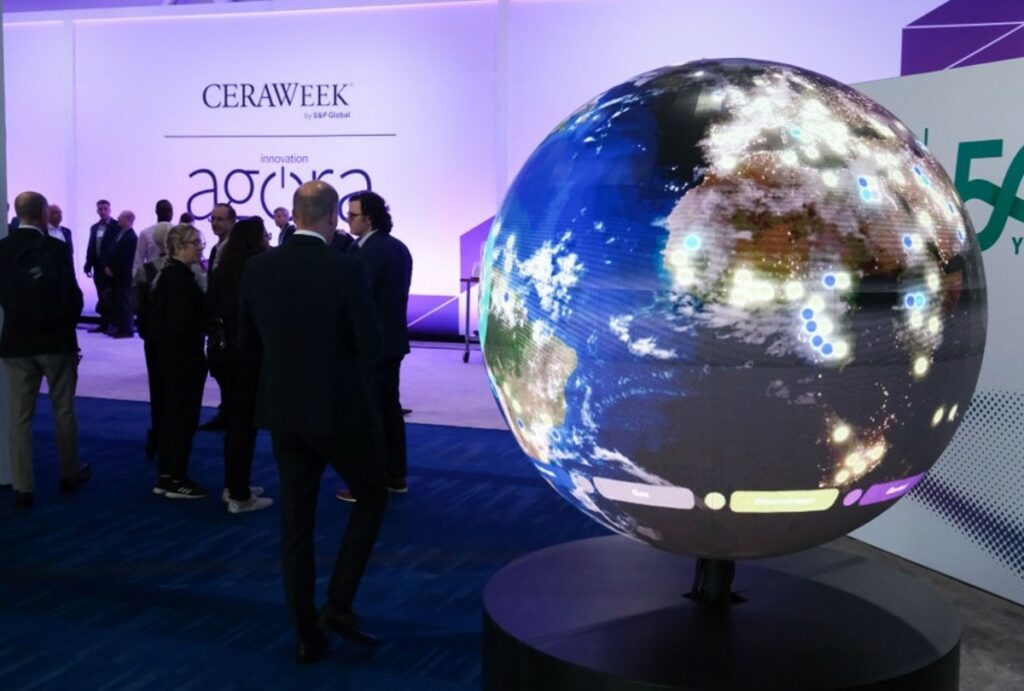
(Reuters) – The world’s top energy executives return to Houston next week as the escalating U.S.-Israeli war on Iran has become a nightmare for energy markets, as unprecedented attacks on infrastructure and shipping disruptions sent global oil prices soaring while governments scrambled to fight inflation and avoid recessions.
Global oil prices jumped this week, hitting almost $120, levels not seen since Russia’s war on Ukraine disrupted markets in 2022.
Industry experts and analysts expect prices to remain elevated long after combat operations end. They say it will take years for the region to recover from the upheaval caused by air strikes and Iran’s virtual closure of the Strait of Hormuz, conduit for 20% of the world’s oil and liquefied natural gas.
For instance, Qatar said a damaged liquefied natural gas facility will take years to repair.
At this year’s CERAWeek conference, over 10,000 attendees from more than 80 countries will also focus on Venezuela after the U.S. captured President Nicolas Maduro in January and eased sanctions on the South American OPEC member nation in an effort to kickstart its oil industry and boost investment.
“The geopolitics around energy has never flown as thick and as fast as it’s flowing right now…. the Gulf situation plus Venezuela, plus all the knock-on issues around Russia, it really is an extraordinary moment,” said Geoffrey Pyatt, who was assistant secretary of state for energy resources under former President Joe Biden and is now a senior managing director at U.S. consultancy McLarty Associates.
MIDDLE EAST CHAOS
The five-day event, set to begin on Monday, comes as Iran’s effective closure of the Strait of Hormuz has forced Middle Eastern producers to shut in much of their output. Tehran has also struck oil and gas targets in the Gulf, after Israel struck one of its large gas fields this week.
Consuming nations have mostly given up hope that disruptions would be short-lived. Many refineries and petrochemical companies, mostly in Asia, have cut runs, shut units or declared force majeure as the conflict disrupts crude and feedstock exports from the Middle East.
In the U.S., diesel prices have topped $5 a gallon for the first time since 2022, as gasoline pump prices have moved toward $4 a gallon. This has raised the political stakes for President Donald Trump and his Republican Party ahead of midterm elections in November.
CERAWeek participants and speakers include U.S. Energy Secretary Chris Wright, Interior Secretary Doug Burgum, ministers from OPEC+ members Nigeria and United Arab Emirates, as well as CEOs of Aramco, Chevron, Shell, TotalEnergies, and the Abu Dhabi National Oil Company.
“There has been more upheaval and disruption in markets than ever before…This is a war that’s been brewing for almost half a century, and the concerns about the Gulf have been prominent for half a century. But now it’s happening,” Dan Yergin, Pulitzer Prize-winning author and vice chairman of CERAWeek conference organizer S&P Global, said in an interview.
Security and affordability will be the defining words for CERAWeek, Yergin said, a quick pivot from weeks ago, when Big Tech and its relationship to the energy industry had been slated to be the preeminent theme.


“All those producers will look at the world differently, and countries will look at their degree of dependence differently. I think there will be a big push for diversified supplies,” Yergin said.
Policymakers worldwide are also now considering proposals to expand nuclear energy and renewables, grow strategic stockpiles and increase domestic production in a bid to reduce long-term dependence on oil and gas imports.
VENEZUELA’S POTENTIAL
A last-minute addition to the official CERAWeek agenda is Venezuelan opposition leader and Nobel Peace Prize winner Maria Corina Machado, who is expected to address attendees on Tuesday afternoon. Her team used the conference last year to present a detailed energy plan, and investors this year will watch for signals she might send about efforts by interim President Delcy Rodriguez to quickly boost production with Washington’s help as she pushes for a restoration of democracy.
“The fact that Maria Machado is addressing CERAWeek is a really interesting reflection of the still unresolved political story,” said Pyatt.
Dozens of investors have been scouting investment opportunities to plumb Venezuela’s huge crude oil reserves. They must contend with legal risks, regulatory uncertainty and old infrastructure that is unusable without significant investment.
U.S. Secretary of Energy Chris Wright said last month from Caracas he expects a “dramatic increase” in Venezuela’s production in the coming months, yet industry experts generally expect early expansions to boost output by as much as 500,000 barrels a day in as little as six months from a current 1 million bpd. That increase would be insufficient to offset the supply disruption from the Iran crisis.
AI AND TEXAS SHALE
The conference will also highlight the role of artificial intelligence in the energy industry and feature an exhibition space for start-ups and stalwarts to show off new technology.
Efficiency gains and new technology helped push U.S. crude oil production to a record 13.6 million barrels per day (bpd) last year. Yet the recent run-up in prices is unlikely to spur huge increases in output, unless prices remain elevated for many months, industry executives and analysts said.
Production from the Permian basin, which straddles West Texas and southeastern New Mexico, is set to grow by just 10,000 bpd this year to a record 6.6 million bpd, according to the U.S. Energy Information Administration.
For the U.S. production outlook, “I think it’s still status quo until there’s some visibility that this war either ends or isn’t going to end,” said Dan Pickering, chief investment officer for Pickering Energy Partners.
“It’s not going to be a tsunami,” Pickering added.
Reporting by Arathy Somasekhar in Houston; Editing by Nathan Crooks and David Gregorio
Share This: