CDN NEWS |
  US NEWS







By Justin Fox

Oil prices are up 15% since the US and Israel began attacking Iran last weekend, and gasoline prices have been following not too far behind. In a big-picture economic sense, this matters a lot less than it used to. The oil intensity of gross domestic product is down about 70% in the US and 60% worldwide since the 1973-1974 oil crisis. The share of US consumer spending going to gasoline and other motor fuel was just 1.8% in December, down from more than 5% in the aftermath of the 1979 Iranian revolution.
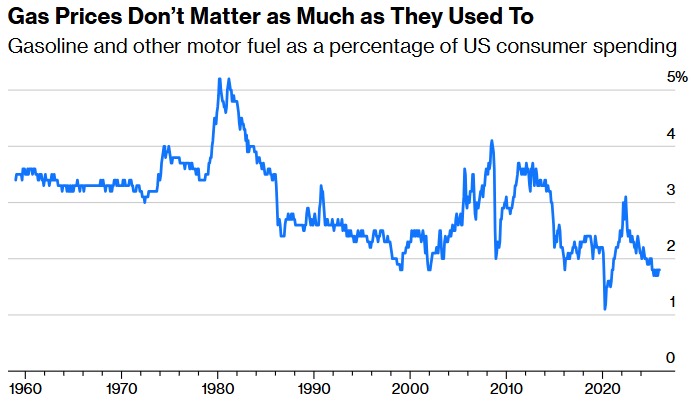
Source: US Bureau of Economic Analysis
Americans still hate it when gas prices go up, though. That’s partly because they’re among the most visible prices in the economy, but the fact that driving is essential to economic survival in most of the US seems relevant, too. Fuel costs are part of a much bigger package of expenses that come with owning or leasing a car or truck, and new and used cars and trucks have become much more expensive since the Covid-19 pandemic. Affordability has been economic topic A in the US since the inflation wave of 2021-2022, and cars and trucks have been a big part of that conversation.
So it’s a little strange to see that, when you put together all the different spending related to motor vehicles, it makes up a much smaller share of overall consumer spending than before the pandemic or at pretty much any other time over the past seven decades.
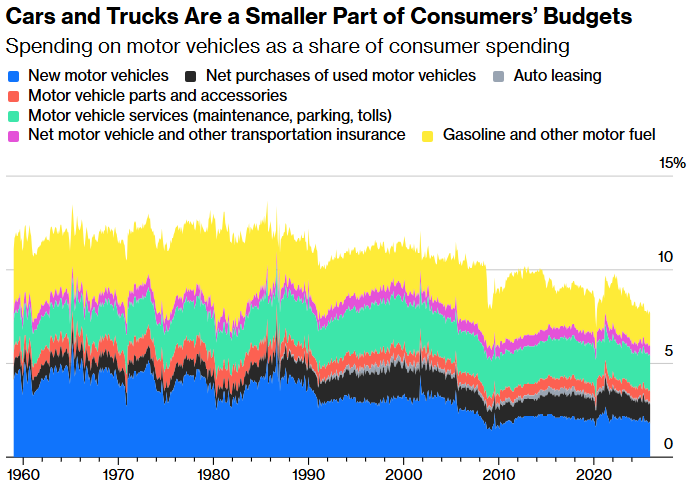
Source: US Bureau of Economic Analysis
Are Americans just imagining that they’re spending a lot on their cars? As so often with such questions, it’s a matter of which Americans you’re talking about. As you might expect, the answers vary somewhat by income, but in recent years an increasingly important differentiator has been the timing of the purchase. If it’s since the pandemic, and you’re in the middle class or below, motor vehicle ownership can be a huge burden — one exacerbated by any rise in gas prices. If that new vehicle is a massive pickup that cost $75,000 and gets 14 miles per gallon on the highway, and towing gigantic things isn’t part of your job description, I question your choices but can understand why you might be especially sensitive to prices at the pump.
Let’s start with the income breakdown. The statistics in the two charts above are from the personal consumption expenditures (henceforth PCE) data compiled by the US Bureau of Economic Analysis, the people who calculate GDP, and are derived from economy-wide spending data. The US Census Bureau also conducts an annual consumer expenditures survey (henceforth CE) on behalf of the Bureau of Labor Statistics where it asks people to keep diaries detailing their incomes and their spending, and that’s where the next four charts come from:
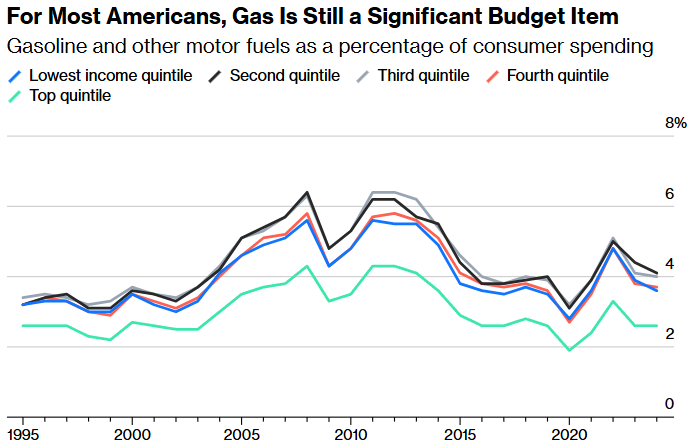
Source: US Bureau of Labor Statistics
Note: Numbers include motor oil for 1995-2022 and not for 2023-2024, but it makes up less than 0.1% of any quintile’s annual spending. Lower income bounds in 2024 were $29,932 in pretax income for the second quintile, $57,452 for the third, $94,511 for the fourth and $155,925 for the top quintile.
How can it be that Americans in every income group report that motor fuel is a bigger share of their spending than its 1.8% share in the PCE data? It’s partly that the PCE includes some spending categories that the CE survey does not and partly that the CE survey misses much of the spending in some categories that are included in both. As of 2010, its estimate of spending on gasoline and other energy goods was 78% of the PCE number, for example, but for alcoholic beverages purchased for off-premises consumption it was just 26%.
Anyway, it’s an indication — and there are many more if you look at the footnotes accompanying the data — that the CE statistics are imperfect. But they’re still informative, and they show that as of 2024 (the 2025 numbers won’t be out until October) the share of consumer spending going to motor fuel was lower than a couple of years earlier, albeit still higher for most income groups than before the pandemic. Add in the other costs of owning and operating a car or light truck, and the trend is mostly downward, but the share of spending is significant, ranging from 15.2% to 16.3% for the top four income quintiles (it’s lower for the lowest because so many can’t afford cars).
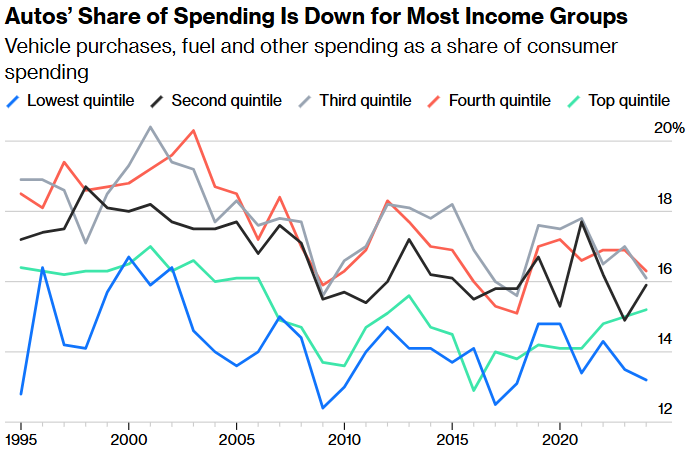


Source: US Bureau of Labor Statistics
Note: Spending categories are “vehicle purchases (net outlay),” “gasoline, other fuels and motor oil” (minus motor oil for 2023 and 2024) and “other vehicle expenses,” which is mainly maintenance and insurance. Lower income bounds in 2024 were $29,932 in pretax income for the second quintile, $57,452 for the third, $94,511 for the fourth and $155,925 for the top quintile.
Housing’s share of spending has been rising for all but the highest income quintile during this period, leaving less money to spend on everything else. Factor that in, and while the overall trend is still slightly downward for the middle three income quintiles, they are devoting about a quarter of their non-housing spending to their cars and light trucks, which seems like a lot.
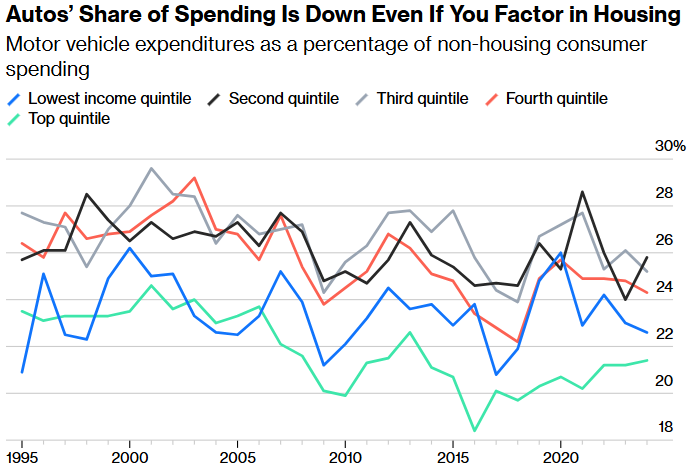
Source: US Bureau of Labor Statistics
Note: Spending categories are “vehicle purchases (net outlay),” “gasoline, other fuels and motor oil” (minus motor oil for 2023 and 2024) and “other vehicle expenses,” which is mainly maintenance and insurance. Lower income bounds in 2024 were $29,932 in pretax income for the second quintile, $57,452 for the third, $94,511 for the fourth and $155,925 for the top quintile.
The spending breakdown for the very middle of the income distribution reveals something interesting about their downward spending trend. Since 2019, the quality-adjusted price of new and used motor vehicles has risen 25%, according to BLS inflation statistics, and interest rates on auto loans are much higher, too. But vehicle purchases made up a lower share of non-housing spending for middle-income Americans in 2024 than in 2019 and in most other years over the past three decades.
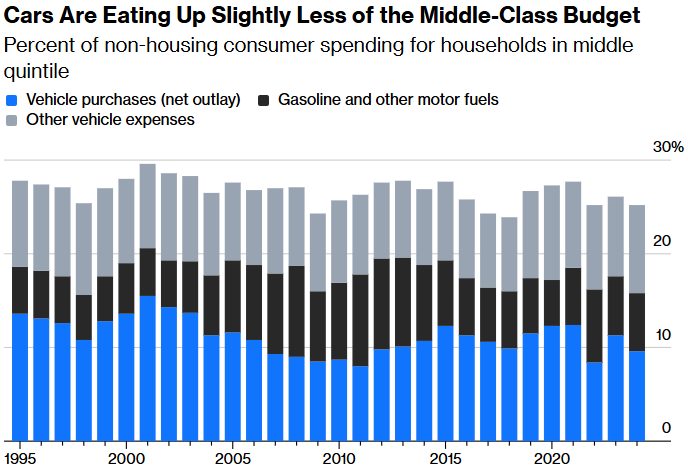
Source: US Bureau of Labor Statistics
Note: In 2024 the middle, third quintile (the 40th to 60th percentiles of the income distribution) was consumer units (like households, but not exactly) with pre-tax incomes of $57,542 to $94,510. Gasoline and other motor fuels includes motor oil except in 2023 and 2024 (but is less than 0.1% of spending in other years).
My read of this is that middle- and lower-income consumers are putting off replacing their vehicles for as long as they can. Higher-income consumers are less constrained, and the share of the top quintile’s non-housing spending going to vehicle purchases was higher in 2023 and 2024 than in any year since 2006. But overall, the light trucks and especially the cars on America’s roads have just been getting older and older.
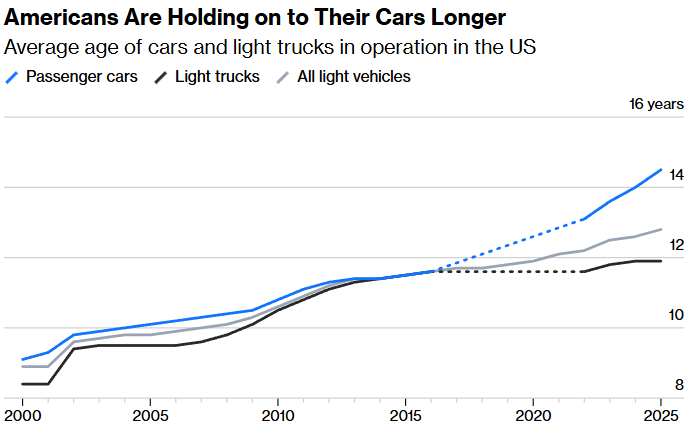
Source: US Bureau of Transportation Statistics
Note: Breakdown between cars and light trucks not available for 2017-2021.
What’s going on here bears some similarities to the housing market, where those who bought or refinanced before 2022 when mortgage rates were below 4% are in a completely different and much more comfortable boat from those buying since then. But while their durability has greatly increased over the decades, cars and trucks generally don’t last forever, and even the most frugal vehicle owners are eventually forced to to buy another one. That is when things can get rough. “Buying a car — new or used — has become a debt trap for many,” Washington Post personal finance columnist Michelle Singletary wrote earlier this year. Nearly 20% of new car loans now come with monthly payments of more than $1,000, reports data provider Edmunds, and more than 20% take seven years to pay off. For many middle-income households, a $1,000 monthly auto-loan payment can boost motor-vehicle-related costs toward 50% of non-housing spending. It will thus perhaps not surprise you to learn that in the fourth quarter of 2025, 5.2% of auto-loan balances were 90 or more days delinquent, a rate last seen in the aftermath of the 2007-2009 recession.
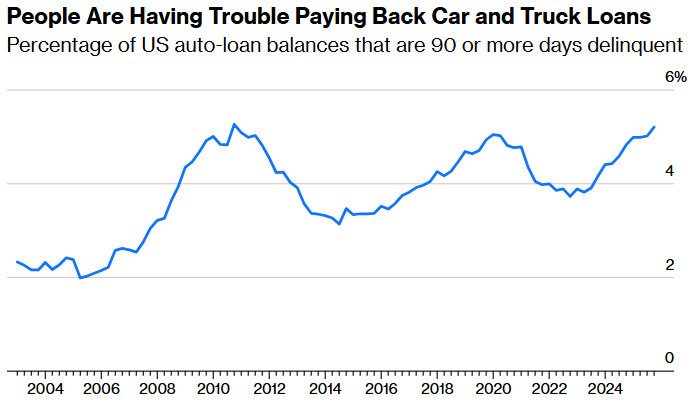
Source: Federal Reserve Bank of New York
The budget bill enacted last year did provide some relief for vehicle buyers — annual deductions through 2028 of up to $10,000 in interest on loans to buy American-made vehicles. But President Donald Trump’s tariffs are boosting purchase prices, and now his attacks on Iran are raising gas prices. Neither of those effects seems enough by itself to derail the US economy. But they’re definitely tough on some car and truck owners, especially buyers of $75,000, 14 mpg pickup trucks.
This column reflects the personal views of the author and does not necessarily reflect the opinion of the editorial board or Bloomberg LP and its owners.
Share This: