CDN NEWS |
  US NEWS







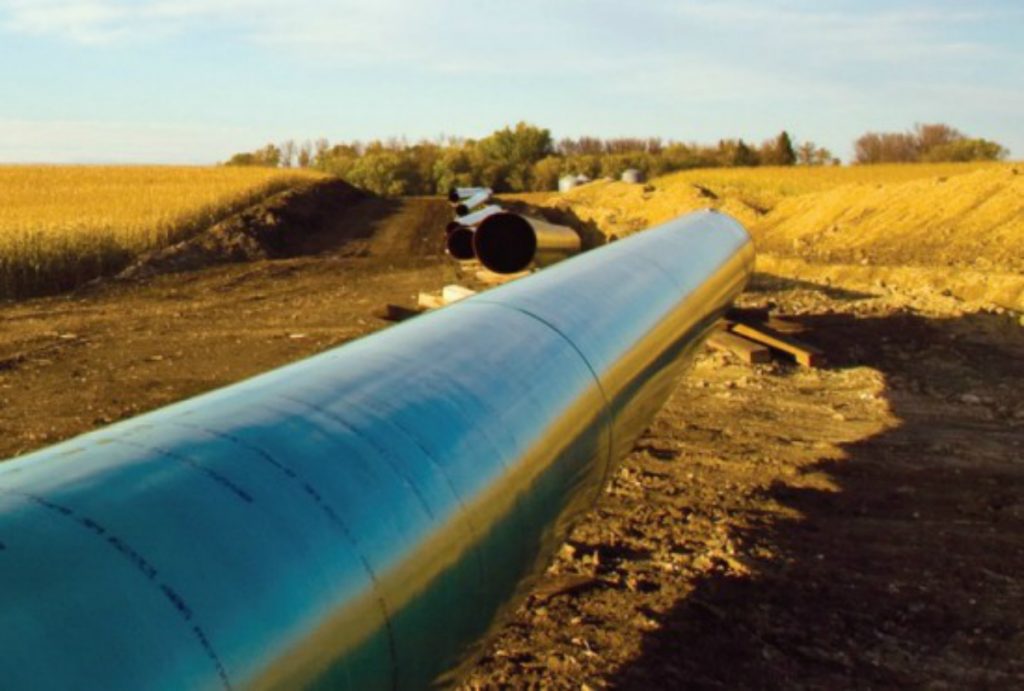
The line from Canada to Wyoming could potentially piggyback off pipe laid for the cancelled project
This Article and More by Meghan Potkins Here
A major new oil pipeline proposed to carry crude from the Canadian border to a hub in Wyoming could potentially piggyback off of existing pipe laid for the cancelled Keystone XL project, according to industry analysts and experts.
Regulatory filings submitted in Montana last month show a private U.S. company, Bridger Pipeline LLC, plans to build a 550,000-barrel-per-day pipeline that begins at the Canada-U.S. border near Phillips County, Montana.
The filings do not explicitly say what infrastructure the line would connect to on the Canadian side. But analysts at Plainsview Energy Analytics and RBN Energy say the proposed route suggests it could link to the partially constructed Keystone XL system in Alberta.
“Given the proposed border origin point, the only infrastructure that appears capable of supplying that scale of incremental volume is the partially constructed Keystone XL system in Alberta, which has remained idle since 2021,” RBN Energy analyst Liz Dicken wrote in a recent note.
First proposed in 2008, Keystone XL was a planned expansion of the existing Keystone pipeline system that would have carried up to 830,000 barrels per day from Alberta to Nebraska, connecting into lines serving refineries in the U.S. Midwest and along the Gulf Coast. The project became a flashpoint in U.S. politics, with its cross-border permit blocked, revived and then blocked again.
TC Energy Corp., which owned and operated the Keystone network before spinning off the assets to South Bow Corp., suspended the expansion project in 2021. The company had already laid some pipe in the ground on the Canadian side, where it remains, untapped.
South Bow declined to confirm reports of a possible revival Monday. But in a statement, the company said it is evaluating an expansion that would “leverage existing infrastructure” and permits to connect to pipelines in the U.S.
“The concept is in early stages and South Bow will work with prospective customers, stakeholders and rights holders before sharing further details,” South Bow said.


The proposal has surfaced just as oil producers in Western Canada once again turn their attention to the sector’s perennial struggle with export capacity. Two of Canada’s main export routes — Trans Mountain Corp.’s newly expanded line to the West Coast and Enbridge Inc.’s Canadian Mainline — are operating at near capacity.
Last year, South Bow was reportedly examining another option to leverage its Keystone XL assets through a potential tie-in to Energy Transfer LP’s Dakota Access pipeline. Though the plans with Energy Transfer did not progress, analysts say the company has spoken openly with investors about using the existing infrastructure to reduce upfront capital costs of a possible new cross-border pipeline.
South Bow did not respond to questions about how much usable infrastructure from the failed project remains. However, as much as 150 kilometres or more of pipe may be left in Alberta, according to a 2021 CBC News report.
Former Alberta premier Jason Kenney, whose government pledged US$5.3 billion towards the extension project, told the Financial Post last year that pipe already laid between Hardisty, Alberta and the U.S. border could provide a “head start” if the project were revived or a similar project were proposed again.
Unlike Keystone XL, which was designed to run southeast to Nebraska, Bridger’s smaller proposal would move crude south from the border to a storage and pipeline hub in Guernsey, Wyoming.
According to the application, the proposed route would largely follow existing pipeline corridors, including significant stretches alongside pipelines owned or operated by Bridger, as well as other existing infrastructure.
Still, like Keystone XL before it, the cross-border pipeline would require a presidential permit, said Richard Masson, former head of the Alberta Petroleum Marketing Commission.
“I guess under Trump they’re not as worried as they would be under (the Democrats),” Masson said, noting the presidential permit for Keystone was denied in 2015 and reinstated in 2017 during Donald Trump’s first term, before being revoked in 2021 by Joe Biden.
“There’s still going to be a lot of perceived risk for the validity of any permit going forward based on the history,” he said. “It’s good that there’s people trying to work on options, but I’m not sure that they are going to be easy to achieve.”
The new proposal would also compete directly for Canadian oil with Enbridge’s planned expansions to its Mainline system.
Enbridge has already sanctioned a first phase of Mainline improvements that will add about 150,000 barrels per day by 2027. It has indicated a second phase could add around another 250,000 barrels per day by 2028 to a network that already moves about three million barrels per day into the U.S.
- Email: [email protected]
Share This: