CDN NEWS |
  US NEWS







Smith’s criteria suggest Prince Rupert may be the top option, as the city is already home to Canada’s third-largest port
By Thomas Seal
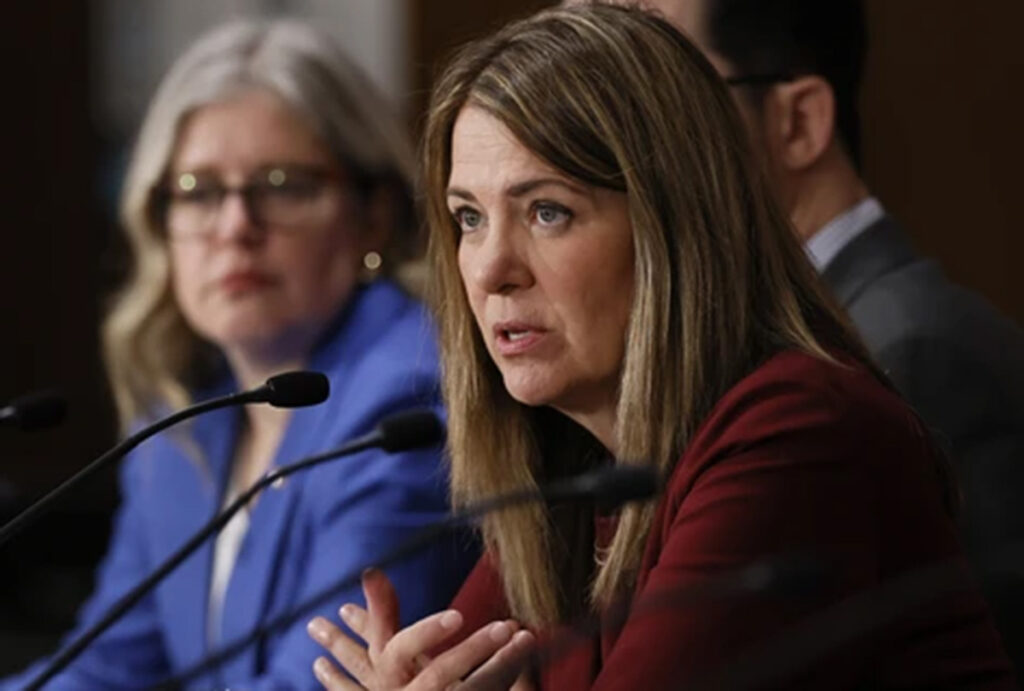
Danielle Smith said last week she and B.C. Premier Eby share “so much common ground” on resource development, including the possibility of expanding Trans Mountain again. Photo by Blair Gable/Postmedia files
Alberta is homing in on potential routes for a proposed new oil pipeline to Canada’s west coast, and a northwest location may hold the most advantages, Premier Danielle Smith suggested.
“I think there’s five different ports that are in consideration right now,” she said in an interview with Bloomberg News. Her government wants to add enough capacity to carry an additional 1 million barrels a day to an ocean port, from which it could be shipped to Asian buyers.
Alberta has launched technical studies on the project in an attempt to get it approved faster by the federal Major Projects Office.
Canadian Prime Minister Mark Carney has prioritized diversifying trade away from the United States in light of President Donald Trump’s tariff policy. Energy is the country’s biggest export and the U.S. its biggest market, but it’s looking to sell more oil and gas to China, India and other nations.
On Jan. 27, Carney told Parliament that a deal he signed with Alberta in November “will build a pipeline to tidewater.” But there’s still an intense debate over whether to build one, where it should go and at what cost.
Smith has ruled out the British Columbia town of Kitimat as an endpoint, calling the remote community at the end of windy fjords “too complex” for oil tankers.
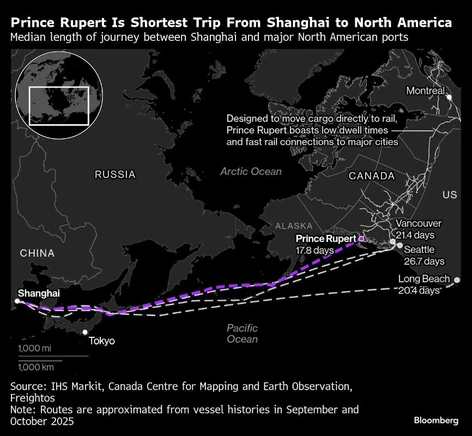
Her criteria suggest Prince Rupert may be the top option. The northern city is already home to Canada’s third-largest port after Vancouver and Montreal. It’s a key exit point for Alberta commodities such as grain, propane and plastics, as its location gives it faster shipping times to Asia than further south.
On the advantages of northwest B.C., Smith said: “Maybe it makes more sense to take it up to an area where there’s less congestion and it might allow for additional export of other items, if you end up with a 24-hour a day operation on more high-value products like that.”
But any project through northern B.C. faces potentially difficult negotiations with Indigenous communities, many of whom have voiced opposition to crude pipelines. Oil tankers are currently banned by federal legislation from operating along that portion of the B.C. coastline.


Another option would be to send the oil southwest to the Vancouver region.
In 2024, an expanded Trans Mountain pipeline opened to ship Albertan heavy crude to Asian markets via a terminal in Burnaby, B.C. After a contentious process and multiple attempts to block it were thwarted, the pipeline is now owned by the federal government.
Smith’s office declined to disclose the five sites under consideration.
The Port of Vancouver is planning a major expansion of container-handling capacity at Roberts Bank, south of the city of Vancouver and just north of the U.S. border.
Andrew Leach, an economics professor at the University of Alberta who previously worked for the provincial government, said that could be a possible location for a new pipeline terminus, for instance if Trans Mountain was expanded again.
A southern B.C. port would face both opposition from environmental activists and the complexities of building yet more infrastructure through a densely-populated metro area, said Heather Exner-Pirot, a senior fellow at the Macdonald-Laurier Institute, a think tank.
Exner-Pirot and Leach both said another possible site could be the inlet at British Columbia’s northern border with Alaska, in the territory of the Nisga’a Nation, where a large liquefied natural gas plant called Ksi Lisims is awaiting a final investment decision.
B.C. Premier David Eby unsuccessfully opposed Trans Mountain’s development and has criticized the renewed national focus on an additional oil pipeline.
However, Smith said last week she and Eby share “so much common ground” on resource development, including the possibility of expanding Trans Mountain again. Eby called a recent meeting with Smith “borderline friendly” and said B.C.’s “role constitutionally is pretty limited” in the pipeline debate.
Bloomberg.com
Share This: