


 CDN NEWS |
  US NEWS







By Niccolo Conte | Article/Editing: Bruno Venditti | Graphics/Design: Amy Realey
Key Takeaways
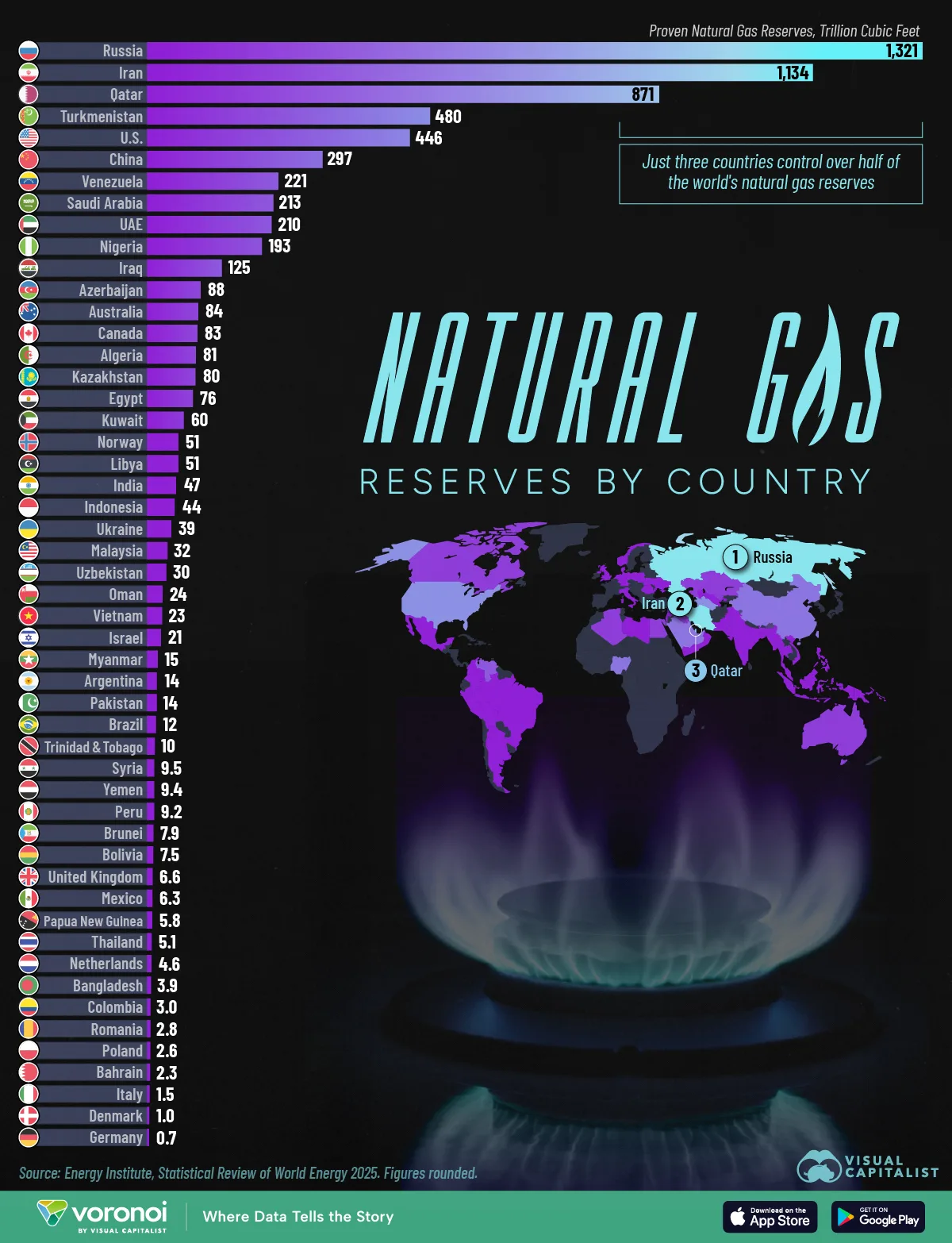
- Russia, Iran, and Qatar together hold more than half of the world’s proven natural gas reserves.
- Natural gas reserves are heavily concentrated in a small number of countries, shaping global energy and geopolitics.
Natural gas plays a critical role in the global energy system, powering electricity generation, heating homes, and supporting industrial activity. Despite its widespread use, the world’s natural gas reserves are highly unevenly distributed.
This visualization ranks countries by their proven natural gas reserves, measured in trillion cubic feet. The data for this visualization comes from the Energy Institute’s Statistical Review of World Energy 2025.
A Handful of Countries Dominate Global Reserves
Just three countries—Russia, Iran, and Qatar—control over half of the world’s proven natural gas reserves. Russia alone holds more than 1,300 trillion cubic feet, giving it the largest national stockpile globally.

Before Russia’s 2022 invasion of Ukraine, around 40–45% of EU gas imports came from Russia, but that share has since fallen to around 13–19% as of mid-2025.
The Middle East and Eurasia Lead


Beyond the top three, countries such as Turkmenistan, Saudi Arabia, the United Arab Emirates, and Iraq add to the Middle East and Central Asia’s strong position in global gas reserves.
These regions benefit from vast, low-cost reserves that can support long-term production, making them central players in global liquefied natural gas (LNG) exports.
The United States and China Among Top Holders
The United States ranks fifth globally, with roughly 446 trillion cubic feet in reserves, reflecting the impact of shale gas development over the past two decades.
China also appears among the top holders, though its domestic demand is so large that it remains heavily dependent on imports despite sizable reserves.
Smaller Producers Still Matter Regionally
Countries with more modest reserves—including Norway, the United Kingdom, and the Netherlands—continue to play important regional roles due to existing infrastructure and proximity to major demand centers.
However, declining reserves in parts of Europe underscore the continent’s growing reliance on imports.
Share This:


















COMMENTARY: The Dangerous Politics of US Oil-Driven Redistribution