CDN NEWS |
  US NEWS







|
|

The Roosevelt Corollary to the Monroe Doctrine:
“Chronic wrongdoing, or an impotence which results in a general loosening of the ties of civilized society, may in America, as elsewhere, ultimately require intervention by some civilized nation, and in the Western Hemisphere the adherence of the United States to the Monroe Doctrine may force the United States, however reluctantly, in flagrant cases of such wrongdoing or impotence, to the exercise of an international police power.” – 24th U.S. President Theodore Roosevelt’s corollary to the Monroe Doctrine, delivered during his State of the Union Address, December 6, 1904.
The Trump Corollary to the Monroe Doctrine:
“After years of neglect, the United States will reassert and enforce the Monroe Doctrine to restore American preeminence in the Western Hemisphere, and to protect our homeland and our access to key geographies throughout the region. We will deny non-Hemispheric competitors the ability to position forces or other threatening capabilities, or to own or control strategically vital assets, in our Hemisphere.” – Passage contained in the Trump Administration’s 2025 National Security Strategy published November, 2025.
Prologue
In late November, the Trump White House issued a new national security strategy which it says is designed to “reassert and enforce the Monroe Doctrine to restore American preeminence in the Western Hemisphere.” The authors call it the “Trump Corollary” to President James Monroe’s 1823 policy that declared the Western Hemisphere a distinct U.S. sphere of influence.
Under Trump’s corollary, the president maintains he can authorize the Pentagon to engage in “non-international armed conflict” with terrorists. Given that the State Department had earlier designated Venezuela-based Cartel del Soles (Cartel of the Suns) and its affiliated cartel network as international terrorist organizations, and America’s longstanding policy that Nicolas Maduro stole his 2020 re-election and was not the legitimate leader of the country, this corollary frees the U.S. President to take action against him and his regime without seeking prior approval from congress.
It is key to note here that the second sentence of Trump’s new Corollary can logically be applied to both China and Russia and their key strategic investments across Central and South America, including Chinese-controlled port operations at either end of the Panama Canal, in Cuba, and its many other infrastructure investments throughout Central and South America. If President Trump intends to continue applying his new Corollary over his three remaining years in office, he will enjoy a target rich environment.
Trump Applies Both Corollaries to Nicolas Maduro
In the wee hours of January 3, 2025, Trump applied both the Roosevelt Corollary and the Trump Corollary to Nicolas Maduro. Maduro and his wife, Cilia Flores, were taken into custody by U.S. special forces and transported by the military to New York City, where they will face numerous charges related to indictments issued by a federal grand jury in 2020.
During his press conference Saturday morning in which Trump and his key officials detailed the operation to capture Maduro and seize control of the Venezuelan power structure, the President made clear that his administration will set the rules for the re-invigoration of Venezuela’s oil sector. The U.S. hasn’t exactly seized control of petroleum assets worth trillions, but it plans to set the rules of capture, production, refining, and export, and there is every reason to assume those rules will inure to America’s benefit.
Here’s a clip of some of what the President said:

Transcript:
As everyone knows, the oil business in Venezuela has been a bust, a total bust, for a long period of time. They were pumping almost nothing by comparison to what they could have been pumping and what could have taken place. We’re going to have our very large United States oil companies, the biggest anywhere in the world, go in, spend billions of dollars. Fix the badly broken infrastructure, the oil infrastructure, and start making money for the country. And we are ready to stage a second and much larger attack if we need to do so. So we were prepared to do a second wave if we needed to do. We actually assumed that a second wave would be necessary, but now it’s probably not.
[End]
President Trump’s statement that the United States has effectively gained control over Venezuela’s vast crude oil reserves and plans to control the process under which they will be developed and brought to market resets the global energy equation. The President’s further statement that his administration will work hand in glove with, specifically, America’s largest oil companies to restart and rebuild Venezuela’s oil sector no doubt sends shockwaves through corporate C-suites of the world’s biggest corporate drillers.
Which companies stand to benefit from this application of the Trump Corollary? Well, Chevron for one. The Houston-based giant has managed to retain its foothold in the country despite the expropriations of oil company assets executed by both Maduro and former president Hugo Chavez over the last 25 years.
Before Chavez invoked his seizing of assets policies, both ExxonMobil and ConocoPhillips were also big producers in the country. Presumably, Trump’s intention is to also bring those two giants into the rebuilding process.
Keep in mind here that other major companies not based in the United States were also major producers of Venezuelan crude. Those include British-based Shell and BP, as well as French major TotalEnergies and Norway’s Equinor.
It is unclear as of this writing whether those non-U.S. companies will be invited into the new program. But we can be sure that they will attempt to aggressively leverage their ways into the program using whatever means available to them, given the magnitude of the potential prize.
The geopolitical implications are enormous:
- Venezuela sits atop an estimated 303 billion barrels of proven reserves, the largest in the world.
- At current prices hovering around $57 per barrel, that’s a staggering $17.3 trillion in potential gross value.
- Even if extracted and sold at half that rate to account for production challenges, we’re talking about $8.7 trillion – more than the GDP of every nation on Earth except the U.S. and China.
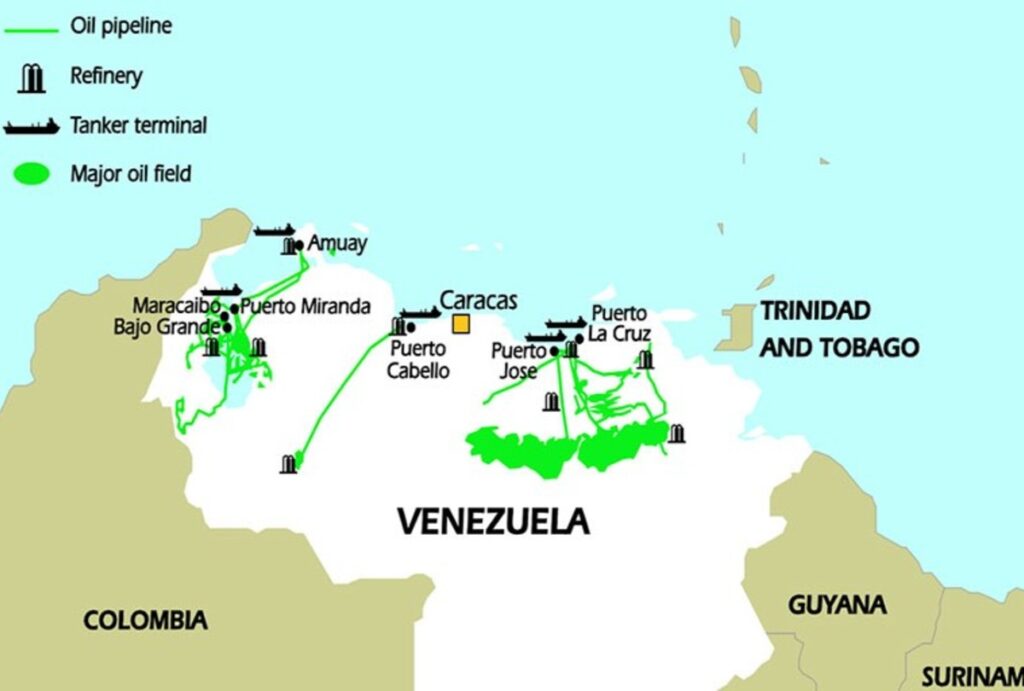
Make no mistake: This move, executed in a swift 12-hour operation, marks a pivotal shift in U.S. energy strategy. For years, Venezuela’s oil wealth has been squandered under the socialist regimes led by Chavez and Maduro, whose mismanagement turned the once-prosperous OPEC founder into an economic basket case. Hyperinflation, corruption, and international sanctions crippled production, dropping output from almost 4 million barrels per day in the late 1990s to about 1 million bpd today. Now, with Maduro ousted, Trump plans to swing the door back open for American firms to revitalize this treasure trove.


This is a geopolitical coup: If properly managed, it could result in a tectonic realignment of global resource flows.
This injection of major new assets into the support structure for the petrodollar system – which had been struggling over the past 3 years to retain its dominance over international trade – combined with the second reminder of America’s unrivaled military might in the past 8 months, re-establishes the United States as the dominant global power. The reassertion of U.S. authority and willingness to enforce the Monroe Doctrine places hundreds of billions of dollars in investments and years of geopolitical maneuvering by both Russia and China at full risk.
Back to oil: Again, if it’s all properly managed – and history tells us it is a very big “if” – this is a move which greatly enhances U.S. leverage over global oil pricing mechanisms for years to come.
From a practical standpoint, unlocking Venezuela’s potential won’t be instantaneous. The Orinoco Belt, home to much of these heavy crude reserves, requires advanced extraction technologies like steam injection and diluents for transport – technologies and processes in which U.S. companies like Chevron and ExxonMobil excel. Past joint ventures under Maduro were hampered by expropriation risks and crumbling infrastructure, but a pro-U.S. interim government could fast-track investments.
The Venezuelan oil sector will be looking at billions in capital inflows, creating jobs in refining, pipelines, and shipping. Still, even with all that new investment flowing in, it can be safely assumed that we are looking at lead times of 5 to 7 years before the sector can be fully restored.
While we know Trump’s plan will be fraught with pitfalls and opposition from a wide variety of interests, the administration and companies likely to become involved do have a nearby success story to use as a model. That model sits right next door in the highly successful development of offshore oil blocks owned by neighboring country Guyana, operated by ExxonMobil.
As it happens, Chevron successfully acquired a 30% interest in the Guyana project last year as part of its buyout of Texas independent Hess Corp. Perhaps an even more interesting aspect of that development is that CNOOC – the Chinese National Offshore Oil Company – is a 25% owner in that Consortium.
Given ExxonMobil’s highly successful and cooperative working relations with the Guyanese government through multiple presidential administrations and Chevron’s uninterrupted operations in Venezuela, no companies are better positioned to help lead the rebuilding effort.
The move to revive Venezuelan oil production also greatly enhances Trump’s leverage in trade negotiations with Canada and its Prime Minister, Mark Carney.
Frustrated with Trump’s tariffs on his oil exports into the U.S., Carney has been working with Albertan Premiere Danielle Smith on a deal to build a massive new pipeline to reroute oil sands crude to the West Coast for shipment to Asian markets. Carney believed he had leverage over Trump in this equation, given that most U.S. Gulf Coast refineries are geared to process the heavy Canadian crude. Now, armed with control over Venezuela’s heavy crude riches, the leverage reverses in Trump’s favor.
Checkmate.
Globally, the ripple effects are profound.
- OPEC+ dynamics shift dramatically; with Venezuela’s output potentially ramping to 2-3 million barrels daily within the next 5-7 years, quota negotiations become a U.S.-influenced affair.
- Russia and Iran, already strained by sanctions, lose further bargaining power.
- Europe, grappling with energy security in what will hopefully soon become a post-Ukraine era, stands to gain a stable Western supplier, but only if its leaders at the EU decide to work more productively and cooperatively with the U.S. government than they have done in recent months.
- China, Venezuela’s top creditor with $60 billion in loans tied to oil shipments, will be forced to recalibrate and decide how best to respond to what it has already denounced as unjustified U.S. aggression.
Critics will decry this as neo-imperialism, echoing Russia’s actions in Ukraine. To which Trump will most likely respond with his best imitation of Ayn Rand’s mythical Atlas shrugging.
It’s important to be clear here: Maduro’s regime functioned as a narco-terror state, propped by human trafficking and drug networks that spilled into U.S. borders, killing tens of thousands of U.S. citizens annually.
This intervention fully aligns with the Monroe Doctrine’s modern revival – protecting the Western Hemisphere from malign influences. Russia and China can complain about U.S. infringement on their investments in the region, but they ignored the potential for an American president invoking the Monroe Doctrine at their own peril. Trump’s new Corollary was no secret – the whole world had every opportunity to read it and reflect on its meaning when it was published in November. If Xi and Putin failed to do that, that’s their failing.
Of course, risks abound. Chinese control of supply chains, legal challenges under international law, and environmental pushback from green activists could and no doubt will complicate extraction. Venezuela’s heavy oil is carbon-intensive, clashing with global net-zero goals. Yet, in the Trump-led rising era of energy realism, physics wins over narratives, and pragmatism overrules ideology, as even green-boosting billionaire Bill Gates recently conceded.
Trump’s critics and America’s rivals must also deal with the likelihood that this move taking down the Maduro regime is almost certainly not the end game, but the first move in a longer campaign that will likely extend to other South and Central American nations actively involved in the drug trade and human trafficking. Those include Colombia, Cuba, and Mexico. Other leftwing bosses in the hemisphere, like Brazil’s Lula da Silva – himself elected under highly suspicious circumstances in 2022 – are no doubt feeling mighty nervous about their own status in light of Trump’s willingness to reapply U.S. regional hegemony.
Bottom line: Trump is scrambling the geopolitical chessboard. Throughout the 20th century and across the first quarter of the 21st, control of oil reserves has always served as the single most important factor in the exercise of geopolitical leverage. With this move into Venezuela, no country controls more massive reserves of oil than the United States does today.


That is All
Share This: