CDN NEWS |
  US NEWS








Infusion of fresh capital and international buyers sharpens competition
CALGARY, Alberta (January 28, 2026) — Enverus Intelligence® Research (EIR), a subsidiary of Enverus, the most trusted energy-dedicated SaaS company that leverages generative AI across its solutions, is releasing its summary of 4Q2025 U.S. upstream M&A activity and full-year analysis.
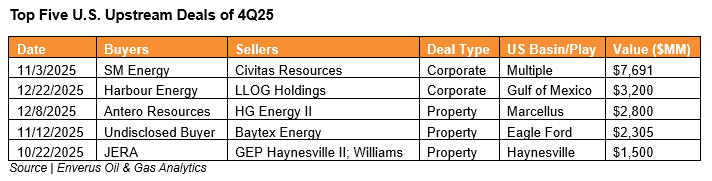
After a midyear slowdown, U.S. upstream M&A regained momentum in 4Q25, closing with $23.5 billion in announced deals and pushing full-year 2025 activity to $65 billion. The rebound reflects a deeper bench of motivated buyers including refunded private equity teams, increased use of securitized financing and new international entrants all competing for scarce assets.
“In the closing months of 2025 it looks like the market found its edge again even with fewer headline-making mega-mergers as it reached a faster pace of acquisitions and divestments,” said Andrew Dittmar, principal analyst at Enverus Intelligence Research. “Fresh capital is back in the field, and the buyer mix has broadened in a way that keeps pricing firm. Reloaded private equity is hunting, ABS-backed groups are bidding aggressively for cash-flowing production, and international companies are no longer limiting their U.S. interest to the most obvious gas trades. That combination helped deal activity finish the year in strong form and sets up an active 2026.”
International buyers accounted for roughly $6 billion of 4Q25 acquisitions, underscoring a continued willingness to pay for exposure to U.S. commodities. Last year international capital reached a seven-year high for acquisitions of U.S. upstream assets. Besides the obvious Haynesville deals, buyers chased Gulf of Mexico and DJ Basin assets. International buying in U.S. upstream markets soared to a seven year high of $7.4 billion in 2025, only to be topped in the first month of 2026 as Mitsubishi made a blockbuster $7.5 billion purchase of Aethon Energy. That deal returned attention to the core Haynesville focus region as international buyers continue to prioritize Gulf Coast gas. With opportunities in the Haynesville becoming sparse, EIR expects buyers to look at other options including Eagle Ford and Anadarko Basin options for gas exposure.
At the same time, buyers deploying asset-backed securitization (ABS) have become increasingly influential, particularly in transactions centered on production-heavy assets with second-tier inventory, adding competition in segments that historically traded at wider discounts.
Deal flow in 4Q25 highlighted stronger activity outside the Permian’s premium corridors. Gulf Coast gas pricing continued to climb on intensifying demand, while Appalachia remained steady with public buyers prioritizing adjacency and operational fit. By contrast, Permian-only transactions were a minor portion of 4Q25 value reflecting the scarcity of top-tier packages coming to market and limited willingness among Permian pure-play E&Ps to exit. The few remaining private operators holding high-quality Permian assets are likely waiting for a more constructive crude price environment in order to receive top dollar. Given the challenge of buying back in, they may view current holdings as the last chance to make a big splash on a Permian sale. The biggest fourth quarter bet on the Permian came from SM Energy’s corporate merger with Civitas Resources, a multi-basin deal that also included significant holdings in the DJ Basin.
EIR’s analysis continues to show A&D or asset markets ascribing more value to inventory than public equities. This creates a strategic tension for public E&Ps: divestitures can crystallize value that equity markets do not fully recognize, but selling too much inventory raises concerns about duration. The result is a cautious posture from public companies that may favor matching non-core sales with acquisition opportunities in core focus regions that build operational synergies.
There were a couple noteworthy public E&P mergers in 2025 with the tie-ups of Crescent Energy with Vital Energy and the fourth quarter merger of SM Energy and Civitas Resources. These deals represent smaller public E&Ps like Civitas and Vital with challenging strategic options moving forward deciding to exit. However, the yardstick for markets approving of these types of deals is high with operational synergies expected. The lack of attractive strategic combinations has likely put a damper on further consolidation. But more multi-basin tie-ups always remain a possibility.
“Public equity investors are demanding precision in deals,” Dittmar said. “In 2025 investors rewarded deals that were clearly additive with overlapping operations, credible cost synergies and durable inventory quality but penalized transactions that looked like scale for scale’s sake. At the same time, private market clearing prices for inventory have stayed resilient, which is why we’re seeing a wider gap between what assets can fetch in M&A and how similar inventory is valued in equities. That gap is likely to keep non-core divestitures on the table in 2026 with the Anadarko Basin, Williston Basin and Utica likely focus regions.”
In Canada, EIR sees conditions that favor continued corporate consolidation. Canadian upstream M&A approached $20 billion in 2025, driven largely by Montney and Duvernay corporate activity. Compared with the U.S. where strong asset pricing can motivate portfolio disaggregation, Canada’s setup is more conducive to further scale-building combinations as operators seek scale to efficiently utilize infrastructure and market relevance.
“Canada has the ingredients for more consolidation,” Dittmar added. “The corporate market there is still working through the logic of scale by combining contiguous positions to improve capital efficiency. That contrasts to the U.S. market defined by strong A&D markets and diversity of buyer groups. If commodity prices stay range-bound, we expect Canada to remain an active arena for strategic combinations, while U.S. deal flow leans toward targeted asset trades and selective bolt-ons.”
As 2026 begins, EIR expects upstream M&A to remain active, led by A&D and supported by fresh private capital, ABS-backed buyers and sustained international interest. With fewer top-tier Permian packages transacting, the market’s center of gravity should continue to broaden toward gas-weighted plays and non-core regional opportunities. The key themes to watch are the durability of the equity-versus-M&A valuation gap, the pace of public-company divestitures and continued consolidation in Canada. “The biggest questions headed into 2026 will be around commodity prices and the strategic direction taken by public companies,” concluded Dittmar. “Price stability should keep markets rolling while an influx of volatility from multiple geopolitical risk factors could derail markets. We know private capital is ready to buy, the question is whether public E&Ps are ready to sell.”
Share This: