CDN NEWS |
  US NEWS







By Ari Natter
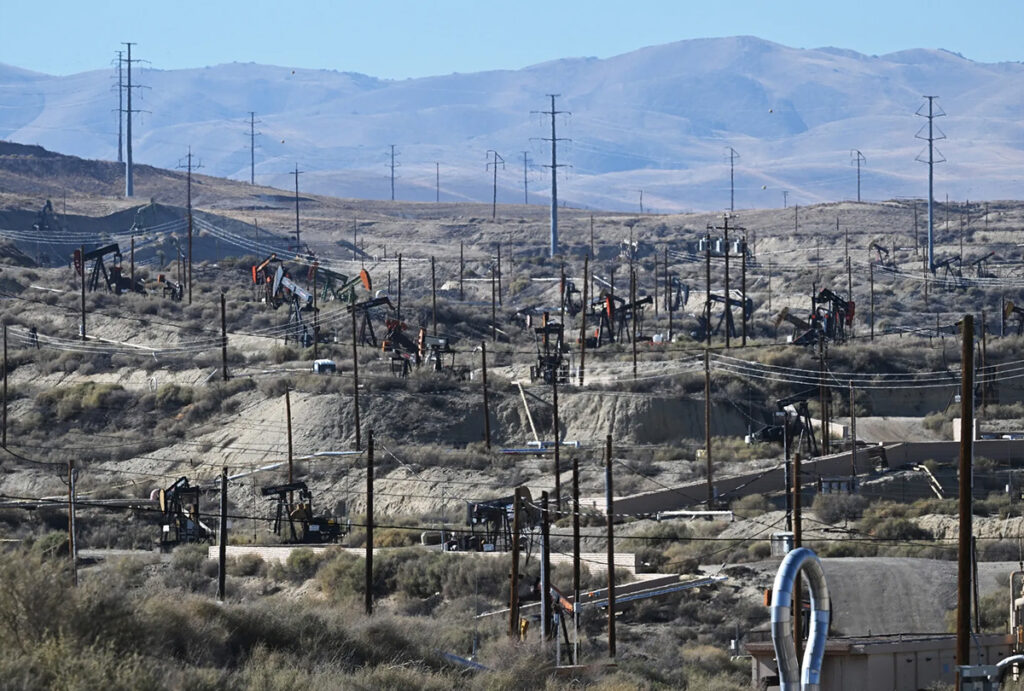
Oil production hit another record this year, climbing above 13.8 million barrels a day in September. Photographer: Robyn Beck/AFP/Getty Images
The US is on pace to pump more oil this year than any other nation in history as President Donald Trump puts the federal government’s full weight behind his sweeping agenda to champion fossil fuels and gut support for wind and solar.
Trump has moved with remarkable speed during his first 10 months to sweep away climate rules, derail clean-energy projects, resurrect proposed pipelines, approve massive new liquefied natural gas terminals and move toward opening more land and water to drilling. He’s vowed, meanwhile, to lower electricity prices and bring gasoline under $2 a gallon.
It’s all part of the president’s goal to achieve US “energy dominance” by maximizing domestic production and using energy as a tool for geopolitical power.
“Fixing Joe Biden’s energy crisis has been a priority for President Trump since day one,” said Taylor Rogers, a White House spokeswoman. “Lowering energy prices for American families and businesses will remain a focus for President Trump in the new year.”
Here’s a look at how he is doing so far.
Energy Output
Oil production hit another record this year, climbing above 13.8 million barrels a day in September. The gains extended a run that began years before Trump returned to office but has continued as shale drillers squeeze more out of each new well.
Natural gas production is hitting records too, climbing to 114 billion cubic feet on Nov. 30, per data compiled by Bloomberg New Energy Finance. This year’s output is set to be up 4.6% from 2024, according to the latest outlook from the Energy Information Administration.
While the rise comports with Trump’s vow to unleash American oil and gas production, analysts say it mostly reflects market forces and industry productivity gains as opposed to government interventions.
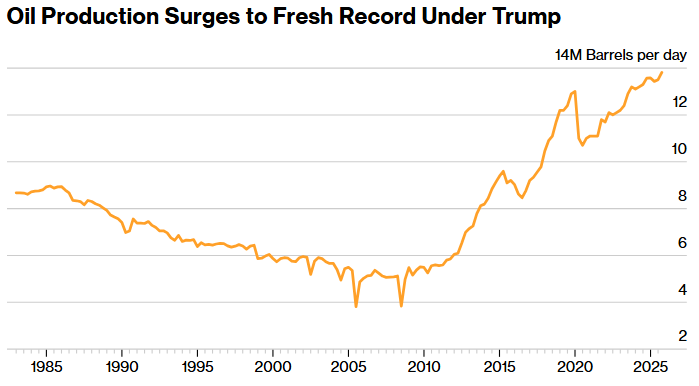
Source: US Energy Department
Note: Data is quarterly
“It’s fair to say the supportive tone from the Trump administration helped, but the lion’s share of responsibility for rising oil and gas production lies with crude prices and the oil and gas industry’s prowess at continually boosting efficiency,” said Bob McNally, president of Rapidan Energy Group and an adviser in the George W. Bush administration.
Much of the growth stems from the shale fields that reshaped American energy over the past two decades, including the Permian Basin in Texas and New Mexico, North Dakota’s Bakken and South Texas’ Eagle Ford.
The Trump administration is also proposing to open new areas off of California, Florida and Alaska to oil and gas drilling as part of a plan that would dramatically expand the sale of oil and natural gas rights. However, it remains to be seen if the effort will translate into a meaningful increase in production. Oil companies have shown limited appetite to explore new US waters far beyond the Gulf, given uncertain prospects and public opposition. Growth in shale fields, meanwhile, is slowing. The EIA projects US crude production will slip next year about 0.6%, to 13.5 million barrels a day.
Gasoline
Prices at the pump have yet to average less than $2 a gallon, which Trump promised on the campaign trail. Still, with gasoline prices averaging around $2.91 a gallon, Americans are paying less than a year ago. And gas prices are at a four-year low nationally.
While the White House has taken credit, there isn’t much evidence to indicate Trump has played an outsized role. Global market forces are the main driver over what Americans pay at the pump, and presidents generally have limited influence.
“There’s been basically zero impact from any Trump policy” on gasoline prices, GasBuddy’s head of petroleum analysis Patrick De Haan said. “Making drilling and new exploration easier takes much longer than most expect to have a meaningful impact to price.”
There’s some indication, however, that Trump has had an indirect impact. The biggest factor behind the price of gasoline is the cost of crude oil, which is down over 20% this year to the lowest levels since 2021.
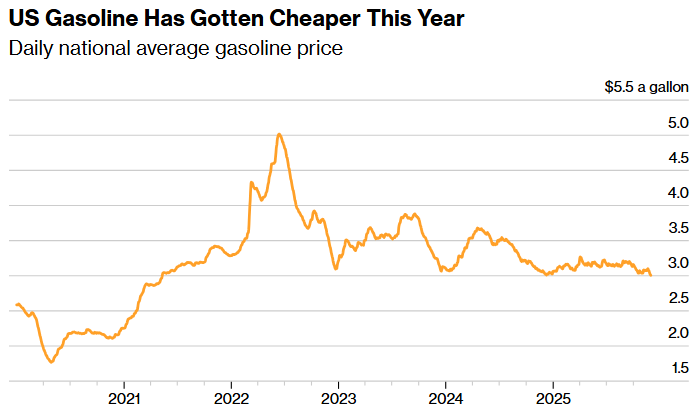
Source: American Automobile Association
Note: Data as of Nov. 29, 2025


One of the biggest selloffs for crude came in early April when futures tumbled to a four-year low after Trump unveiled his sweeping “Liberation Day” tariffs. Hours after his announcement, Saudi Arabia pushed to triple the size of an oil-production increase scheduled for May, adding to the selloff.
Was the timing coincidental? Officials in Washington and Riyadh held discussions in the days beforehand, a person familiar with the matter told Bloomberg at the time.
Natural Gas
Trump delivered on a campaign pledge to restart gas export approvals by lifting the moratorium on his first day in office. Since then, the Energy Department has approved three large projects, including Venture Global LNG Inc.’s planned CP2 Louisiana facility, which could be capable of producing as much as 28 million tons a year at peak capacity.
The previous freeze grew out of environmental opposition led in part by activist Bill McKibben, who helped block the Keystone XL pipeline. The pause forced companies such as Energy Transfer LP and Commonwealth LNG to slow work on multibillion-dollar projects.
Read More: How Trump, AI and Pricey Gas Are Fueling Coal Revival: QuickTake
Coal
Coal, which Trump unsuccessfully tried to bolster during his first term, is having a terrific run so far this time around. US consumption is expected to reach about 448 million short tons this year, up roughly 37 million tons from 2024, according to EIA data compiled by Bloomberg. Even so, demand remains roughly 60% below its 2007 peak.
Once again it has more to do with market dynamics than a Trump-inspired coal renaissance. Coal demand rose largely in 2025 because of the unusual weather at the start of year. Trump can, however, take credit for the coal burned by a 1.4-gigawatt power plant in Michigan that was set to close at the end of May until the Energy Department issued an order to keep it running.
Trump, who pitches coal as an essential power source grid despite its higher emissions and competition from natural gas and renewables, is likely helping to make the fuel more economic. Among the wide-ranging efforts his administration has taken is exempting coal-fired power plants from environmental regulations, halting the planned retirement of older ones and opening millions of acres of federal land for coal-leasing. These efforts are unlikely to restore coal to its former prominence, but they may at least pause its long-term decline as electricity demand surges. The EIA expects power generation from coal to rise about 10.52% this year to 412.6 million tons, up from 373.3 million tons last year.
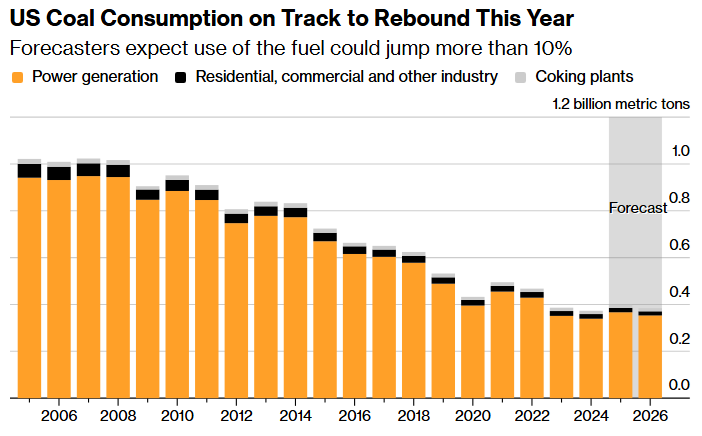
Source: US Energy Information Administration’s Short-Term Energy Outlook
Electricity Prices
Trump pledged to cut electricity costs in half within a year of taking office. Instead, they’ve gone up amid surging demand. Nationally, the average retail price for electricity gained 7.4% in September to a record 18.07 cents per kilowatt-hour, the biggest gain since December 2023, according to the latest government data. Residential prices have jumped even higher, rising by 10.5% between January and August 2025, marking one of the largest increases in more than a decade, according to the National Energy Assistance Directors Association.
All signs suggest skyrocketing electricity rates will be a pivotal issue in the US congressional midterm elections next year. Democrats running on promises to ease utility bills swept key elections in New Jersey, Virginia and Georgia.
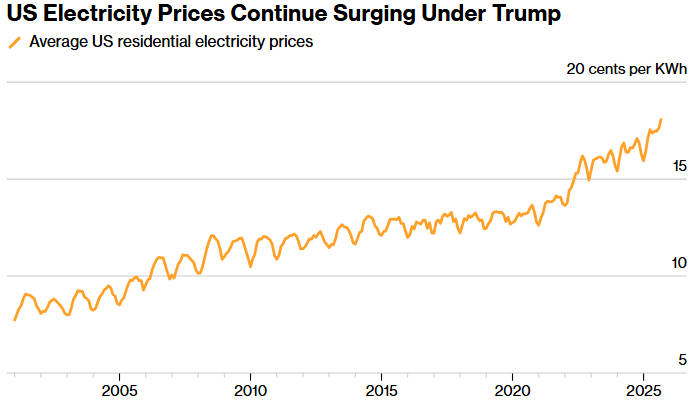
Source: US Energy Information Administration
Pipelines
President Trump scored a win in the Northeast this fall as New York and New Jersey approved permits for a long-stalled Williams Cos. pipeline project in November. The Northeast Supply Enhancement project, which would bring more natural gas to the New York City area from Pennsylvania, was revived last spring, following New York Governor Kathy Hochul saying she wouldn’t block the pipeline as long as there was an impartial review and it met all required laws. In turn, Trump allowed construction to resume on a wind farm off Long Island.
Renewables
Trump has long criticized what he dubs the “green new scam,” and has been making good on his pledges to undo government policies intended to fight climate change and promote emission-free energy.
The administration’s broadsides against wind and solar energy have included yanking approvals for projects, halting work on multibillion dollar wind farms under construction in federal waters, imposing standards that essentially prevent the development of new renewable projects on federal land and canceled billions of dollars in grants for clean energy projects awarded under former President Joe Biden. And Trump’s signature tax and spending legislation, the One Big Beautiful Bill Act, ended lucrative tax credits for electric vehicles and wind and solar projects years early, among other tweaks to incentives that makes clean energy projects less profitable.
Read more: How Trump’s War on Renewables Is Upending Wind, Solar: QuickTake
Deregulation
The White House set out to dismantle Biden-era energy and climate rules, but major rollbacks take time. Rewriting federal regulations requires public comment, environmental reviews, cost analyses and interagency signoff.
Trump has already reversed several appliance-conservation standards covering refrigerators, water heaters and shower heads. Efforts to unwind larger pollution rules for power plants and vehicles — and to limit the government’s authority to regulate climate impacts — remain underway.
“They are knocking it down as fast as they can,” said Michael Burger, executive director of Columbia Law School’s Sabin Center for Climate Change Law. “This administration is taking a shorter amount of time than any previous administration to undo rules of this scale and scope that are at issue here.”
— With assistance from Ruth Liao, Will Wade, Mia Gindis, Josh Saul, Emma Sanchez, David Wethe, and Naureen S Malik
Share This: