CDN NEWS |
  US NEWS







By Ewa Krukowska and Stephen Stapczynski
The European Union has reached a deal to phase out Russian gas faster than originally planned, a move that aims to finally sever ties between the bloc and its once-primary energy supplier.
In the aftermath of the invasion of Ukraine, traders and energy companies have closely monitored the EU’s shift away from Russia toward alternative suppliers such as the US and the Middle East. But while Europe halved purchases after the war began in 2022, Russian gas has continued to account for roughly a fifth of imports.
Negotiators representing member states, the European Parliament and the European Commission cut that remaining link in the early hours of Wednesday, agreeing to gradually prohibit liquefied natural gas imports from Moscow by the end of 2026. That’s a year earlier than originally proposed by the Commission and in line with a ban on seaborne deliveries already approved by the EU under its latest sanctions package on Russia.
Gas Ties
Russia used to be Europe’s biggest gas provider with several pipeline routes to many countries
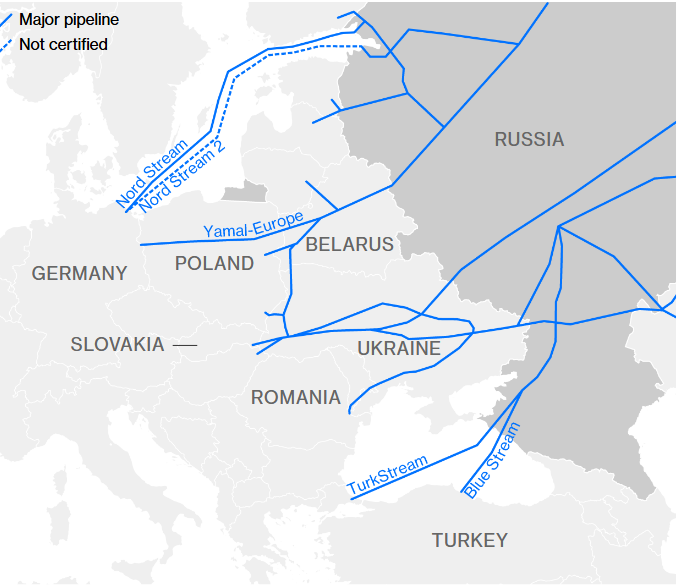
Source: AW Consulting
Pipeline gas imports under long-term deals will have to halt by Sept. 30, 2027, with a possibility of an extension to Nov. 1, 2027, depending on fulfillment of gas storage targets set by the EU. That compares with an end-2027 ban on those contracts originally put forward by the commission.
“Finally, and for good, we are turning off the tap on Russian gas,” EU Energy Commissioner Dan Jorgensen said on X. “Europe has chosen energy security and independence. We will never go back to volatile supplies and market manipulation.”
The EU had proposed the measure in June to address risks to its energy security after the crisis triggered by Russia’s invasion of Ukraine and Moscow’s subsequent curbs on gas flows to the bloc.
The US has sought to broker a peace deal between Russia and Ukraine, and speculation that a potential agreement could eventually ease sanctions on Russian energy has contributed to benchmark European gas futures recording their longest downward streak in almost four years.
But the EU has continued to push its plan, known as RePowerEU, to cut reliance on Moscow for good.
Going back to Russian supplies would be “a mistake” for the region, Fatih Birol, executive director for the International Energy Agency, told Bloomberg Television on Wednesday. “Russia being the major energy supplier in Europe — that saga is gone, that chapter is closed.”
“This is a big win for us and for all of Europe,” said Lars Aagaard, energy minister for Denmark, which is holding the EU’s rotating presidency and was representing member states in the talks. “We have to put an end to the EU’s dependence on Russian gas, and banning it in the EU permanently is a major step in the right direction.”



The EU receives about 15% of its LNG supplies from Moscow, making Russia the second-largest provider of the fuel to Europe after the US. The monthly bill for those imports ranges between €500 million and €700 million.
The shift away from that trade comes at a time of plentiful supply. The global gas market is expected to start shifting into a surplus in the second half of next year, reducing the risk that an EU phaseout of Russian shipments would put pressure on supplies and drive up prices. That’s helped secure broad political support in the region for a comprehensive and lasting break with Russia.
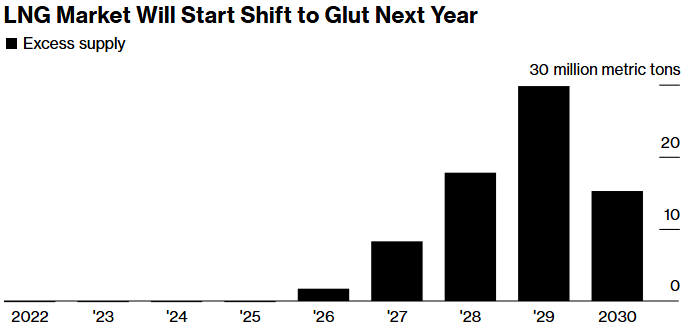
Source: BloombergNEF Global LNG Market Outlook 2030, July 14, 2025
Europe has also been under pressure from the US to speed up moves to sever its energy ties with Moscow, and buy more American LNG. A trade deal between Europe and the US agreed earlier this year included a commitment to purchase $750 billion in US energy by 2028.
Under the deal on RePowerEU, the phaseout of Russian gas would start with a ban on new purchases from the beginning of next year, with exemptions for existing deals.
For LNG, short-term contracts concluded before June 17, 2025 will be prohibited as of April 25, 2026, the date on which EU sanctions on seaborne deliveries kick in. Pipeline gas brought into the region under short-term deals will be banned as of June 17, 2026.
To avoid circumvention, the measure introduces a prior authorization regime, the EU Council representing member states said in a statement.
For Russian gas and imports in the transition period, information required for authorization will have to be submitted at least one month before entry. For non-Russian gas, it will have to be provided at least five days before and seven days for volumes brought in via the Strandzha 1 interconnection point.
That requirement will not apply to major gas-producing countries that exported more than 5 billion cubic meters to the EU in 2024, and either have restrictions on Russian gas or no infrastructure to import.
To put an end to Russian oil imports, the measure obliges member states to prepare plans to diversify their supplies. The commission also plans to put forward a legislative proposal on phasing out Russian oil imports no later than the end of 2027.
The deal reached in the so-called trilogue format will need to be formally approved by member states and the European Parliament and published in the bloc’s bulletin to become a law.
— With assistance from Elena Mazneva
(Updates with comments from IEA’s Birol in 9th paragraph.)
Share This: