


 CDN NEWS |
  US NEWS







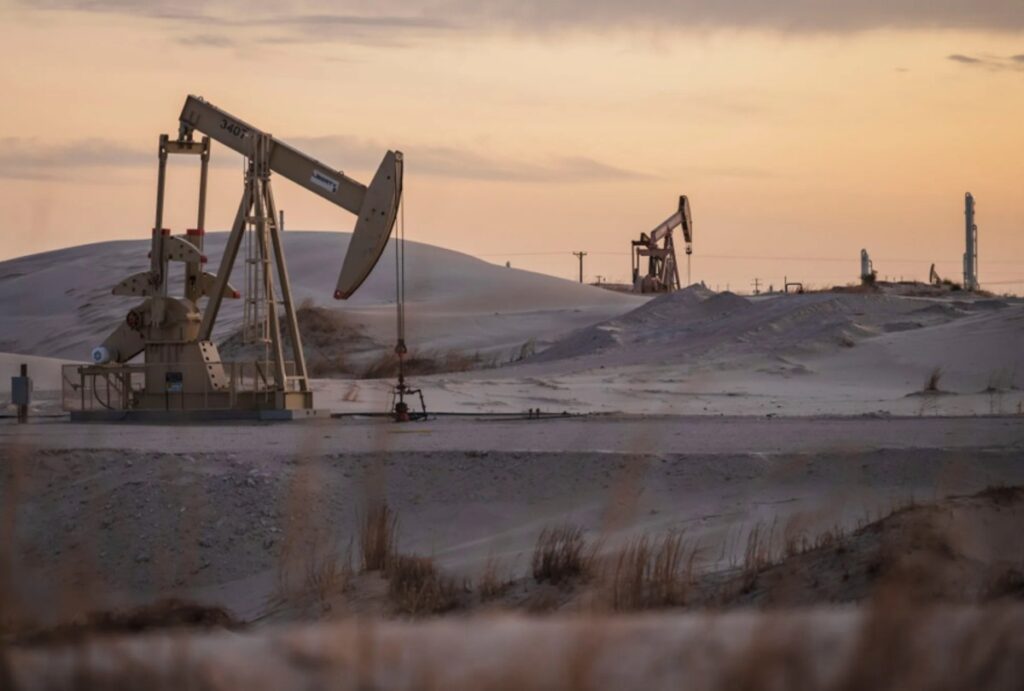
Some of the largest US oil companies are dialing back capital spending in the country’s shale basins as they use the windfall from high crude prices to boost shareholder returns and pay down debt rather than accelerate production growth.
Chevron Corp. and ConocoPhillips cut capital expenditure in the Lower 48 by 10% in the first six months of the year while Occidental Petroleum Corp. cut spending in the Permian Basin by 20% in that period, according to earnings reports. APA Corp., Matador Resources Co., and HighPeak Energy Inc. are also on track to spend considerably less on drilling and fracking in the US than a year ago.
Lower spending doesn’t automatically translate into reduced output, though. Gains in drilling and fracking techniques mean most operators are producing more oil for every dollar spent. But it also means more companies are holding production flat or growing through efficiency gains rather than higher expenditure. The trend is dampening US crude supply growth when President Donald Trump is lambasting the industry for not bringing down gasoline prices at the pump fast enough.
The US will grow production by about 200,000 barrels a day this year to 13.8 million barrels a day, according to US Energy Information Administration forecasts. But operators aren’t drilling as frenetically as they had when oil prices spiked in the past. After Russia’s 2022 invasion of Ukraine sent oil prices soaring, the US added about 1.1 million barrels a day in 2023, about five times more than this year.
To be sure, most shale production growth tends to come in the second half of the year when operators are less affected by weather and focus on beating annual targets. Negative prices for gas — a byproduct of oil — in the Permian for the most recent quarter prompted some companies to withhold production until new pipelines come online.
And not all companies are pulling back. Diamondback Energy Inc. plans to increase capital spending to the top end of its guidance range to lift production after the Iran war sent oil prices surging, a signal that Chief Executive Officer Kaes Van’t Hof called a “green light” for growth. ExxonMobil Holdings Corp., by far the largest shale producer, increased output 12.5% to 1.8 million barrels a day in the second quarter and plans to increase production a further 40% by 2030.
Plateau Strategy
Chevron is the largest US oil major to implement the ‘plateau’ strategy. Its production has hovered around 1 million barrels of oil equivalent a day in the Permian Basin of West Texas and New Mexico for the last five quarters, and about 400,000 oil-equivalent barrels in Colorado’s DJ Basin for the past 10 quarters.
The Permian, DJ and Bakken shale basins are expected to generate $7 billion a year of free cash flow at least through 2030 — enough to fund half of Chevron’s annual dividend, currently the fifth-highest in the S&P 500 Index. The business model is the opposite of US shale pre-Covid, when the industry burned through about $350 billion as it focused on production growth over profits.
“They are seeing huge efficiencies with this focus on sweating the assets,” Chief Financial Officer Eimear Bonner said on a call with analysts, referring to Chevron’s Permian team. “Not growing production. Growing free cash flow.”



Chevron’s Windom Central Facility, about an hour’s drive north of Denver, is an example of how the new strategy is being implemented. Sandwiched between corn fields in the foothills of the Rocky Mountains, a web of khaki-colored steel pipes, cylinders and industrial fans hummed under the smoky Colorado skies on an early August afternoon.
With no storage tanks, it’s designed so that oil and gas can flow through continuously, favoring steady-state production rather than the runaway growth US shale has been known for in the past. Chevron plans to flow 50,000 barrels a day from 72 wells through this single facility, a critical first step that separates oil from gas and water before it begins a 1,200-mile journey through tanks in Cushing, Oklahoma and on to Gulf Coast refineries.
Previously, dozens of separate sites — each loaded with storage tanks, gas compressors and other heavy equipment — were needed to enable production on this scale. The new processing facility is unmanned, monitored remotely from a control center about four miles away. It’s safer, easier to monitor and has fewer emissions than prior iterations, according to Nick Gonzalez, an operations supervisor at Chevron.
It has another advantage: 20% lower costs.
“Rather than investing for the peak production on each individual site, you buy a fleet of equipment and redeploy it as necessary,” Gonzalez said.
Growth from the Gulf of Mexico and elsewhere meant Chevron’s US production was a record in the second quarter, but the plateau model is a key reason why executives expect to hit the low end of its annual expenditure range this year. Spending in the Permian will be about 30% lower than two years ago.
Others are following suit.
Occidental’s capital spending drop means the company will drill fewer wells in the Permian this year, but it’s still on pace to increase oil-equivalent production 3% due to efficiency improvements. CFO Sunil Mathew said investors should expect “relatively flat” companywide production in 2027 assuming a similar capital budget as this year.
ConocoPhillips’ Lower 48 production has hovered around 1.5 million barrels a day for the past six quarters, with growth in the Permian offset by declines in the Eagle Ford and Bakken, both older shale basins. Future investments will be for “modest growth,” incoming CEO Andy O’Brien said on a call with analysts.
“I can’t emphasize this strongly enough, that’s at a structurally lower reinvestment rate than where we are today,” he said.
Share This:
















THE RETHINK: Cash-Rich Oil Majors Face Post-Iran Strategy Rethink: Bousso