CDN NEWS |
  US NEWS







By Andrew Mills

As mediators shuttle drafts between Tehran and Washington, the shape of a possible Hormuz deal is becoming clearer even as its timing remains anything but certain. Yet despite President Donald Trump’s upbeat talk of negotiations “moving along nicely” and a strait reopening “very soon”, negotiators are still haggling. With one regional source warning that “the devil is in the details” and another noting that a single Trump post could upend the process, the pace of diplomacy remains as volatile as the conflict itself.
In this edition of Gulf Currents, we unpack how a real Hormuz reopening might look, and the signals markets should watch for. We also have Aramco chief Amin Nasser’s stark assessment that the world has lost 2.6 billion barrels of oil since the conflict began, fresh evidence of the UAE’s non-oil economy’s resilience and an exclusive look at how five months of war have left the U.S. military running dangerously low on some of its most important long-range precision missiles.
NEWS BRIEFING
* The world has lost more than 2.6 billion barrels of oil since the Iran war began in February, Aramco CEO Amin Nasser said on Tuesday. This is equivalent to nearly a month of normal global crude production, reflecting the scale of disruption from the closed Strait of Hormuz. Nasser warned the disruption had exposed vulnerabilities in the global refining system, with the industry having few buffers to absorb further shocks, although production could return to pre-conflict levels within days if needed.
* The UAE’s non-oil private sector expanded at its fastest pace in four months in July, with the PMI rising to 52.7 from 50.8 in June. New orders expanded at the fastest pace since February, while export business increased for the first time since March and at the quickest rate in a year. Employment grew, though business confidence weakened for a third consecutive month amid Strait of Hormuz uncertainty.
READING THE RUNES: THE SIGNS THAT WILL SHOW IF HORMUZ IS REALLY REOPENING
U.S. President Donald Trump has declared the Strait of Hormuz “open” at least four times since March, only for fighting or closures to resume within days each time. This week he’s back to predictive language, telling Fox News that talks are “moving along nicely” and the strait “is going to be open very soon.” We’ve heard this before, and the announcement itself will matter less than the details of what’s being negotiated and what happens on the water. The proposal now on the table, reported by Reuters on Wednesday, would give Tehran control over ships entering the Gulf through Hormuz. This would be one of the biggest concessions to Iran since the war began and reverse Washington’s repeated insistence that it would never accept Iranian control over the waterway.
The unresolved sticking point is outbound traffic. Regional negotiators want regional supervision of inspections, and any fees kept nominally voluntary. Iran is seeking 5% to 7% of cargo value; Oman has floated 3%; Washington wants zero.
That gap alone argues against an imminent signing. Regional sources have pushed back on Trump’s “imminent” framing, and Iran’s foreign minister is on holiday while talks continue.



The June 17 memorandum of understanding is the cautionary template: it formalized a ceasefire and lifted the U.S. naval blockade but sidestepped Iran’s core demand for fees and administrative control. It unravelled within three weeks when both central provisions — no attacks on shipping, and sanctions relief — collapsed at once.
The indicators to watch are those that move independently of statements: the number of ships that transit daily counted against the pre-war baseline; war-risk insurance premiums, which price actual exposure rather than diplomatic language; whether crude, LNG and fertilizer cargoes resume with regularity; and whether Washington’s blockade on Iran-linked shipping lifts in parallel. Past “reopenings” decoupled these steps.
Then there’s the lane split itself: Gulf-bound traffic through Iranian waters, outbound through Omani waters. Holding without friction would suggest genuine, shared management. But if Iran pushes this into the “selective control” analysts see as its real goal, expect friction at the lane boundary.
The clearest tripwire, one Iranian source said, is that “a single tweet” from Trump could unravel it entirely. The real test is whether we get a detailed, verifiable text, or another vague nod to “positive talks”.
GRAPHIC OF THE WEEK
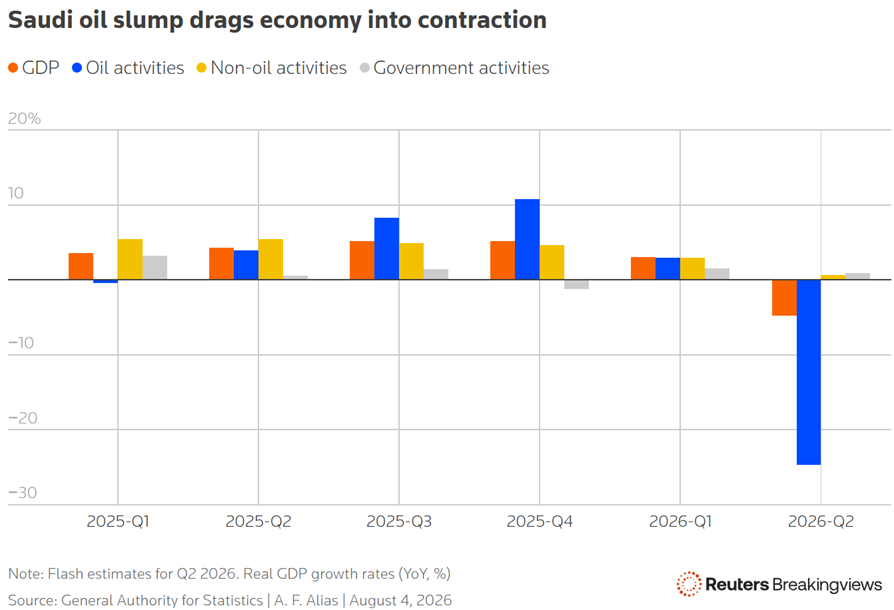
Saudi Arabia’s economy and its national oil champion are telling markedly different stories. Preliminary GDP figures showed the kingdom’s economy shrank 4.8% year-on-year in the second quarter, its sharpest contraction since the pandemic. Yet Saudi Aramco, opens new tab reported adjusted net income of $33.4 billion, up 33% from a year earlier. Riyadh’s economy is shrinking even as its main fiscal engine thrives. Read more from Afiq Fitri Alias.
LAST WAVE: U.S. HAS USED ‘VIRTUALLY ALL’ OF ITS LONG-RANGE PRECISION MISSILES
The U.S. Army has used up “virtually all” of its ATACMS and Precision Strike Missiles during the five-month Iran war, according to three sources familiar with the data, raising concerns about military readiness for future conflicts. The Navy has also burned through nearly half its global Tomahawk supply.
These long-range munitions, costing over $1 million each, allow precision strikes from a safe distance; their depletion means the Trump administration may need to rely more on riskier piloted bombing missions if strikes resume. Officials worry the drawdown could limit America’s ability to deter adversaries like Russia and China, though one source noted Central Command can reload from global U.S. military supplies.
Editing by Alexander Smith
Share This: