CDN NEWS |
  US NEWS







Alberta’s Danielle Smith spent three years fighting with the previous government. Now she has an ally in Ottawa also keen to sell more of the country’s oil to the world.
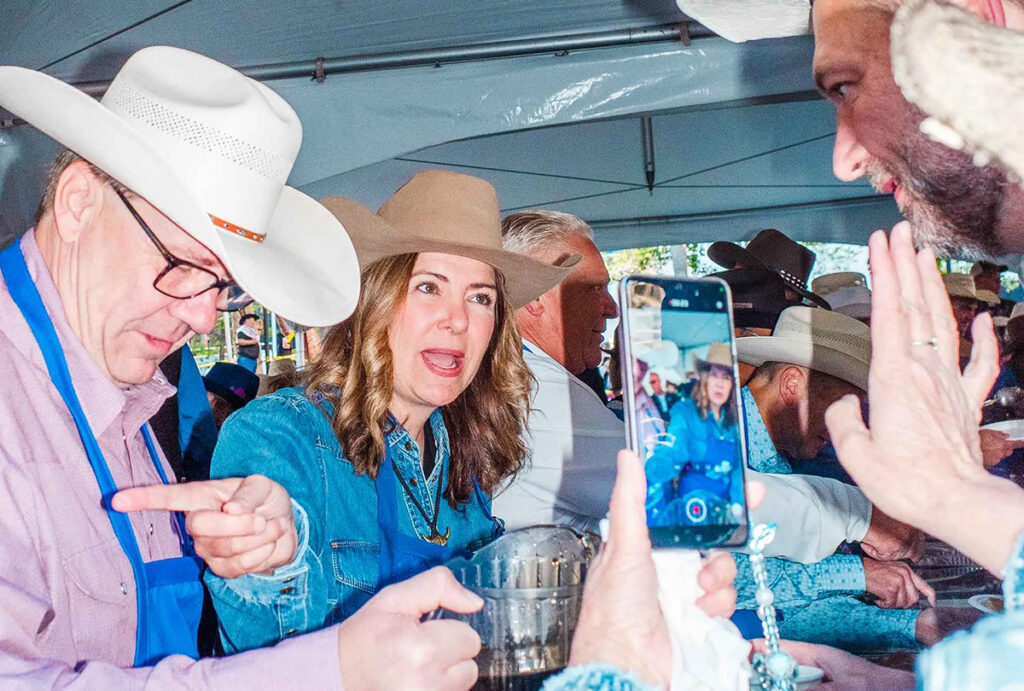
Smith at a pancake breakfast during the Calgary Stampede. Photographer: Kelsey McMillan for Bloomberg Businessweek
It’s midafternoon, and Alberta Premier Danielle Smith is being ferried to her eighth public appearance of the day. Since 7 a.m. she’s flipped pancakes alongside other Canadian politicians and the US ambassador, presented cowboy hats to a delegation of international visitors, unveiled the new logo for certified Alberta-made whisky and shaken countless hands. In 15 minutes she’s due at a beef industry event across town. But for now, in the car on the way there, she has a brief moment of calm.
Smith was on Day 4 of her province’s biggest event of the year: the Calgary Stampede. Each year the festival draws hundreds of thousands to Alberta’s largest city over 10 days in July in what’s both a celebration of western culture and one of the country’s marquee venues for politicians and business leaders to meet, all under the wide brims of those ubiquitous hats. Almost every federal cabinet minister will visit — Prime Minister Mark Carney makes multiple appearances — to mingle with throngs of everyday Canadians and corporate executives donning hats, belt buckles and boots. Before the event is up, Smith will announce two oil pipeline projects and a plan from US tech behemoth Meta Platforms Inc. to build a $10 billion data center, its first in Canada.
She’ll hold court at a dozen events, most of them for a carefully choreographed half-hour, and that’s not counting private meetings, briefing time with her team, an outfit change and a short detour for some personal shopping. Even during this quick interlude in the car, Smith isn’t truly alone: She’s traveling with her press secretary, security detail and driver. She removes her cowboy hat, reviews some notes on her phone and checks that the binder her staff has prepared for the next event is up to date. The festival’s pace is always intense, but the 55-year-old Calgary native says she’s grown used to it. “I don’t know that there’s been a year that I’ve missed Stampede,” she says.
This year’s event feels especially buoyant to Smith and her supporters, as her message of selling Alberta’s vast energy resources to the world finally appears to be landing on receptive ears. After spending her first three years as premier, from late 2022 to early 2025, fighting bitterly against the left-leaning Canadian government’s climate policies, the conservative leader has suddenly found herself at the center of many of the nation’s priorities. A new federal government led by Carney has made increasing oil and natural gas production a cornerstone of its agenda, and between the dual economic threats from US President Donald Trump’s tariffs and the trade-disrupting war in Iran, Canadian public opinion on the need to expand the country’s natural resources sector has shifted in her favor.
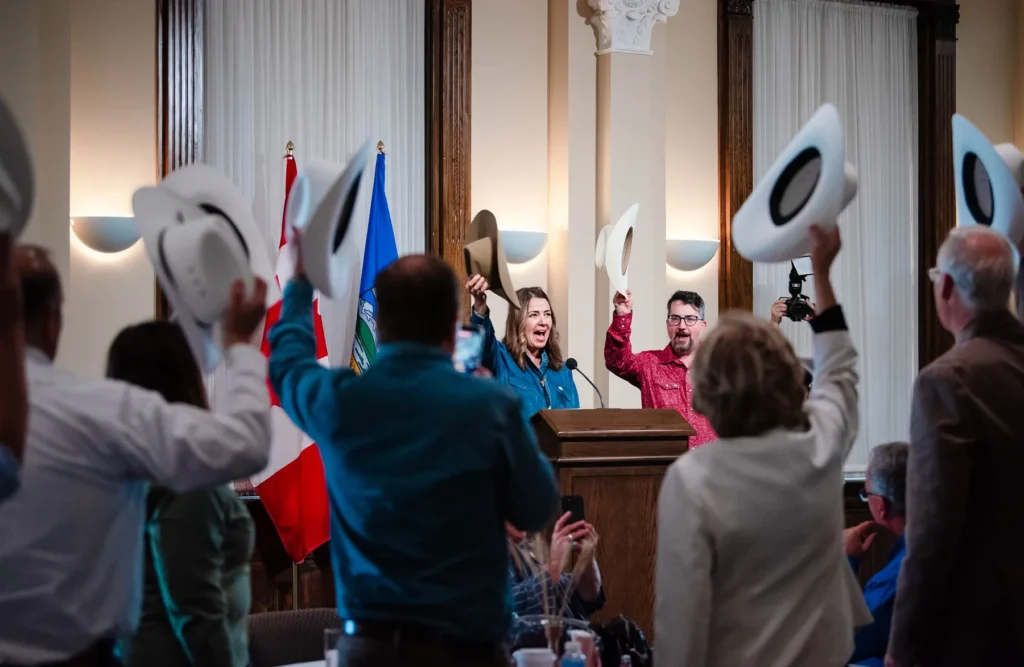
Smith at a White Hat ceremony with international industry representatives. Photographer: Kelsey McMillan for Bloomberg Businessweek
Canada is the fourth-largest crude oil producer in the world, the majority coming out of Smith’s province, and she’d like to see it pump even more. Her oft-repeated goal is for Alberta to double its oil output, a clear response to what she says was an effort by the government of former Prime Minister Justin Trudeau to “cut our oil production in half.” (The government had proposed a cap on emissions from oil and gas production as a way to fulfill Canada’s climate commitments, which was viewed by some as a de facto cap on output that would have disproportionately hit oil-pumping regions such as hers.) Her goal, she recalls, was “sticking my finger in their eye, saying, ‘You don’t have a right to tell us and our people and our producers here what we can and cannot do.’”
In the year and change since Carney took office, Smith has found a pro-business ally in Ottawa, working with his administration to remove or water down a slew of environmental policies, pledge faster regulatory approvals for new projects and support the construction of a million-barrel-a-day oil pipeline to the West Coast. The pipeline will give the country more access to Asian markets eager to diversify their energy suppliers, as well as reduce Canada’s reliance on the US, which currently buys about 90% of the country’s output.



“I really feel like not only have we convinced our fellow Canadians, and they’re rooting for us, and convinced the federal government, and they’re rooting for us, but I think we’ve indicated to the world that we’re here and we want to help,” Smith says as we wind through some quieter side streets. “And we have a lot of folks looking to Alberta now to assist with energy security.” Her vocal pro-energy stance has turned her into one of the most prominent people in Canada today.
Also controversial: Smith is one of very few elected Canadian politicians still championing tight bonds with the US despite the trade war sparked by Trump’s tariffs and his repeated suggestion that Canada become America’s 51st state. At an afternoon event attended by Pete Hoekstra, the US ambassador to Canada, she touts Alberta as open for American businesses and tourists. She points out that Jack Daniel’s whiskey can still be bought in Alberta, despite bans on sales of US alcohol in most other provinces, a fact met with a round of cheers.
Smith, who has visited the president at Mar-a-Lago, reiterates in the car that the special ties between the US and Canada haven’t frayed as much as many think — and nowhere is this more obvious than at the Stampede, founded by a pair of Americans in the early 1900s. Many of the major oil companies operating in the province have significant or majority US ownership, and investment and shareholder rewards benefit people on both sides of the border. Alberta sends roughly $80 billion of oil to its southern neighbor every year, which is then refined into finished products in the US, in a win-win for both countries. “It keeps prices low for American citizens, and it allows them to export as well internationally so that they can pursue their goal of energy dominance,” Smith says. “And we’re here to help. We can do that. I share the aspiration.”
The country’s turn in favor of more aggressive fossil fuel production ignores the obvious elephant in the room: climate change. Parts of Canada are in the middle of what might prove to be the country’s worst wildfire season, exacerbated by the Earth’s rising temperature. Officially, the federal government and Alberta say they’re both committed to achieving a net-zero emissions economy by 2050, though neither Smith nor Carney has explained just how they’ll pull that off as they’re preparing to pump more, not less, oil and gas. As part of the deal to build the new pipeline, oil-producing companies in the province have agreed to advance a major carbon capture project, though its size has been scaled back from the original proposal. (Climate scientists largely agree carbon capture is a step in the right direction but is more like a Band-Aid than a permanent solution to the warming planet.)
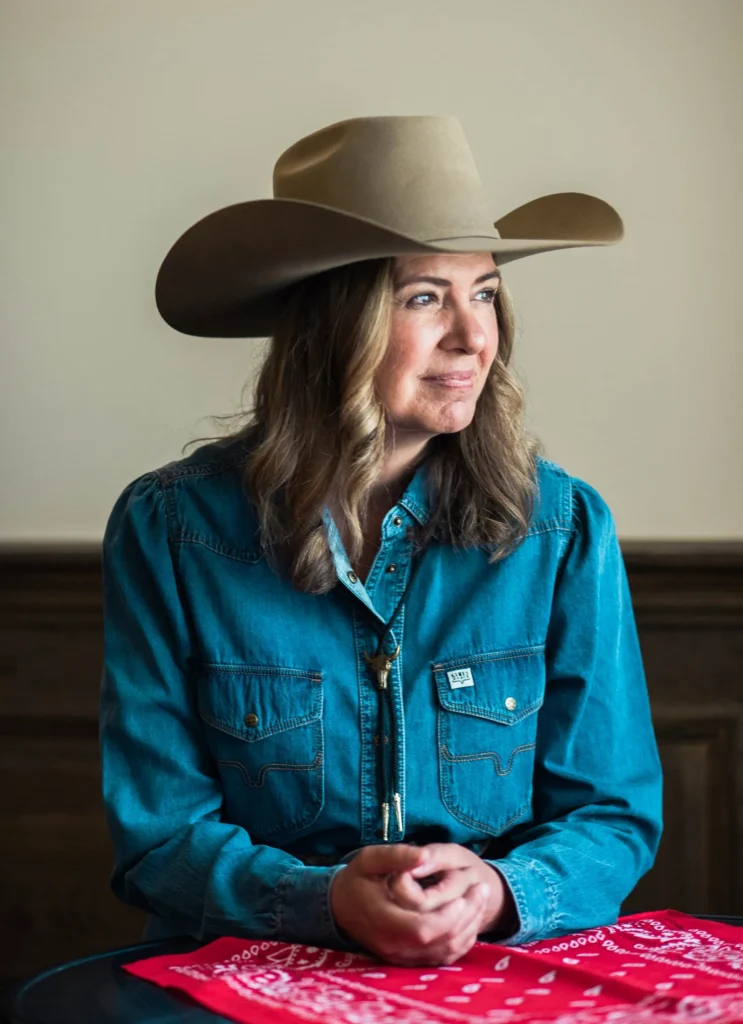
Smith’s goal is to double oil output in Alberta. Photographer: Kelsey McMillan for Bloomberg Businessweek
Smith — who describes herself as “a bit of a policy wonk,” particularly on energy — studied English and economics at the University of Calgary before becoming an opinion columnist and media personality. She entered provincial politics in 2009 to lead the upstart conservative Wildrose Party before crossing the floor to join Alberta’s main, long-reigning conservative party. After losing her bid to run for a seat under its banner in 2015, she left politics, resuming her life as a radio host and political commentator. But she returned in force in 2022, harnessing pandemic-fueled anger toward the then-leader of the ruling United Conservative Party, and took over as premier. Smith hasn’t fully left her media background behind, though, hosting a call-in radio show every two weeks where Albertans can ask her questions directly. She says growing up watching her mother raise five children while also pursuing her education and career shaped her own path: “I’ve never really felt that for my generation that there were any barriers, because I think the women who came before us cleared all of them.”
Perhaps the most existential issue she’s navigating now is the small but vocal movement advocating for the province to separate from Canada. That sentiment has been lurking in Alberta for decades, and it came to the fore again during the Covid-19 pandemic, heightened by vaccine mandates and lockdowns, as well as what many saw as the anti-energy policies of the Trudeau government. “There’s a lot of emotion in how Alberta was treated,” Smith says. What “politicians need to understand a little bit more is that, when you make these kinds of decisions that have that kind of devastating impact on people, it creates a lasting scar and a lasting pain.”
Smith inflamed some of that discontent with her own anti-Ottawa rhetoric, but she has softened significantly under Carney’s leadership, advocating now for more provincial powers within the country. Still, she has at times played both sides of the issue, on one hand making it easier for separatists to trigger a referendum on the matter while also saying she advocates for maintaining “a strong and sovereign Alberta in a united Canada.” Notably her UCP base is mostly in favor of separation; some leaders in the movement have recently called for her ouster as party leader over her support for staying in the country.
During Stampede, though, it’s hard to plan 10 years — even 10 minutes — out. Yet after being behind most of the afternoon, she’s somehow managed to get back on schedule for her next appearance. “You can’t really think about how many you have left until you’re on your last event,” she says of the pace, with a laugh. After her team exits the car, Smith gets a real moment alone. She takes one last scroll through her phone, her security waiting patiently by the door. As she steps out and dons her cowboy hat again, her team shepherds her toward another swarming crowd.
Share This: