CDN NEWS |
  US NEWS







By Priscila Azevedo Rocha and Ruth Liao
US liquefied natural gas developers expected Europe to become the cornerstone market for the next generation of export projects. Instead, the region is increasingly shying away from the long-term contracts needed to get them built.
US executives are coming back empty-handed this year from the industry meetings and conferences where deals are usually forged. In conversations with Bloomberg, several gas exporters said that negotiations held with European counterparts over the past few months have produced plenty of interest but hardly any firm commitments for LNG as would-be buyers have grown wary of becoming too reliant on America.
One exporter described the gap as a “cultural dissonance” in which Europeans are content to talk while Americans just want to close deals.
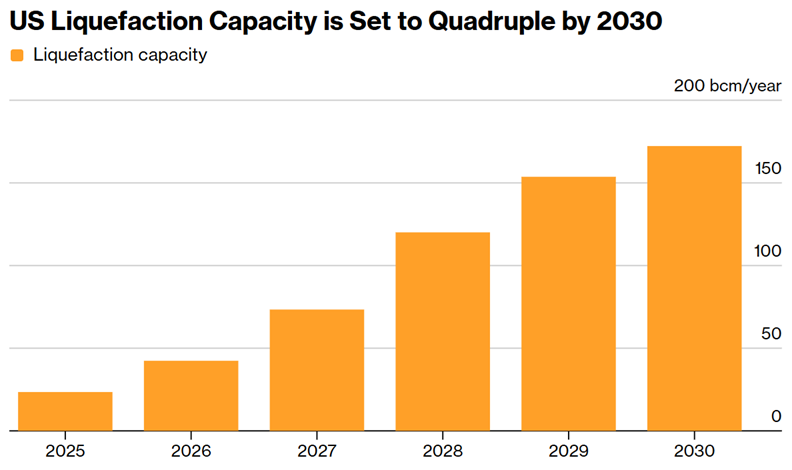
Disruptions to Qatari LNG shipments caught up in the Iran conflict have pushed back expectations for a global supply glut by at least two years, the International Energy Agency said. But the delay does little to alter the longer-term picture of abundant new supply, much of it from the US, that still needs buyers. That has sharpened the focus on Europe, where companies have been slow to sign long-term contracts even as the region prepares to phase out Russian LNG imports by the end of the year.
The shortage of long-term LNG deals risks constraining investment in US export infrastructure while increasing Europe’s exposure to price swings as buyers depend more on spot and short-term markets.
“There is this obsession from the US that Europe should commit to more long-term contracts,” said Anne-Sophie Corbeau, a researcher at Columbia University’s Center on Global Energy Policy. “There is also a concern that Europe is becoming too dependent on US LNG.”
Source: European Union
The slowdown in deals comes as relations between Washington and its European allies have become less predictable and at times strained as US President Donald Trump has imposed stiff tariffs and upended long-standing assumptions about America’s security commitments to the continent.
Just one new long-term deal has been signed between the US and Greece. While companies in Europe’s largest gas-consuming markets like Germany, Italy and France are yet to agree anything. That compares to six contracts in 2025 for enough gas to power as many as 6 million homes, according to publicly available data compiled by Bloomberg.
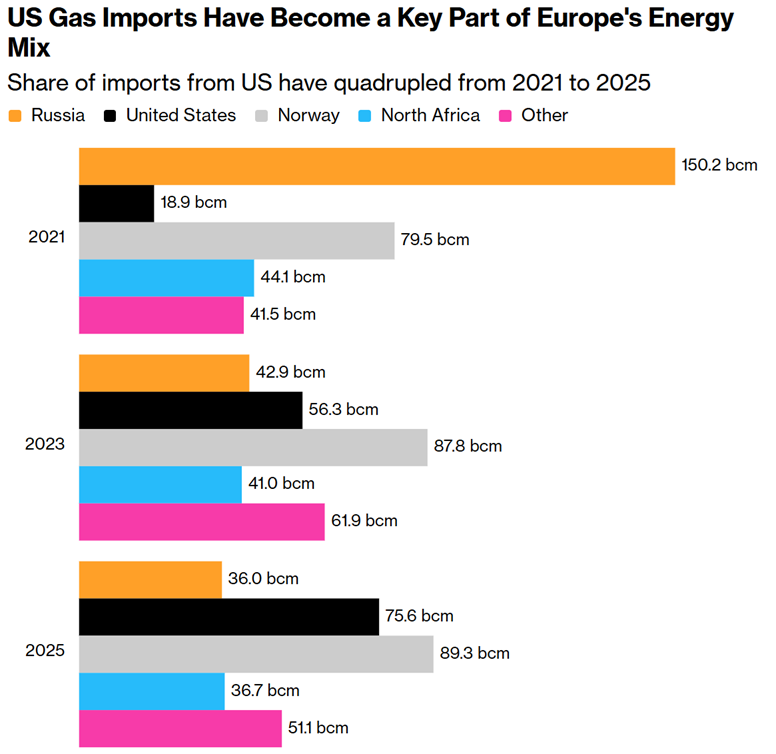
It’s a reversal from the aftermath of Russia’s invasion of Ukraine, when European utilities rushed to the global LNG market to replace lost pipeline gas and the US and Norway emerged as key suppliers.
For US LNG exporters, Europe’s retreat from long-term contracting is difficult to reconcile with the continent’s energy security needs and could have implications for future projects. One executive said Europe had long been viewed as the industry’s most attractive growth market because of the strong credit profiles of its utilities, but a lack of new commitments could make export projects harder to finance.
Developers need to balance the cost of building with attractive offtake contracts when negotiating financing for multi-billion-dollar projects. Late last year, Energy Transfer abruptly halted development of the Lake Charles LNG export facility in Louisiana as rising costs pressured the project economics.
Just last year, developers were buoyed by strong European demand, mounting pressure to phase out Russian fuel and expectations that the EU would sharply increase purchases of US fuel. In July, Germany’s Securing Energy for Europe GmbH signed a 20-year supply deal with Venture Global, while Eni SpA also inked an agreement and TotalEnergies SE backed major American export projects.
By early 2026 that optimism was fading and European leaders began warning against relying too much on the US. Officials have grown increasingly uneasy about Trump’s trade threats, NATO rhetoric and stance on Greenland.



Germany is particularly vulnerable, having swapped Russian gas for US LNG, getting 94% of imports from America. In February, German Chancellor Friedrich Merz traveled to the Middle East to try and diversify energy supplies and reduce reliance on the US, and companies began looking beyond America, most notably Canada, for future supplies.
Read more: German State Gas Firm Plans LNG Tender to Diversify Supplies
“There are commercial considerations, but the bigger challenge appears to be market and demand uncertainty,” said Richard Nelson, partner in the global energy practice at Mayer Brown. “Buyers are still trying to assess what European gas demand looks like through the next decade.”
Originators, traders, and industry executives that spoke to Bloomberg on the condition on anonymity, said that Europeans seem increasingly comfortable relying on spot markets rather than locking in supplies decades ahead, particularly as uncertainty grows over how much gas the region will need as it decarbonizes. But that flexibility comes at the cost of greater exposure to supply shocks and price spikes.
“As we have learned, having a long-term contract is not a guarantee to have LNG supply – talk to the customers of Qatar LNG,” said Columbia University’s Corbeau. The Iran war forced Qatar LNG to call force majeure on several cargoes.
Source: International Energy Agency
A saturation point has also been reached – most of the major LNG buyers in Europe have had their fill of US volumes and it’s down to the smaller, newer companies to sign further contracts. Among that pool of buyers, the size of the company and credit rating also plays a part.
Read more: Greek LNG Buyer Says Long-Term US Deals Getting More Difficult
With selling to Europe on hold, US suppliers have turned elsewhere. Asia has stepped up efforts to secure cargoes since the near-closure of the Strait of Hormuz. Buyers including Taiwan have made a renewed effort to negotiate more shipments from the US, including discussions on long-term deals.
Demand in Asia due to searing summer temperatures is already creating competition with Europe and, once the Strait reopens, bartering for supplies from Qatar could be fierce.
India is ramping up purchases of liquefied natural gas as it braces for rising summer temperatures and scrambles to substitute lost Qatari volumes. The country’s 30-day moving average for deliveries this week reached the highest level since 2024, after surpassing the five-year seasonal average in May, according to ship-tracking data compiled by Bloomberg.
Many European companies are reluctant to commit to contracts that extend into the 2040s as they pursue decarbonization targets and expect gas demand to decline.
“There are also plans in Europe to decarbonize on the long-term and these are regulations in place and we need to factor them in,” Charbel Abi Daher, chief commercial officer for gas and LNG at Uniper SE global commodities arm said at a conference in London last week. “I do not expect customers committing for a 20-year contract in Europe that easily.”
— With assistance from Petra Sorge and Stephen Stapczynski
Share This: